
IWASAKI AND THE INVISIBLE MEN
By 1931 in Japan, animation was a viable industry again, even if that was largely down to government funding. So some new directors were joining the fray, although not all of them lasted. IWASAKI Akira was a left-wing film critic, which was an increasingly unsafe thing to be in an increasingly right-wing Japan.

He only directed a single animation, in association with the equally leftist Proletarian Film League of Japan. And it’s fair to say that their logo is a little… unfortunate. It bears a horrifying resemblance to the nuclear hazard symbol, and that won’t be invented for another twenty years.
“Three Little Bears”
Anyway; Iwasaka’s only animated film was “Sanbiki no Koguma-san” / “Three Little Bears” (Prokino, 1931). It was based on a manga from “Children’s Friends”, written by MURAYAMA Toshiko, and drawn by her husband Tomoyoshi. The bears are brothers, and the stories are gentle comedies about basic family situations. If you’ve ever watched TV with a pre-schooler, you know the type. This one had animated milk jugs and a very familiar sounding duck.
But “pre-schooler” is the odd part. This is aimed at three or four year olds, and I can’t work out how they saw it. Wrangling a kid that young into a cinema sounds like a terrible idea. It would have made excellent TV. Even the tone of the recorded narration reminded me of Mr Tumble and the Tellytubbies. It was fine for what it was; “Three Little Bears” gets 4/10.
Iwasaki was the only film reviewer to be arrested by Japan’s secret police. After the war, he was a vocal critic of those who had supported the Imperial regime. But he had no better luck with the censors who replaced them. Two of his documentaries, looking at the aftermath of the nuclear attacks on Japan and at the legacy of Emperor Hirohito, were banned by the Occupying forces. He went on to write key books about film theory in Japanese; when OTOMO Katsuhiro was asked if he was up to “AKIRA”s big budget, he replied, “I’ve read my Iwasaki and Eisenstein”.
Iwasaki Akira passed away in September 1981.
Miyashita Manzo
I’d like to tell you about the next director on my list, but I couldn’t find out much about him. MIYASHITA Manzo made three films in his career for Nikkatsu Studios; “Urashima Taro” (Nikkatsu, 1931) was the first.
The original story is a fairly solid fairytale. A fisherman saves a turtle, who promptly takes him under the sea. They arrive at the Sea King’s Dragon Castle, where the fisherman meets and parties with a princess. She gives him a present that he mustn’t open, so of course the moment he gets home, he opens it. Gas pours out of the box and ages the fisherman into senility.
Miyashita’s version of the story does all of that. But it only takes 72 seconds. If this isn’t a cut-down version of a much longer work, I’m a banana. There’s not enough here to review.
“A Day In The Life Of Chameko”
I also strugged to find out much about NISHIKURA Kiyoji, whose only directing credit was for “Chameko no Ichinichi” / “A Day In The Life Of Chameko” (studio unknown, 1931). It’s a record-talkie based on a version of a nursery-rhyme song performed by HIRAE Eiko.
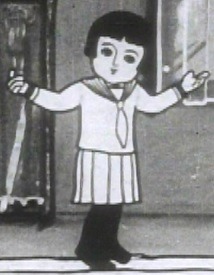
Chameko is a school-girl and she’s doing the things you have to do to get to school. Brush your teeth with Lion Toothpaste, eat a good breakfast but shun the natto, walk past the Charlie Chaplin advert to get to school on time. Then do some maths and reading and go home. Then persuade your mother to take you to the cinema, to watch some live-action athletics here and a nice jidaegeki samurai drama there. And that closes out the cartoon.
This was fun and silly, and given that the kids were inevitably watching this in the cinema, all a bit metatextual. Again, all things considered, this was fine, and so “A Day In The Life Of Chameko” gets another 4/10.
A NEW PILLAR
Back in 1918, Morinaga, a chocolate company that’s still around today, commissioned an animated advert based on “The Tortoise And The Hare”. Alas, the advert is gone, but it was the first directorial credit for OISHI Ikuo. He was only 16. He went into title-card work for live-action studio Shochiku Kamata, but eventually set up his own studio, Oishi Senga Seisakujo.
The Japanese Film Archive claims him as “The Japanese Disney”. Spoiler alert: that’s not hyperbole. But it’s about his influence on the animation industry as a whole, not just for his films. Oishi would teach a huge number of people how to make animation. He would also teach people some considerably darker things.
Wikipedia thinks his first surviving film is 1930’s “The Fox Versus The Raccoon”. That’s wrong twice; its a tanuki, not a raccoon, and it’s listed as a Toho film. Toho weren’t even formed until 1932. So we’ll look at that one another time.
“Home Alone Mice”
So what is Oishi’s earliest film? Well, I was able to find “Nezumi no Rusuban” / “Home Alone Mice” (unknown studio, 1931). But there’s only 78 seconds of it left. It’s another record-talkie featuring a song by Hirae Eiko; a clan of mice try to raid a house for food, but there’s a cat in the way. The mice sing about how they’re not scared and that’s all we have. Once again, not enough to score. But I couldn’t let it slide; Oishi is far too important to skip.
fin
Special thanks, terrifyingly enough, go out to the American Museum of Radiation and Radioactivity. And as always, I must thank AniDB, who have helped me work out what to look for and the Japanese Film Archive, who have given me the material to actually watch. And of course, to the inseparable pairing of Jonathan Clements & Helen McCarthy and their “Anime Encyclopedia”.
The Prokino logo is in the public domain, via Wikimedia Commons. The Chameko image is in the public domain, via Anime News Network.