
There are four main Japanese writing systems: kanji, hiragana, katakana, and romaji.
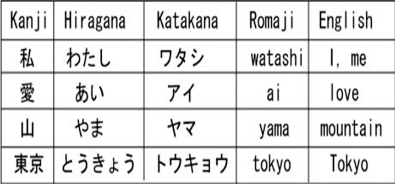
ROMAJI
The one you’ll definitely know is romaji, because it uses the same twenty-six (or thereabouts) characters that this article is written in. There are three main ways to do this, but the most common one is the HEPBURN system. It was officially adopted by the Japanese government in November 2025, so a lot of the romaji signs in the country are probably still being swapped over from the system they used before. Which I’m not mentioning. This is a complicated enough story as it is.
I’ve done my best to use that throughout this website, and it’s why you see macrons like this – ō – over some of my names. It’s how Hepburn distinguishes between the short and long O. By rights, that means that Japan’s capital city should be written as “Tokyō”, but no-one bothers. And at least it’s a nice easy way to explain it to the reader.
In theory, Japanese people could use this all the time. They don’t. But almost all Japanese people study English at some point in their lives. And the sheer amount of romaji that’s used in Japanese advertising and branding is mind-boggling. While they don’t spell it as “Sony” at home, that company and thousands of others use romaji for their logos worldwide, including back at home. I’m still not sure I get it.
KANJI – 日 本 語
I’m hesitant to call Kanji the most important writing system in Japan, because that’s a topic of debate even today. But as you can see, they’re what a lot of people – me included – think of when they think of Japanese writing. The text up there reads from left to right, and it says “Ni Hon Go”. Nihongo means “Japanese language”, and because I’ve been hunting around on Japanese Wikipedia for extra information regularly, it’s text I’ve come to recognise.
But I can’t read it. All I do is click on the “other languages” bar on a wiki page and look for those symbols. And there are another 2,133 kanji which are “regarded as necessary for functional literacy in Japanese”.
There are no hints in the actual character to either the meaning or pronunciation. Sometimes the same kanji can sound completely different based on context: 生 can mean “Be Born”, “Raw”, and “live” as in both “laugh, love” and “television, please do not swear”. Which proves it’s not a problem unique to Japanese.
The kanji dictionary has been reformed and altered several times, and according to the English Wikipedia page, “since the 1920s, the Japanese government has published character lists periodically to help direct the education of its citizenry.” Thankfully, there are extra hints.
HIRAGANA & KATAKANA HINTS AND TIPS
There are two bonus character sets in common Japanese use. Hiragana are a set of 48 characters, each representing a specific sound. Five are the vowel sounds on their own, one is a consonant on its own – the “n” sound – and the rest are consonant-vowel pairs. For example, the top line of the standard chart would read “ka, ki, ku, ke, ko”. There are three sounds which could, in theory, have characters. But because they don’t really exist in Japanese, there’s no need for “yi”, “ye” or “wu”.
It’s these sounds, and these characters, that comprise “The Song Of AEIOU” that’s commonly used in Japanese schools, and first came to prominence in “Momotaro: Sacred Sailors”.
The second set are the Katakana, and they use different characters for the same 48 sounds. So why bother? Well, if you see the more curved, script-like hiragana in use, the word you’re reading is of Japanese origin. And if you see the more angular, straight-line katakana instead, then the word is a loanword or calque from another language.
So, while in theory you could spell “United States” as “亜米利加” in kanji, you’re far more likely to see it spelled out in katakana as “アメリカ”. They both read as “A Me Ri Ka”, but tradition is a powerful thing in an old culture like theirs. Or my own Britain, to be honest.
Which means that people use the four scripts however they want, in whichever combination makes the most sense to them. Because language exists to serve its speakers, not the other way around. No matter what the Academie Francaise may tell you.
CREDITS
Image at top of article from “SILK as Kanji Learning Model for Students at Japanese Department”, by Amira Agustin Kocimaheni, Japanese Department, Universitas Negeri Surabaya, Surabaya, Indonesia. Advances in Social Science, Education and Humanities Research (ASSEHR), volume 108.