
THE SECOND GENERATION BEGINS
In my last article, I asked a simple question. Following the wrecking of the entire Japanese animation industry in the Great Kanto Earthquake, how did Japanese animation come back, and who was responsible? This week, I’ll be doing my best to answer that question, one or two artists at a time.
The first of the four animators I’ll be looking at is KIMURA Hakusan. Despite his future infamy, there’s so little known about him today that, at time of writing, he has no English Wikipedia page. He’s thought to have honed his art skills by painting signboards. But we do know he began his animation career with “Akagaki Genzou: Tokuri no Wakare” / “Akagaki Genzo, a Sake Bottle Farewell” (Asahi Kinema, 1924).
From context, it’s set in 1703, and Akagaki is one of the famous 47 Ronin. He’s having one last ritual drink before committing seppuku under the orders of the military government. The film has been lost. In the circumstances, I’m not too unhappy about that. But I’ll have to deal with the 47 Ronin one of these years.
JAPANESE COPYWRONG
I can’t get access to Kimura’s next work, either, which is a pain because it’s the earliest surviving take on a very famous Japanese fairy-tale; Urashima Taro. I’ll discuss the plot when I have a version I can actually review, but Kimura’s version is interesting for a completely different reason.
He called his cartoon “Nonki na Tosan Ryugu Mairi” (Suzuki Eiga, 1925). That means “Carefree Dad Visits Dragon Temple”, and “Carefree Dad” was the main character of one of the first four-panel newspaper manga, created by YUKATA Aso.
Japan had no cartoon copyright law in 1925; despite the cartoon’s success, Yukata never saw a yen of the profit. Perhaps in an effort to glide over this embarrassment, the official English title is “Dreamy Urashima”. According to Jonathan CLEMENTS and Helen MCCARTHY’s frankly essential “Anime Encyclopedia“1, it’s quite good, but it’s not available for streaming.
THE TEMPLE OF CRABS
Kimura would next co-direct “Kanimanji Engi” / “Tale of Crab Temple” (Asahi Kinema, 1925), alongside UCHIDA Tomu. Uchida’s live-action directing career would stretch into the 1970s. He’s noted as being a fan of Western film, but I was still surprised to see Japanese and English titles together. It’s only 1925, after all. The format surprised me as well. Unusually for Kimura, this is a silhouette cartoon, using backlighting and paper cutouts.
We meet an old man and his daughter, both faithful Buddhists. On their way to temple, the pair save a crab from having its legs ripped off by a cruel boy – that’s what the intertitles say! – because the crab is a symbol of compassion in their faith. The crab thanks them and flees. Later that year, to save a frog from being eaten by a snake, the man promises the snake his daughter’s hand in marriage.
Later that night, the snake transforms into a man who animates the bones of a vulture who finds the girl for its master. Gentle reader, this was the point where I checked no-one had put anything in my coffee. He demands the promise is kept, but the old man asks for three days’ grace. The snake-man arrives at midnight on the third day, and while the girl is busy fighting him off, one hundred crabs turn up and kill the snake.
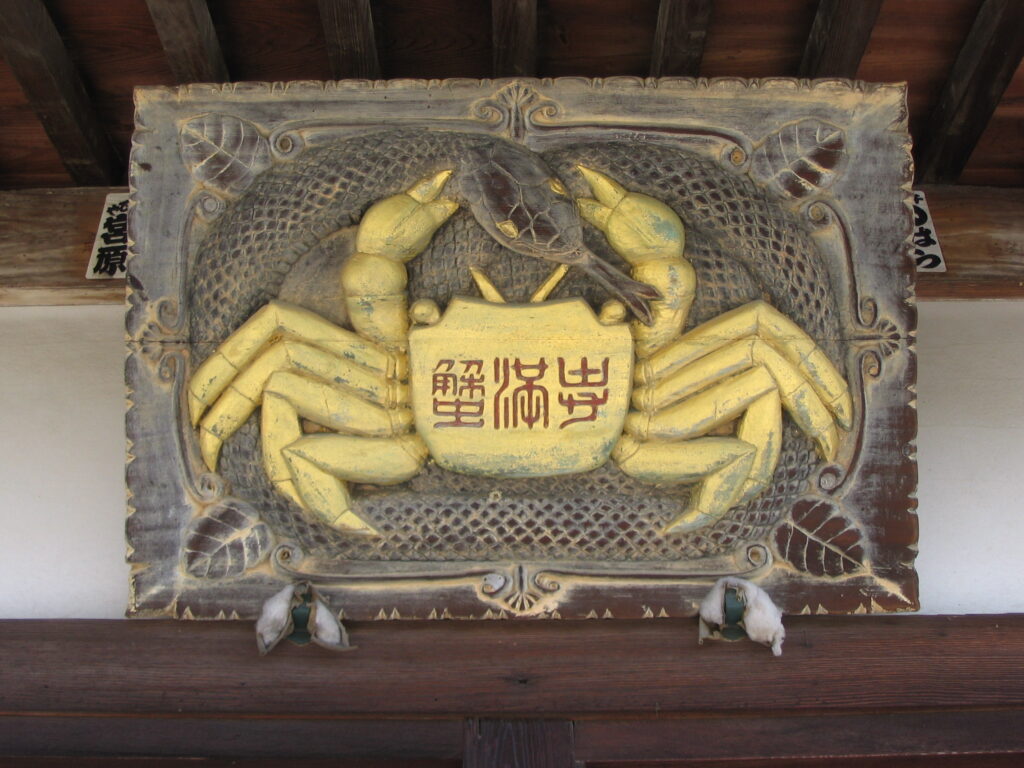
Image taken, with permission, from https://www.taleofgenji.org/
All things considered, the fight at the end is well done. But I couldn’t get past Kimura’s frankly bizarre additions to the original story. This is based on a folktale from the Konjaku Monogatarishu, and there’s a real temple covered in crab icons in Japan. But the way the story is handled in this version is so odd that I couldn’t take it seriously. “Tale Of Crab Temple” can only score 3/10.
CAREFUL, SHIOBARA
Kimura’s next film, “Kinken Chochiku Shiobara Tasuke” / “Careful Saver Shiobara Tasuke” (Asahi Kinema, 1925) is an adaptation of a famous kabuki2 play from 1892. The story itself is fairly straightforward – a hardworking farmer suffers, and eventually succeeds – but this was the first cartoon I’ve seen in this project which shocked me.
Halfway through, exhausted from work, Shiobara lies weeping on a bridge, and sees the silhouettes of families having fun at home. And he clearly wants to throw himself off the bridge. He’s only stopped by a passing kindly stranger, who ends up employing him, launching him into his successful business career.
I knew the “animation is for kids” box didn’t exist in Japan today; this made it very clear that it has never existed. Even though the animation is excellent, I wouldn’t let your children watch this one either. “Shiobara Tasuke” scores 6/10.
Based on these films, it would be fair to assume that Kimura has a long and fruitful career ahead of him in animation. And he very nearly did. But that’s a story for another day.
fin
Next time, I’ll look at an apprentice who ended up eclipsing his master: YAMAMOTO Sanae. As usual, I want to thank AniDB, whose peerless database has helped me work out what to look for, the Japanese Film Archive, who have given me the material to actually watch, and Jonathan Clements & Helen McCarthy’s “Anime Encyclopedia”. Special thanks for this post go out to Lambiek’s Comiclopedia, the International Tomu Uchida Appreciation Society, and to Leaf Kyoto. Website image used with permission from Tale Of Genji.
Leave a Reply