
THE RETURN OF NIKKATSU STUDIOS
As these reviews have made clear, Japanese animation was now back on its feet. In 1929, Nikkatsu Studios set up a new animation department at their studio in Uzumasa, to the north-east of Kyoto. I’ve already mentioned Miyashita Manzo in my last article, but the studio hired someone else as well. Other anime historians have called him “the father of anime”.
Enter Masaoka
His name was MASAOKA Kenzō, a former arts student turned animator. By 1930, he’d had already made two cartoons independently. I’m as sick of saying it as you are of hearing it; neither cartoon survives to the present day.
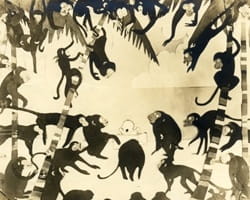
But one of his two works from this year for Nikkatsu has survived. Masaoka’s effective debut is therefore “Nansensu Monogatari Dai Ippen: Sarugashima” / “Shipwreck Story, Vol.1: Monkey Island” (Nikkatsu Uzumaza, 1931). But I’m not sure that counts as a pun in the title. “Nansensu” is a false friend – it doesn’t mean “nonsense”, it means “shipwreck”. Except.
“Nansensu” was a loaded word at the time. A sort of counter-culture was forming in Japan that called itself “ero guro nansensu“. The words are deliberately corrupted English: “erotic, grotesque nonsense”. The art movement which took that name explored weird and transgressive ideas. So it’s quite bold to put the word in your animation title, especially when it’s your studio’s first for eleven years. This sets a couple of records for my reviews, and possibly for animation in Japan as a whole. The entire 24 minute runtime is intact, and it credits a six-person team. But was it any good?
“Shipwreck Story, Vol. 1: Monkey Island”
An ocean-going ship gets wrecked in a storm, and a baby in a crate washes up on a distant island. A tribe of monkeys find him; their male leader is oddly bipedal, and their female leader has a disturbingly large rack. The human child is given to Mother Monkey and she breastfeeds him into youth in about fifteen seconds. She’s left with no boobs and no milk for her own children. If that isn’t “weird and transgressive” I don’t know what is.
The boy and two monkeys then run to a hill and, in theory, play. But the kid finds the monkeys’ pain amusing, and the games involve a thrown coconut and a passing crab. In no time at all he’s gone too far, and the monkey tribe quickly decide to reject him.
To celebrate, a pair of worryingly human-feminine monkeys don grass skirts and dance to a ukelele band. The boy watches from a distance. He starts catapulting coconuts at them for a laugh, until the monkeys chase him off the island. Our “hero” escapes on a crude raft, and the cartoon ends by irising in on a passing ship. There’s a question mark next to it.
beauty in the service of nonsense
Masaoka’s background in classical Japanese art is obvious from the very start. The animation of the storm that sets the plot in motion is beautiful; was this ink being dropped into water? It’s smooth and fast enough to be. But this is a bit on the slow side, especially compared to the frenetic comedy shorts I’ve been watching. Masaoka’s characters here also lack depth. They’re all facially crude, and the boy’s physical emotional expressions are so vague as to be pointless. Half-raising your hand could mean anything and he does it twice.
The art is good, sure, but we’ve seen other studios do just as well. The story is twisted and the protagonist is horrible. This wasn’t enjoyable but it had a few good points, and so “Shipwreck Story, Vol.1: Monkey Island” scores 3/10.
a lost sequel
It looks like there was a sequel to this. Some sources say it came out in the following month: “Nansensu Monogatari Daini Hen: Kaizokusen” / “Shipwreck Story No. 2: Pirate Ship”. That one is lost completely. I’m not sure how I feel about that, in the circumstances, but Masaoka will be back again soon enough.
YAMAMOTO’S GNAT
I don’t know what was going on with YAMAMOTO Sanae around this time. His rivals were able to gallop ahead delivering animation by the mile. He was getting support from the Ministry of Education. But somehow he was struggling to produce anything at all. Perhaps I’m being unfair, and it’s just that his work hasn’t survived. Only one cartoon of his is available from 1931, and it’s “Goichi-jiisan” / “Old Man Goichi” (Ministry Of Education, 1931).

“Old Man Goichi”
It opens with live-action. We see the titular Old Man, working at a water mill beating rice into flour. A song is playing, telling us to “work hard until your sash breaks”. A group of children turn up and ask him to tell them stories. So he shares what the Japanese Film Archive claims are a couple of Aesop’s Fables. This does appear to be an old story, but it’s not either of the fables the site talks about.
This animation shows us a pair of hungry dogs who find a steak and start to squabble over it. They eventually cut the meat in half, but neither dog is happy, and they go to a monkey to arbitrate. He’s hungry too, though, and much smarter than the dogs. While the he’s weighing the meat, the monkey bites pieces off for himself and his family, to make them “equal”. By the time the dogs catch on, they only have a mouthful each left. The moral is “If you’re greedy, you’ll lose out”. The kids leave, and Goichi goes back to tending his mill.
Given the personnel involved, this one was a disappointment. This is the first cartoon from Yamamoto I’ve been able to review since my 1928 blogs. The animation quality since that year’s very good “Momotaro, Japan’s No. 1” has dropped enormously. The backgrounds are vague and the dogs are poorly drawn. It gives me no pleasure to give this rating: “Old Man Goichi” gets 3/10.
fin
And that ends this blog post. As always, I must thank AniDB, who have helped me work out what to look for, and the Japanese Film Archive, who have given me the material to actually watch. Special thanks also go out to Kyoto Travel, and to My Anime List.