
MURATA ROLLS ON
Murata and his studio suffered something of a hiccup at the end of 1930. It looks like it was connected to Yokohama Cinema’s recording setup. But these things are relative; 1931 saw the company “only” release seven films. We should all wish for such problems.
Three of the cartoons don’t have a clear release date. So I’ve picked “Manga Ookami wa Ookamida” / “A Wolf Is A Wolf” (Ministry of Education, 1931) to start with.
“A Wolf Is A Wolf”
A tanuki and a goat go into the woods to look for persimmons. Along the way, the tanuki reminds us that he can shapeshift. After they’ve gorged themselves on fruit, a wolf attacks the animals. The goat faints and the tanuki flees. The village of animals plot to defeat their new enemy, but the tanuki insists he can win with his powers. The other animals don’t look convinced.
They’re right; the tanuki can’t control his shapeshifting properly, and the wolf isn’t fooled and eats him. Winter comes, and nothing’s changed. We see bunnies dance in a circle, but the wolf is coming for his toll. The lookout squirrel yells and everyone runs for shelter. A rabbit arrives with a monkey from a nearby village in tow, and he has a plan. The monkey tricks the wolf into trusting him to cross a river. Then an entire tribe of monkeys form a classic cartoon bridge for the wolf to cross. The wolf gets dizzy halfway across, and the monkeys break the bridge so he falls to his death.
This ought to have been really good. The wolf in this cartoon is superbly drawn and wonderfully threatening, but the story is unsatisfying. The animal villagers have to rely on outsiders to solve their problem, which made me uncomfortable. I suspect that the thumb of the Ministry of Education was starting to bear down on Murata’s creative process. As a result, “A Wolf Is A Wolf” can only get 4/10.
“The Monkey Masumune”
Next up is “Saru Masamune” / “The Monkey Masumune” (Yokohama Cinema, 1931). The version I watched had a lady narrator and a male voice actor; unfortunately, neither of them were credited. If anyone reading knows the details, please drop me a note and I’ll make sure they get their due. Masumune was a legendary bladesmith, so I’ll be interested to see what monkeys have to do with him.
A messenger is running along a road and stops for a rest. He saves a mother and child monkey from a hunter, and in the ensuing fight, the hunter’s gun goes off. Thinking he’s killed the messenger, the hunter flees. The monkeys consult for a moment and steal the message. The messenger, out of options, follows them home, where they give him nut sake and an apparently gorgeous sword.
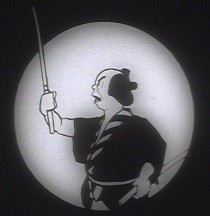
Image from Anime News Network.
When the same hunter makes the mistake of shooting a bulletproof boar, the messenger saves him and cuts the boar in half with one stroke of the blade. The hunter thanks the messenger and shows him a short-cut. He probably needs it after dilly-dallying with monkeys. Then we learn that the titular sword becomes a treasure.
The added soundtrack made this an incredibly easy watch. The story is simple and good fun, with a couple of wonderful puns thrown in for good measure. I’m not against overly-complicated stories, but sometimes simple is best. As a result, “The Monkey Masumune” scores 7/10.
“At The Circus”
Finally in this category comes “Manga Misemono Kenbutsu” / “At The Circus” (Yokohama Cinema, 1931). It looks like Murata had hold of the record-talkie technology, but time has put paid to the “talkie” part. The animation is fine, but it relies so heavily on the lost vocal and musical elements that their absence means there’s nothing there any more. So it can’t be fairly scored.
There are dates for Murata’s four remaining 1931 films, but one of them is sadly lost. “Tanukichi no Ohanashi” / “The Story Of Tanu-kichi” (Yokohama Cinema, May 1931) must surely be another tanuki yarn, but that’s no more than a guess.
Thanks in part to the studio issues I mentioned earlier, “Manga Revue Haru” / “Animated Revue: Spring” (Yokohama Cinema, June 1931) was meant to come out in the Spring of 1930. It came out as a silent film, fifteen months later, which pushes “spring” to its limits. It’s based on a traditional song, “Haru ga Kita”, or “Spring Has Come”.
“Animated Revue: Spring”
Winter is leaving, and the animals are emerging again. The baseball rabbits are back, and a bear decides it would be funny to knock a tanuki off his stilts. Must be a pun. Various animals exercise and play, including a race between a pig in a pedal-car and a monkey on a tricycle. Then everyone goes back to school, with the usual flung board-eraser level of discipline that was common at the time. The birds play jazz in the trees, while adult animals do chores, and various other short comedies play out.
While the backgrounds are lovely, this is just a load of unconnected little sketches. Without the music to potentially tie the whole thing together, it falls a bit flat. “Animated Revue: Spring” gets 4/10.
“Electrical Telegraphy, Electric Bells & Telephones”
October saw Yokohama Cinema lean into the educational part of their remit, with “Electrical Telegraphy, Electric Bells and Telephones” (Yokohama Cinema, October 1931). The title is much better in Japanese; “Denshin Denrei Denwa”.
It’s a silent physics lesson, that’s largely live-action film showing various bits of equipment in action. But it uses some basic animation to show idealised versions of electromagnetic equipment, like telegraphy sets, to make them easier to understand.
It must have been useful at the time. It’s certainly historically interesting to see how a subject was taught, and how animation was being used in new ways. But I’m not about to review a physics lesson. If it was a history lesson, I might have considered it.
THE INCIDENT AND THE WAR
Like, for example, this one. The South Manchuria Railway was a Japanese-owned railway company. Their lines ran through Manchuria, the north-east part of China. The railway connected Russia and China to ports on the Japanese-held Korean peninsula. The company made most of its money through freight.
In the autumn of 1931, a pair of Japanese Army colonels put a false flag operation into place. On September 18th, 1931, a Japanese soldier placed a small quantity of explosives near a railway line in Mukden, Manchuria. That’s now Shenyang City in northeast China. No damage was done; a train passed over the line not long afterwards.
But the Chinese got the blame for the attack on Japanese property. The following morning, against direct orders from Imperial General Headquarters, General HONJŌ Shigeru ordered a full attack. The defending Chinese Army troops weren’t close to ready, and lost ground rapidly, everywhere. By February of 1932, Manchuria had been replaced with the Japanese puppet state of Manchukuo.
The Japanese government, who had ordered none of this, chose to send reinforcements, instead of issuing orders which would have been ignored. As a direct result, Prime Minister WAKATSUKI resigned. The incident led directly to Japan leaving the League of Nations in 1933. While General Honjō was fired for insubordination, he returned to Japan a hero. He served as aide-de-camp to Emperor Hirohito, whose quiet approval had made the illegal attack possible, until 1936. That’s when his implication in a failed coup by a group of officers forced him to step down.
Japan calls the period from the invasion of Manchuria to their occupation by the Allied Powers, “The Fifteen-Year War“. Honjō was arrested for war crimes in 1945, but committed suicide before he could face trial. He was far from the only one.
MOMOTARO IN THE SKY
Murata Yasuji’s last film of the year was “Sora no Momotarou” / “Momotaro In The Sky” (Yokohama Cinema, November 1931).
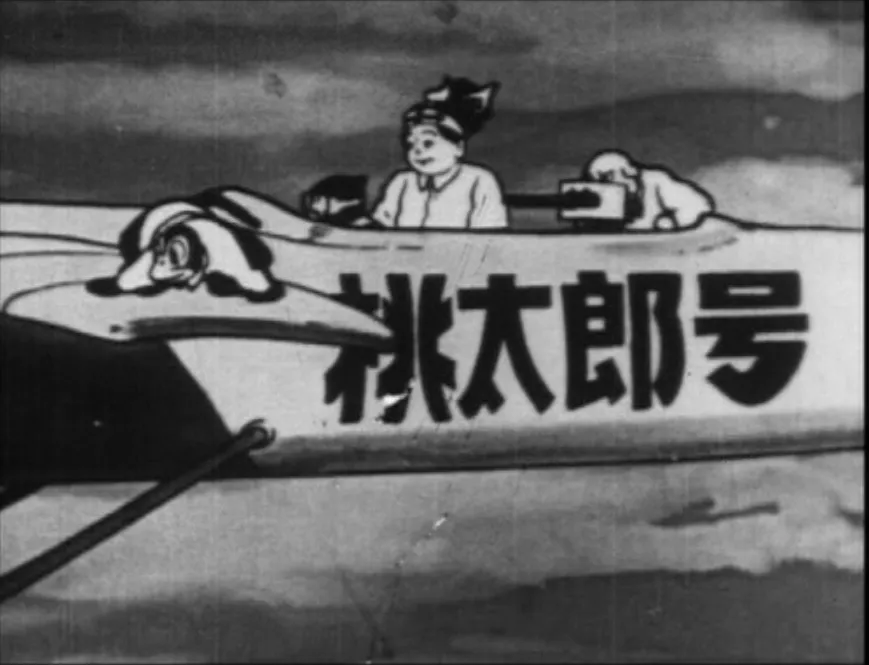
An albatross and a penguin find Momotaro and complain they’ve been attacked by an eagle. Momotaro, fan in hand, looks over a world map and worries that the island is too far away. But the penguin reassures him; there are two fueling stations along the flightpath.
Flightpath? Huh.
A flight crew are fixing up an aircraft – I’m told this was a Nakajima Type 91 fighter, which would enter service in the Japanese armed forces in 1934 – who say they’ve not been needed since “the Ogre war”. They pray at a temple for protection, and everyone gets an omomori charm. Momotaro and his crew of three fly off.
Shortly after, they find a neatly signposted turtle, carrying an albatross and a fuelcan on his back. They pick the fuel up, and the turtle yells a deafening “BANZAI!” at them. The second station is a whale carrying a penguin – you know, this ought to be funny – but the eagle tries to interfere with the pickup.
Gotta say, folks, that’s a pretty bald-looking eagle.
The whale spouts his fuel cans up to the aircraft. That allows Momotaro and his team to reach the icy, mountainous island, just in time to see a seal get taken by the eagle. The ensuing dogfight is well directed, until Momotaro orders that the eagle should be taken alive. They lasso it, bring it down easy, and then knock it out with a hammer.
Momotaro then flies over the island, with a featherless eagle attached to the plane by a rope. The plane also carries a Japanese flag with “Japan’s No. 1” written on it. And then the film ends.
“Momotaro In The Sky” does not get a score. Quite a lot of this is very well made, but propaganda isn’t art, and Murata – or whoever paid him – is spoiling for a fight with America.
FIN
I know that the timing of “Momotaro In The Sky” was a coincidence that I’ve milked for dramatic effect. I know it’s not close to the first piece of propaganda I’ve watched for these reviews. But there will be more of them. A lot more. Japan’s military had made its first move, and fairly soon, the people would have to be told who they were supposed to hate.
I would like to give special thanks to this blog’s four pillars. AniDB, who have helped me work out what to look for, the Japanese Film Archive, who have given me the material to actually watch, and the inseparable pairing of Jonathan Clements & Helen McCarthy and their “Anime Encyclopedia”. I must also apologise to Jon Bois of Secret Base. I hope I didn’t mangle his style too badly for that last review.
The image from “Momotaro In The Sky” is from Dr. Grob’s Animation Review. The one from “The Monkey Masumune” is from Anime News Network.
I’ve been Douglas Howell, and I’ve started to watch 1930s Japanese animation. Join me next time, as Japan somehow becomes stronger, more unstable, and better at making cartoons, all at the same time. Peace; out.