
OFUJI NOBURO AND HIS CHIYOGAMI CIRCUS
OFUJI Noburo’s career was continuing to build momentum and garner respect. His only film from this two year period to survive was “Mikanbune” / “A Ship Of Oranges” (Ofuji Noburo Productions, February 1927). Unfortunately, the version I watched was edited down from the original 35 minutes to 6 in 1931.
Ofuji’s hero Dangobei returns in his spider-web kimono as semi-mythical 17th century merchant BUNZAEMON Kinokuniya. As with his inspiration, Dangobei is getting rich by shipping oranges around Japan. But he kicks one of his boxes off the boat, and it smashes an unnamed wind god in the face. Understandably, the god decides to sink the boat, but only succeeds in blowing the ship to its destination in record time. The cuts have made the resultant cartoon more than a little confused. “A Ship Of Oranges” can’t get anything more than 4/10.
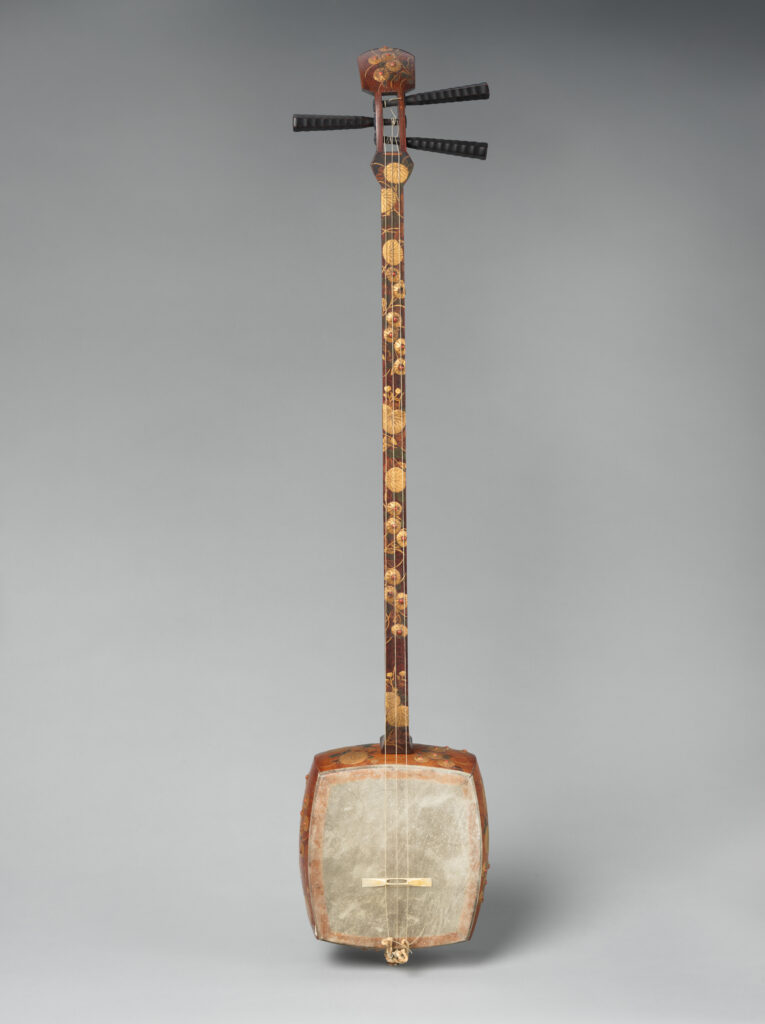
Something important happens in the closing scene, though. A geisha pulls out a shamisen. That’s a traditional Japanese three-stringed fretless banjo, and her colleagues dance to it as she sings. It’s the first time we see an Ofuji trademark. As a child of the 80s, I can only call them “music video” animations. Once his technology caught up to his ideas, he had several more to come.
Lost Cartoons
Ofuji made two further cartoons in this period that haven’t survived. 1927 saw his first version of “Kujira” / “Whale”. He’d been experimenting with silhouette animation, and apparently this was his first release using the technique. According to Jonathan CLEMENTS and Helen MCCARTHY, authors of the frankly essential “THE ANIME ENCYCLOPEDIA”, it even used synchronised sound, like live-action classic “The Jazz Singer” (Warner Bros., 1927)1. I’m a bit doubtful of that claim, though. Sadly we’ll never know, although Ofuji would remake the film after the war.
His second lost film is “Chinsetsu Yoshida Goten” / “The Strange Tale of Yoshida Palace” (Chiyogami Eigasha, April 1928). According to the Kobe Planet Film Archive, this was based on Don Quixote and starred Dangobei. Beyond a precis of the plot that didn’t make any sense to monolingual me, that’s all I can say.
SIDE NOTE
I couldn’t find anywhere else in this blog entry to put the following review, so here it is. There is, technically, another cartoon from 1928 that could be reviewed. But nothing about it is good; it’s 86 seconds of blurry, incomprehensible nonsense which involves a samurai riding a bear. It’s called “Tairiki Tarou no Mucha Shuugyou” / “Mighty Taro’s Reckless Training”. One source I read attributed it to KATAOKA Yoshitarou. Given that his next directing credit isn’t until 1935, I find that a little doubtful, but I don’t have any alternatives.
historical sidebar: losing control
If I had to summarise the political scene in Japan in 1927 and 1928 – and as will become obvious, I do – I would use words like “chaotic” and “unstable”.
turning a crisis into a catastrophe
In the spring of 1927, concerns were running high about the stability of Japan’s banking system. Finance Minister KATAOKA Naohiro turned a crisis into a collapse when he blundered in a committee meeting, saying that a specific bank had gone under when it hadn’t. The resultant bank run led to thirty-seven banks collapsing, and helped to end the centre-left government of WAKATSUKI Reijirō.
His replacement was the right-wing Baron TANAKA Giichi. Early in 1928, Japan held a general election, which Tanaka’s party won by one seat. Threatened by the rise of what he saw as Japan’s far left in the elections, Tanaka ordered the arrests of over sixteen hundred leftists and Communists.
But even he wasn’t right-wing enough for the Japanese Kwantung Army. Formed to protect Japanese holdings on the East Asian mainland, and controlled by junior officers belonging to the totalitarian Imperial Way Faction, they had been disobeying minor orders from the Japanese Home Islands without consequences for years.
how not to start a war
China had been shattered by a successful revolution in 1911. Since 1926, the Chinese Nationalist government had been fighting against the rival Beiyang government in an effort to reunify the country. As any sensible neighbouring state would have done in the circumstances, Japan and Russia had meddled throughout to make sure the new China was favourable to them.
When the leader of Beiyang’s armed forces, ZHANG Zuolin, fled by train to his stronghold in north-east China, Colonel KAWAMOTO Daisaku, then a junior officer in the Kwantung Army, decided it was time for a change. When Zhang’s train home was passing through the only unprotected section of the track, Kawamoto blew it up, successfully assassinating Zhang and several of his officials.
But he didn’t wait for authorisation from the Japanese government. Kawamoto went too soon. The Kwantung Army’s favoured successor wasn’t ready. Everybody condemned the attack, including the Japanese government. When ZHANG Xueliang took control of his father’s armies, he quickly pledged to the Nationalist government instead. The attack was meant to prolong the war, but it led to immediate peace.
This botched coup attempt horribly weakened Japan’s influence in the strategically and economically vital Manchurian region of China. It had an impact at home, too. Prime Minister Tanaka’s position was fatally undermined. The officers who carried out the assassination faced no punishment. As a direct result of that, Emperor Hirohito would dismiss Tanaka from office in 1929.
If I had to summarise the political scene in Japan in 1929, I would use words like “chaotic” and “unstable”.
FIN
But that closes out the blog for today. The shamisen picture was provided by the New York Metropolitan Museum of Art. Thanks also go to the NPO Planet Film Preservation Network. As always, I must thank the blog’s four pillars. AniDB, whose peerless database has helped me work out what to look for, the Japanese Film Archive, who have given me the material to actually watch, Jonathan Clements & Helen McCarthy’s “Anime Encyclopedia”, and Clements’ “Anime: A History”.
- “The Anime Encyclopedia, Third Revised Edition”, Clements & McCarthy, p. 690, 2015 ↩︎
Leave a Reply