
“Sankichi The Monkey: Air Combat”
Last week, I covered the cartoons I knew existed, but have either been lost to time, or aren’t available to watch without getting on an aircraft. For 1942, that leaves three cartoons which I have been able to see.
I prefer to open with the names of the studios or directors involved, but I can’t do that here. I briefly thought I knew who made one of them; “Osaru no Sankichi: Boukuusen” / “Sankichi the Monkey: Air Combat” (unknown studio, 1942).
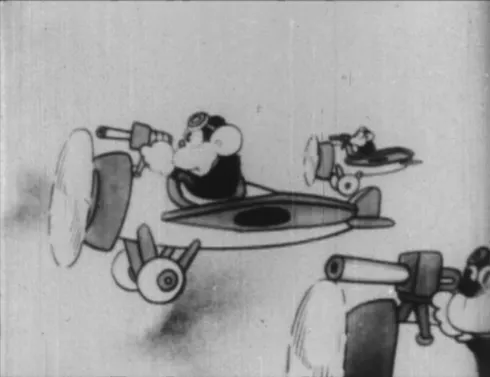
Thing is, though; if you follow that link, it will tell you you’re watching something different. This cartoon is listed on YouTube twice, under two different names. There’s a three minute version called “Air Combat”, and this full version which is down as 1941’s “Sankichi The Monkey: Our Marines”. But the plot – which I’ll get to shortly – means this is pretty clearly “Air Combat”. I don’t think that’s anyone’s fault; the fog of war had pretty clearly descended by 1940.
The provenance of the cartoon is just as confused. Was KATAOKA Yoshitaro involved? He’s been associated with a version of Sankichi before, but that didn’t resemble this at all. What about SEO Mitsuyo? The chimps in this do look like the ones he drew for a 1934 Sankichi cartoon, “Shock Troops”. But there’s no clear evidence in any direction. I suppose I’ll just have to ask the question: was it any good?
Monkey City Air Raid
We watch an assortment of identical monkeys as they assemble aircraft out of wood, to the bafflement of the local crow population. Apparently the peaceful monkeys’ land is subject to frequent massive air-raids, from bears flying aircraft with stars on the side.
The monkeys literally fly into action and shoot some of the bears down. Monkey City blacks itself out, and between the anti-bearcraft1 fire and some handy bomb-catching blankets, none of the attacks do any damage. The monkeys win, but promise they’ll remain vigilant against “the other enemies”.
Between their species, their roundels and their natty little hats, I’m pretty sure this is a Russian attack. Whoever made this must have done so in April 1942 at the latest. That, as I wrote last week, is when Russia and Japan signed their non-aggression treaty. Apart from that, this is decently animated and tells a very clear story. “Don’t worry, kids, the air-raids are nothing to worry about and the bad guys won’t hurt you!”
Sometimes this project sucks. By policy, no score.
“Co-operative Air Defence”
Next up is “Kyouryoku Boukuusen” / “Co-operative Air Defence” (Unknown, 1942). And while this is officially by an “unknown” director, I’m personally convinced it was ASHIDA Iwao at the helm. Partly because he used so many pseudonyms in his work, but mostly because one of his long-term associates gets his first official credit on this cartoon.
Enter future anime stalwart, DAIKUHARA Akira. According to the frankly essential “Anime Encyclopedia” by CLEMENTS & MCCARTHY2, Daikuhara had been working under Ashida since 1936. Daikuhara would stay in the industry until the early 1980s in various capacities, but this time he gets credited as an animator.
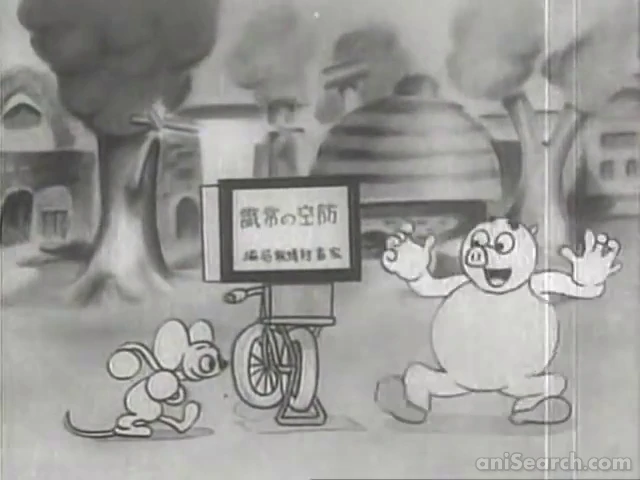
The first half is a presentation: a pig and a mouse arrive in a village with a Kamishibai paper theatre set, and the houses empty to see what they’ve got to display. Hurrah! It’s what to do in case of an air-raid! The animation which follows shows various different bombs and how to handle them, especially the incendiary types.
From Theory To Practical
Then we see the area from above, and zoom in – very cleverly done, in passing – on a ship that’s watching out for bombers. We see how the attack signal is passed inland, and we hear the sirens wail. The attackers fly in, and equally accurate Japanese-roundeled fighters rise to join them.
The kamishibai scenes were backed by pleasant and soothing music. Now all we hear is the crackle of bullets, the roar of aircraft engines, and the deep pop of anti-aircraft cannons, like the ones my grandfather used to fire.
An enemy bomber gets through, and the soundtrack returns to stir the heroic animals. The non-combatants flee to a shelter, after turning off their gas-taps and dousing any fires. Their grins are ridiculous, even in context. An incendiary bomb falls and spits sparks, and the properly trained animals douse it quickly, even though it’s briefly and bitterly funny that the flame briefly resembles Franklin D Roosevelt before it goes out.
The remaining bombers get blown out of the sky, one by one, and the all clear sounds. The Japanese audience have to be told what that is. Then the animals dance and sing a song of victory under the Japanese flag.
The End Of The Phony War
This cartoon represents a massive shift in tone, compared to what came before. Previous films which discussed the idea of an attack on Japan put cute bears or copies of Bimbo the Bear at the controls of the aircraft. Not any more. These are brutal and accurate-looking bombers. We see an enemy pilot once; he’s a vicious-looking critter of no species I could identify, and he dies easily.
The animation is patchy. Sometimes, especially when it comes to showing how bombs spin as they fall, it’s excellent. But the animals we see are all pretty badly designed, which is an odd choice given that they’re standing in for the Japanese viewing audience.
For the first time in this project, I’m watching a cartoon about the realities of war and how to best protect yourself from them. I can’t score this, it’s half propaganda and half wartime education. But from a historian’s point of view, it’s darkly fascinating.
“The Animal Village In Trouble“
Finally for this year, I watched “Doubutsu Mura no Daisodou” / “The Animal Village In Trouble” (Unknown, 1942). This one has no cast or creator information on it on AniDB – but the first thing you see after the title screen is a page that reads “Animation by YAMAMOTO Sanae”. Which is fascinating all on its own, but isn’t going to make me give him the credit.
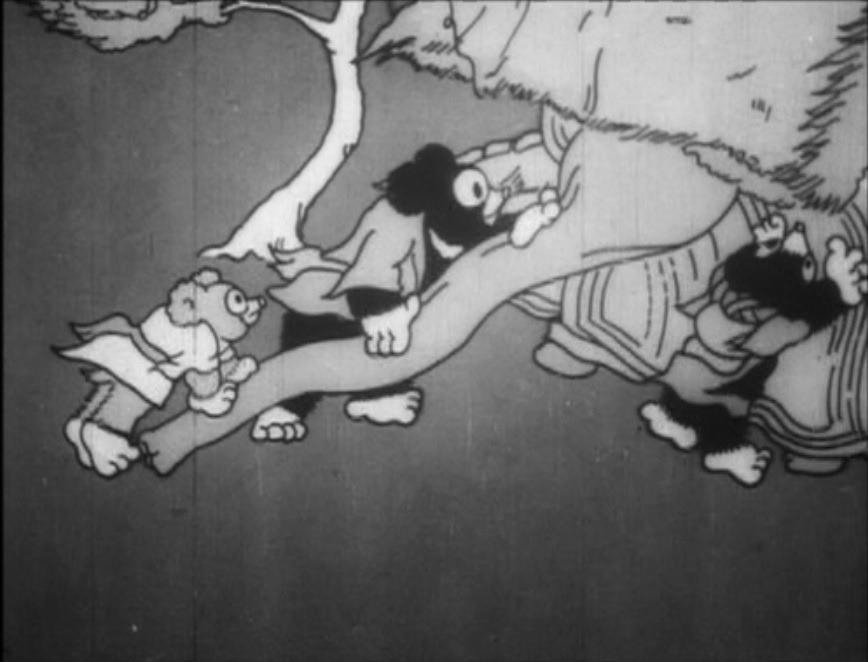
We see a huge tree, with every branch stuffed full of homes. A huge family of monkeys – at least fifty – emerge from one for a communal breakfast, and a broad-chested pair of parents wryly and lovingly talk about how hard they have to work for such a big troop. A pair of bear parents smile as their apron-clad child uses a fish as a punching bag to get big and strong, and the inevitable trio of tanuki are still in bed. The youngest wakes and shapeshifts into an alarm clock to get his parents up too.
We see a workday, which mostly involves the animals cutting down trees. And then night falls, and a huge storm hits the animals’ tree. The monkeys work together and save their homes, but the bears can’t do the same, and they all end up in a raging river. The tanuki try and shapeshift to save them, and end up joining them instead. Finally, the monkey clan shows up, and work as a team to save the day. And there’s the usual abrupt ending.
I Can Actually Score This One
This was a cartoon that was made. It was fine, I suppose. It wasn’t overt propaganda, although it covered the same themes of combination in times of trouble that “Co-operative Air Defence” did. The animation was good and the soundtrack was pretty solid, although it leant on traditional jazz-esque Western music quite hard. But it lacked the zing that the best cartoons I’ve seen in this project had.
I have a score for this kind of thing; “The Animal Village In Trouble” gets 4/10. Which makes 1942 the worst year, in terms of scores given out to cartoons, that I’ve seen so far. It’s certainly made me feel sadder than most.
fin
My thanks go out to AniDB, who have helped me work out what to look for, and the pairing of Jonathan Clements & Helen McCarthy and their “Anime Encyclopedia”. Without them, this project would have been impossible, instead of being merely silly.
That wraps up 1942. I’ve been Douglas Howell, and I’ve been watching Japanese animation. When I could get hold of it, anyway. Join me next time, please, when I fully expect the challenges to get harder still.
Images for “Sankichi The Monkey: Air Combat” and “The Animal Village In Trouble” from Dr. Grob’s Animation Review, and for “Co-operative Air Defence” from AniSearch.
Leave a Reply