
AMERICAN ANIMATION INNOVATION
It is impossible to discuss animation in the inter-war period without mentioning American cartoons. And let’s be honest; that means the Mouse. Between 1923 and 1931 – two years that loom large in Japanese history – Walt Disney Productions made 142 cartoons. That, of course, includes the 1928 landmark, “Steamboat Willie“, the first cartoon with a synchronised soundtrack, allowing Mickey to abuse the other animals on the boat in time to the music. It was acceptable in the twenties.
Japanese creators could only manage 72 cartoons in the same period. It’s why Jonathan CLEMENTS and Helen MCCARTHY, in their frankly essential “Anime Encyclopedia”, refer to Japanese animation in this period as being “an obscure cottage industry”1. I think that’s correct but more than a little unfair; the Japanese were starting several laps behind. There were three key innovations that allowed American and European studios to gallop ahead.
The first two were purely technological. John Randolph BRAY opened Bray Productions in New York in 1912, and anyone who was anyone in American animation (who wasn’t named Walt) worked for him at some point or other. He encouraged innovation, and that included funding his friend Max FLEISCHER‘s experimentation with rotoscoping, that would eventually lead to his successes with Popeye and Betty Boop.
More significantly, Bray worked with his employee Earl HURD to develop cel animation. Hurd had worked out that you could paint directly on to layers of celluloid film to animate movement, far more easily and quickly than anyone else could manage. The first cartoon to use this new technique was “Bobby Bumps Gets Pa’s Goat” (Bray Productions, 1915), although I think that’s lost now.
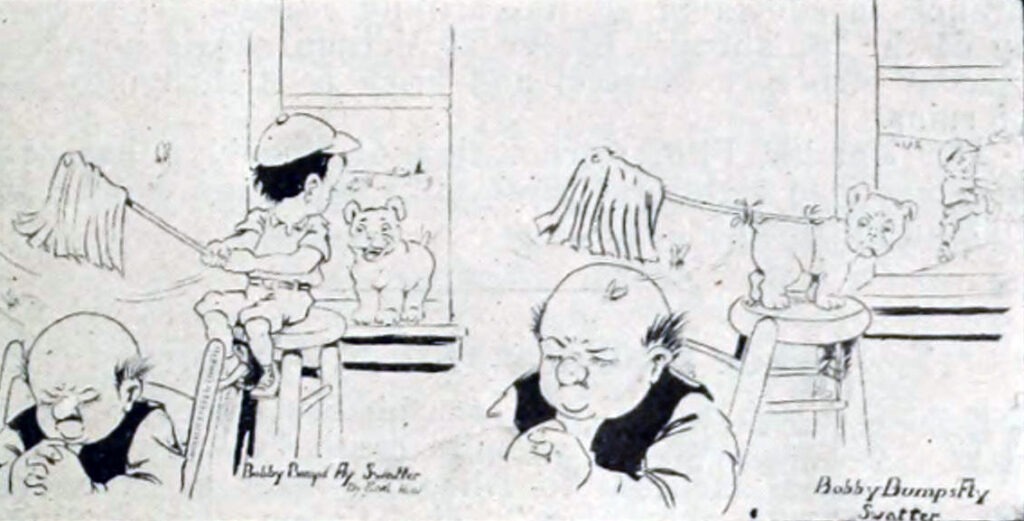
The last innovation was about working smarter and harder at the same time. The resultant cartoon process was simpler, frame by frame, than anything else invented so far. Bray Productions were able to employ an animation assembly line now, which all the other American studios quickly moved to, along with the new technology. Cel animation wouldn’t make it to Japan for years.
A JAPANESE REGENCY
Speaking of years; while Japan mostly uses the Western Common Era dating system, the country’s Imperial Calendar is still also in use everywhere. As I write this in early 2026, it is REIWA 7, the seventh year of the reign of Emperor Naruhito. By that reckoning, 1924 was TAISHŌ 12. That was Emperor Yoshihito’s regnal name, but in 1924, he was not in charge of anything. He had always been sickly, having contracted meningitis at three weeks old, and had dealt with physical and mental health problems throughout his life. During his reign, the balance of power in Japan slid slowly away from him, and towards the democratically elected parliament, the Diet of Japan. This was the Taishō Democracy; it would not last.
On November 4th of 1921, Prime Minister HARA Takahashi had been assassinated. Under normal circumstances, the Emperor would agree on a temporary replacement. Instead, two of his senior advisors – neither of whom was an elected official – appointed one over the Emperor’s head. A ruler who cannot select their own chief politician is no ruler at all. Before the month was out, Crown Prince Hirohito had been made the Emperor Taisho’s Prince Regent.
Hirohito spent the next few years studying statecraft and working out how to “reclaim the lost powers of the throne”2. His government remained stable until it was struck twice in short succession. Prime Minister KATO Tomosaburo died of cancer on August 14th 1923, and two weeks later, while his successor YAMAMOTO Gonbei was appointing cabinet ministers, the Great Kanto Earthquake struck. It killed 105,000 people and left nearly 2 million homeless across the Kanto region, which includes Tokyo.
fin
So by the start of 1924, Japanese animators had very little financial backing and were technologically miles behind the West. And Tokyo, home to the only animation studio even arguably worthy of the name, had just been flattened by an earthquake. It’s a surprise that anything got made quickly at all, never mind animation. So what happened? How did Japanese animation come back, and who was responsible?
Well, that’s what I’m going to answer next week. For this article, I’d like to thank Jonathan Clements & Helen McCarthy for their “Anime Encyclopedia”, and Herbert P. Bix for his “Hirohito And The Making Of Modern Japan”.
Leave a Reply