
Murata-san, Why Are You So Popular?
MURATA Yasuji, and the work he produced through Yokohama Cinema Shokai, have been dominating this blog since the company was founded. This year will be no different. He produced a stunning five surviving films. So I’m starting with “Manga Kamishibai Itazura Tanuki no Maki” / “Rascal Raccoon” (Yokohama Cinema, April 1933). That title literally means “Comic Book Story: The Mischievous Tanuki”. But it usually does, doesn’t it?
“Rascal Raccoon”
A starving tanuki has been homeless for a month, and sneaks into a temple to steal the food offerings. After demolishing a plate of buns in front of a statue of Buddha, a child monk turns up with more. The tanuki transforms into a second statue. The child eventually tells a senior monk, who burns a lot of incense in front of the two statues. Hacking and coughing, one of them transforms back into a tanuki. A fight ensues, and the tanuki gets the upper hand by turning into a warrior. But once he’s trapped the monks under a ceremonial bell, he runs away. Full and happy, he dances to end the cartoon.
This was a welcome bit of fun after all the historical and propaganda cartoons I’ve been watching recently. I’ve become used to seeing jokes and ideas inspired by Western animation. I don’t mind that, but this is eventually going to be an anime review blog one day. So seeing a good cartoon that was unmistakably, completely Japanese was a relief. I genuinely felt relaxed after seeing it. So “Rascal Raccoon” gets 6/10.
“Sankou to Tako: Hyakuman-ryou Chinsoudou” / “Sanko And The Octopus: A Fight Over A Fortune” (Yokohama Cinema, 1933) is up next. And it’s slow; I’m convinced that the opening shots of several scenes are unmoving, still photographs. I’m also pretty sure this was Murata’s first cel animation. I saw looped images happening in a repeated dance, and that’s a dead giveaway.
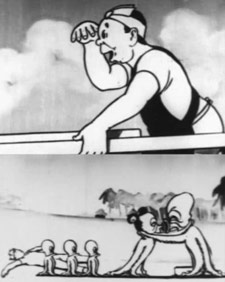
“Sanko And The Octopus”
Sanko is three things; a fish merchant, a drunkard, and a total noun. He wakes up too “tired” to go to the fish market, so his wife shrugs and goes in his place. Again. Sanko only wakes up when Kuma, his drinking buddy, hits him with a walking stick.
Kuma tells a story of a shipwreck that a recently deceased friend of his survived. Apparently Kuma now has a treasure map that he’s too decrepit to use, which is where Sanko comes in. Sanko falls for it, and when his wife objects he knocks her over. I did say he was a noun. Sanko swims down and finds a box of treasure but gets interrupted by an octopus who insists that it’s his.
Sanko takes the treasure away and lands on a tropical island rammed full of racist stereotypes. Bugger, I was enjoying this. As an inexplicable piano version of “Singin’ In The Rain” plays, one of the locals flees with the treasure. The resultant chase scene involves a random monkey. Then somehow the box hits Sanko and opens to reveal the octopus’ family. Then the monkey tries to wake Sanko up..and the whole thing was a dream. Sanko apologises to his wife and the film ends.
toilet break?
The animation is well-executed and I think Murata is getting used to his new technology. Mind you, he doesn’t know how to animate running with it yet. Sanko runs like he needs a potty. I don’t know who the benshi was for the version I watched, but she was excllent. Her work made my viewing experience better than the cartoon deserved, and that was already a pretty high bar. I’m knocking a point off because even for 1933, there was no excuse for the racist plot points. So “Sanko And The Octopus” scores 6/10.
“Larks’ Moving Day”
“Hibari no Yadogae” / “Larks’ Moving Day” (Yokohama Cinema Shokai, 1933) is a story about a family of larks. We see three young larks go out to play. And they use a Bangalore torpedo – oh, gods – to attack a snake. No-one actually gets hurt. The next day, after the larks’ parents get back from work – I think – the kids tell them that all their neighbours have already moved. So the parents decide they’re going too. While the larks are packing, two relatively enormous humans show up. Father Lark talks about being self-sufficient and doing things for yourself. Then the family packs up a huge wagon and go.
This didn’t make a lick of sense to me at first. Maybe that was down to a bad translation, I don’t know. But the story didn’t snap into focus until I went and read the Aesop’s Fable it was based on. It still didn’t make a lot of sense, but I understood what they were aiming for.
We never get told why the birds move out. From the story, I know that the farmer, the landlord, is about to harvest the wheat from the field they live in. But without knowing that, the whole thing falls flat. If someone can read the intertitles and confirm the translation theory, I’ll publish an apology and a rescore. Barring that, “Larks’ Moving Day” is only worth 3/10.
I must mention that another of his films, “Osaru no Tairyou” / “The Monkey’s Big Catch” (Yokohama Cinema, 1933) is still technically extant. But the image quality of the versions I found were so bad that the thing was unwatchable, and hence ungradable. That done: on to Murata’s biggest success of the year.
The Dog Of War: Norakuro
That success came with two films about Norakuro, an anthropomorphic dog serving in Japan’s military. Norakuro originally appeared in boys’ magazine Shonen Club, drawn by TAGAWA Suiho. Two of Tagawa’s trainees would go on to significant careers. HASEGAWA Machiko moved to TV anime in 1969 with “Sazae-san”, a slice-of-life show which has outlived her. The other was a guy called TEZUKA Osamu. That’s weird; I can hear a rumbling noise coming from very far off. It’s probably nothing.
Norakuro quickly became an icon of Japan’s ongoing conflicts among Japanese children. The artist’s own military experience meant that his manga was detailed and, of course, supportive of his country’s military exploits1.
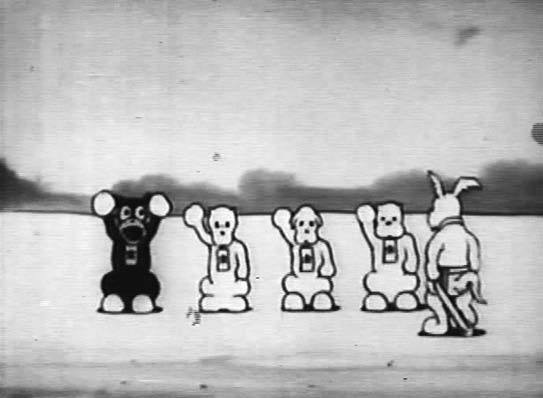
The manga was a big success. So Murata and Yokohama Cinema adapted it for the big screen. The dog’s first two cartoons came out in 1933. They were “Norakuro Nitouhei: Kyouren no Maki” / “Private Norakuro: Boot Camp” and “Norakuro Nitouhei: Enshuu no Maki” / “Private Norakuro: The Exercise” (Yokohama Cinema Shokai, 1933). And for obvious reasons, the Japanese Animated Film Archive combined them. So, were they any good?
Private Norakuro: “Boot Camp” & “The Exercise”
“Boot Camp” opens with an introduction from Norakuro himself. His name means “black stray dog”, and he went from being an orphan to being a soldier. Then he throws the title card into the air, salutes, and walks off.
Nurakuro goes into his commander’s office to clean it. Alas, he can’t resist strapping on his boss’s katana and nicking one of his smokes. When the bugle calls for assembly, Norakuro runs out with the sword still on and knocks his commander flat. There’s a drill sequence afterwards, where Norakuro gets everything wrong. In the best slapstick tradition, all the soldiers obey orders without thinking and cause problems.
“The Exercise” sees the dog soldiers out on a route march until Norakuro collapses. The commander complains about cowards and leaves Norakuro behind. While he rests and gets himself back together, two dogs from “the other team” try to capture him.
Thanks to fast thinking and a handy truck with a box on it, Norakuro manages to capture them. But then the silly pupper drives off without the box, and then over a cliff. Thankfully he lands on a passing eagle, which lets him set up a trap for an equally passing tank. He successfully traps it! But his commanding officer is inside the thing, and he immediately rips poor Norakuro a new one.
Highly Esteemed Dog Show? No.
It’s entirely possible to make boot camp amusing. I can heartily recommend comedy genius Spike MILLIGAN‘s war diaries, as a masterwork in the field. It’s possible that the source manga was a laugh-riot. But both these cartoons were bland and almost entirely unfunny. I can see exactly what everyone involved was aiming for. That’s not a compliment. The creative team don’t come close to achieving their repugnant goals in these cartoons. By policy, no score.
fin
That wraps up my look at 1933. I would like to give my usual thanks to this blog’s pillars; AniDB, who have helped me work out what to look for, the Japanese Film Archive, who have given me the material to actually watch, and the inseparable pairing of Jonathan Clements & Helen McCarthy and their “Anime Encyclopedia”.
I’ve been Douglas Howell, and I’ve been watching Japanese animation. Join me next time, as Japan’s animators continue to produce as their country destabilises around them. Again.
- Nakamura, Kimihiko, ‘Norakuro: Imperial Japan’s Unofficial Mascot for Children’, Aziatische Kunst 54, no. 2 (June 2024) ↩︎