
YAMAMOTO MANGAEIGA SEISAKUSHO
YAMAMOTO Sanae was still working for the Ministry of Education in 1928. Unfortunately, he didn’t have the resources to bang out quality cartoons like his student MURATA could. He only produced one film in this two-year span, and it’s the earliest surviving animated tale of a key Japanese folk hero, whose origins arguably start in the 14th century CE. This take is called “Nihon`ichi Momotarou“/ “Momotaro, Japan’s No. 1” (Yamamoto Mangaeiga, May 1928).
A FIELD GUIDE TO YOUKAI
But Momotaro gets to fight oni in this one. So I need to stop for a moment and define a couple of words. If you already know about Japanese folklore, feel free to skip ahead a little. If not, please consider this a youkai sidebar.
They’re evil, spiritually powerful creatures, who are nevertheless part of the fabric of rural life in Japan. They make me think of the aos sí or “fair folk” of Ireland, although only at the most superficial level. The youkai are typically malevolent, but can often be defeated by wise people, who know the specific tricks to fend each one off.
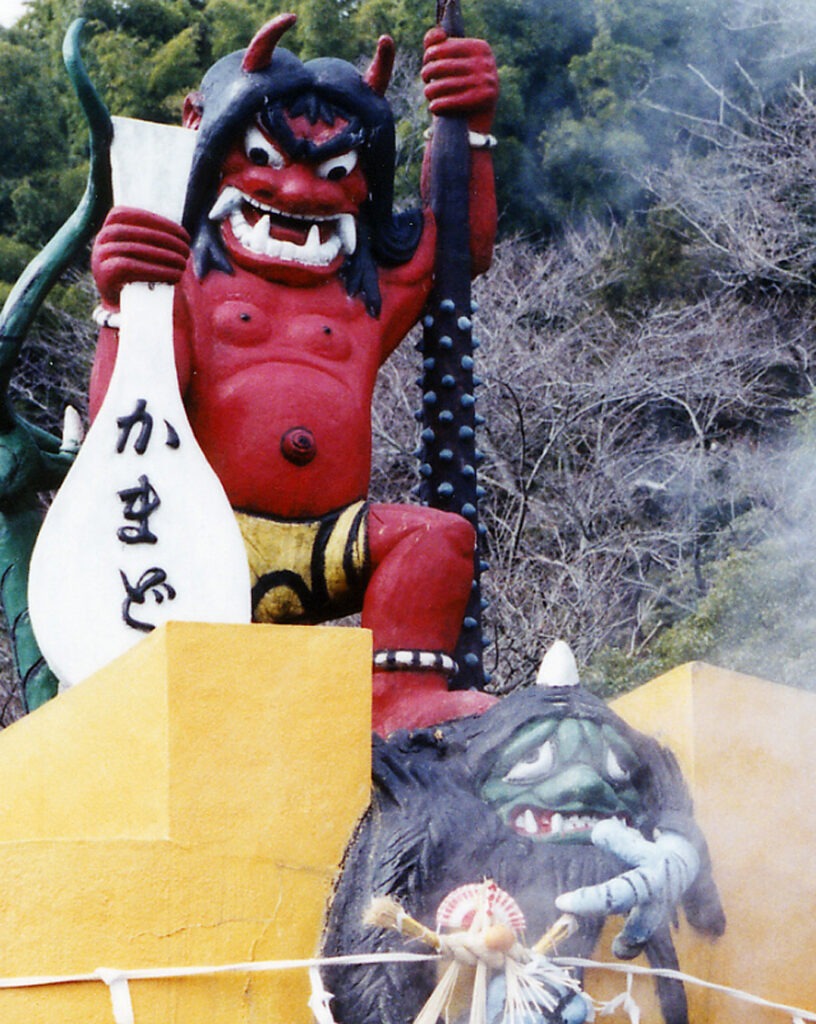
There are countless kinds of youkai, but there’s a Big Three of sorts. First are the kappa, slimy green creatures who love to drown the unsuspecting. Then there’s the tengu, winged demons who began as crow-monsters but are now red-faced humanoids with enormous noses. And finally are the oni, huge humanoid creatures with a single horn and fanged mouths, who love to eat humans. And this is their first appearance in animation.
“MOMOTARO, JAPAN’S NUMBER ONE”
The actual story is based on a foundational Japanese fairytale. An elderly couple find a mysteriously strong child, inside a huge peach (hi Clark!). This is Momotaro, who goes on to recruit a monkey, a dog and a pheasant as a pocket army. They beat up some oni who have been stealing stuff from local villagers and get them to stop. Like many fairy tales, it’s dark and violent in places. But it remains deeply satisfying thanks to a big dose of “evil thwarted, good rewarded”.
The biggest flaw in Yamamoto’s work up to this point was his insistence using a single, overly complicated model for each of his characters. Yamamoto must have caught on; this time around the problem has vanished. He also makes a point of having one of his characters remain partly visible while he passes behind a mesh. It’s pretty clear he’s been watching Ofuji.
My worries about this cartoon stemmed from what I know about Momotaro’s future. The Peach Boy will be put to some very dark uses over the course of the next 18 years. The version of the story being taught in Japanese schools at the time was already unpleasant. The oni were flat out called “evil beings”, and the relationship between Momotaro and his allies was one of violent dominion.
Thankfully, while these oni are still clearly intended to represent the enemies of Japan, Yamamoto manages to keep them non-specific. All Momotaro needs to do to get his animal friends on-side is feed them and break up a pointless fight. The characterisation was simple, but no worse than in other shorts being produced elsewhere. Despite my fears, “Momotaro, Japan’s No. 1” scores a handy 6/10.
KIMURA HAKUSAN, PROPAGANDA MACHINE
Just because Yamamoto didn’t want to make propaganda cartoons, that doesn’t mean other animators weren’t keen to. KIMURA Hakusan produced two cartoons in this period, and they’re both pretty scary in ways that have nothing to do with their content.
It’s not clear which order they were released in, so I’ll start with the one the Japanese Film Archive is happy to host. That’s “Manga Sakana no Kuni” / “The Nation Of Fish” (Ministry Of Education, 1928). The production credit isn’t a subtle one on-screen, either.
“The Nation Of Fish”
The tone of the cartoon is set from the first scene. We see a fish general with jackbooted legs where its belly fin should be march on-screen. He pulls out a sword and yells “Tuna, assemble!”. The fish soldiers do swimming drills until they’re scattered by an attack from some heavily toothed killer whales. A council of undersea creatures forms, guarded by a crab and a squid in military uniforms. The council declares the whales to be “non-fish” – I swear to you I am not making this up – and that the fish will “unite to defeat this powerful enemy”.
Naturally enough, they do. Then the victorious fish have a very military looking party. It’s funny how none of the rank and file fish attend it. Alas, they’re now hungover enough for a pair of human fishermen to catch them all. A rising sun ends the film with the text “Remain vigilant even after a victory!” and I’ve never wanted a cartoon to end faster.
The animation was excellent and superbly well observed, with various fish being drawn perfectly. Kimura’s skill and standards aren’t at question here. But this was unsubtle propaganda aimed squarely at children. Some moments that would otherwise be funny – that general from earlier, riding into battle on the back of a prawn – are simply depressing. The closing fight where the fish work together to rip the whales apart, dropping sea urchin mines on them, was just a bit sad. For all its beautiful underwater observations, “The Nation Of Fish” is a blunt instrument that only gets 1/10.
“For The Good Of The Country”
Kimura’s other work from 1928 was even more warlike than the first. But thankfully “Mikuni No Tame Ni” / “For The Good Of The Country” (studio unknown, 1928) isn’t anything like as bad.
The cartoon follows a hard-working Japanese farmer, who gets drafted into what we eventually learn from visual clues is the Russo-Japanese War (1904-05). Our nameless hero gets sent on a suicidal reconnaissance mission, where he casually rips up enemy cannons and trenchlines like he’s Superman. Then the Japanese attack and win; not without losses, but without very much trouble.
The biggest visual clue to the setting is the presence of Count NOGI Marusuke, leading the Japanese forces. Nogi was one of the key figures in the land campaigns of that war. To a degree, he’s still seen as an icon in Japan, for his nobility and self-sacrifice. He’s depicted very respectfully, with drawings at near-photographic quality.
This is gory in places, but it is a war cartoon. However, it’s a much easier watch than “The Nation Of Fish”. The story is much stronger and doesn’t shy away from the brutal nature of war. It also appears to have its original martial soundtrack intact. But the key difference is having the farmer at the centre of the plot. If it wasn’t for the purpose of the cartoon I’d have enjoyed this. “For The Good Of The Country” scores 4/10.
FIN
Only a few years before, big business had decided that there was no way to make animation profitable. But with the temporary exception of Ofuji Noburo, the Ministry of Education were bridging the financial gap. So their messages were getting across to Japan’s children, and more than a few adults. And now that we’ve left 1928, that will lead to animation that’s impossible to grade.
I would like to give special thanks to this blog’s pillars; AniDB, whose peerless database has helped me work out what to look for, the Japanese Film Archive, who have given me the material to actually watch, and the inseparable pairing of Jonathan Clements & Helen McCarthy and their “Anime Encyclopedia”.
The oni image comes from Fg2 (the uploader took the photo), Public domain, via Wikimedia Commons.
I’ve been Douglas Howell, and I’ve been watching 1920’s Japanese animation. Join me next time, as a new director enters the fray, and Japan takes another big step to the right. Peace; out.
Leave a Reply