
WHY THE MINISTRY?
I noted last week that the driving force of animation in Japan in the period I’m looking at wasn’t an individual studio, or even a specific director. It was the Japanese Ministry of Education. It bugged me for weeks. Then I got hold of a copy of “HIROHITO AND THE MAKING OF MODERN JAPAN” by Herbert P. Bix.
Emperor Hirohito’s grandfather was Mutsuhito, the Emperor Meiji. During his reign, Emperor Meiji oversaw enormous changes in Japan. He turned it from “an isolationist, feudal state to an industrialized world power”, as Bix puts it. But from the point of view of this blog, he did two things that were very important.
After the Emperor threw out the Japanese feudal system and replaced it with a democracy, he gave away almost all of his power to the new Japanese parliament, the Diet. The two key exceptions were the control of the military and the Ministry of Education. The Emperor considered universal education under Confucian principles key. This was to supply the country with an educated and patriotic workforce, sure. But it was also to ensure the people of Japan would remain correctly obedient to their Emperor’s will.
And the new Emperor, Hirohito, strengthened these controls even further. Which is why the Ministry of Education now saw animation as merely another tool to indoctrinate Japan’s youth.
MURATA YASUJI RIDES THE GOVERNMENT TRAIN
Yokohama Cinema Shokai’s edutainment film series, the “Athena Library Series”, was clearly a success by 1929. Director MURATA Yasuji mixed good Japanese moral messages with surreal ideas, borrowed from Western cartoons. They began the year with “Kaeru wa Kaeru” / “A Frog Is A Frog” (Yokohama Cinema Shokai, February 1929). Unfortunately , there’s only 150 seconds left of the original fifteen minute short.
A wealthy tourist teases an innocent monkey in a zoo, until the monkey steals his hat, tie and cigar. The poor thing poisons itself with the tobacco, until an older chimp nurses it back to health. He’s about to start telling Aesop’s fable of “The Frog And The Ox” when the footage ends. This is far too short to get a score, but it shows that the studio remained on form.
“Taro’s Train”
The studio continued its prolific run with “Tarou-san no Kisha” / “Taro’s Train” (Yokohama Cinema, 1929). This was a public information film aimed at telling kids what they shouldn’t be doing when they’re on the railways. It’s loosely based on a live-action film from the Department of Education from 1926.

An express train, stuffed full of animal passengers, speeds along the line. Taro is the kind of guard I like to see. He makes a literal pig put his suitcase on the overhead rack so an elderly goat can sit down, gets a couple of careless hippos to stop dropping banana peel on the floor, that sort of thing.
The stuff inside the train is well-drawn. When the camera moves to the front and we see the countryside whipping past on both sides, the illusion of speed is superb. But when we’re watching from the side, the backgrounds are a bit sparse. And then the creators decide to hit us over the head with a pun, pointing out that a horse and a cow over-indulging is literally the transliteration of the Japanese term for eating too much, “Gyuinbashoku“. I felt that the joke fell a bit flat.
Like many trains, “Taro’s Train” is short, and there to do a job rather than be particularly entertaining. But I’m still only going to give it 4/10. Perhaps it acted as an audition of sorts. The Department of Education had partially funded several of Murata’s previous animations, but that was about to change. Murata’s next film saw them take the production credit. And it really shows.
“Two Worlds”
That was “Manga Futatsu no Sekai” / “Two Worlds” (Ministry of Education, October 1929), a retelling of Aesop’s Fable “The Ant And The Grasshopper”. A family of kimono-clad ants work hard in very gender-appropriate ways on a summer’s day. Meanwhile, a drunken toad, a grasshopper in a high-collared shirt and a butterfly dressed as a flapper enjoy the summer.
The young ant complains to his father, that they’re the only ones working. His father replies, “Summer fun leads to a winter of misery”. He’s proved right in that winter. The ants are safe and warm at home when they get visited by the grasshopper, begging in rags. Apparently the butterfly isn’t likely to see another summer and the toad has had a stroke – good god – and the father quotes the proverb again.
This was a terrifying watch. The Two Worlds of the title belong to the hard-working, morally superior Japanese ants and the other lazy, Western bugs. I didn’t say “coded”, there’s no subtext here. The presentation of the two sets of characters is as different as night and day. An intertitle even calls the grasshopper and butterfly “bourgeois”. The ants do help the impoverished grasshopper out, but it’s very clear that they pity the other insects.
when the propaganda finally gets too much
Being fair, the animation is superb. Murata’s flowers are excellent, and his backgrounds that depict the change of seasons are truly beautiful. They said so at the time, as well. The actual execution of the story is of the highest standard too. The problem is that the original fable was merely saying “worker good, slacker bad”. I might be biased; I review animation online, it’s not like I’m in the worker class. But whatever your feelings are on that matter, extending it to teach your nation’s children “Japan good, West bad” is simply appalling.
I wish I could give this a seven. Artistically it deserves at least that. But there is no separating the authorial intent of a nationalistic government department from the art of the animation director who’s taken their money, now as much as then. By policy, going forward, I do not grade propaganda works; no score.
“The (Stolen) Lump”
Next was “Kobutori” / “The (Stolen) Lump” (Yokohama Cinema, 1929). This returns Murata to his work with the Athena series, and uses one of Japan’s most popular folktales. There’s a slight disagreement about the translation of the title of this one, hence the bracketed word.
This cartoon marks the first surviving appearance of one of Japan’s most iconic youkai: the tengu. Unlike the other big two youkai, the oni and the kappa, who were depicted in broadly similar ways across Japan, the tengu had a much greater variety of forms. Some, like the majority of the those shown in this cartoon, were humanoids with the wings and beaks of birds; others were far more human-looking, but had bright red faces and enormous noses instead.
Once upon a time, there were two old men, honest Tarobei and lazy Jirobei, and they both had growths on their cheeks. One night, Tarobei is looking for firewood and finds a thunderstorm. He hides in a hollow tree and falls asleep. When Tarobei awakes, he sees a clan of tengu having a party, and he happily joins their dance. That pleases their long-nosed lord. He gives Tarobei sake, and invites him back for the next night. But to ensure he comes back, the tengu steal Tarobei’s “treasure”, his cheek growth, from him.
When he goes back home, Tarobei tells Jirobei what happened. Jirobei asks if he can go the next night, and he does. But Jirobei botches his trademark stick dance, then steals the tengu’s actual treasure and flees. He doesn’t get far, though, and Master Tengu is so angry he throws Tarobei’s “treasure” at Jirobei. Now the greedy thief has growths on both cheeks.
Technical Excellence
Intriguingly, this one’s been tinted so it’s black and gold instead of black and white. I was a little frustrated by the Japanese Film Archive translating the word “tengu” as “goblins”, though. The animation is, once again, excellent. The rain is skillfully animated, and when the lightning briefly illuminates Tarobei’s face, it is superb. Murata mixes his usual cutouts with silhouette animation for the night-time scenes, and the transition between the two is simply beautiful. So is Jirobei’s silhouetted stick dance.
Time to sniff for problems: I wish the soundtrack was still there, although the story still zips along without it. Um; that’s it. Murata’s work here is wonderful, even if the reason why he has the time and money to reach these heights is an appalling one. But Murata and his rancid employers are both long gone, so I can give this wonderful cartoon the mark it deserves. “The Stolen Lump” gets 9/10.
fin
Murata and Yokohama Cinema were so prolific in this period, I’ve decided to split their work across two blog posts. So on Wednesday, I’ll look at their work from 1930. Among other things.
My thanks go to Project Gutenberg, Tokyo Weekender, and the Kobe Planet Film Archive. And of course, as always, I must thank two of this blog’s pillars. AniDB, whose peerless database has helped me work out what to look for, the Japanese Film Archive, who have given me the material to actually watch.
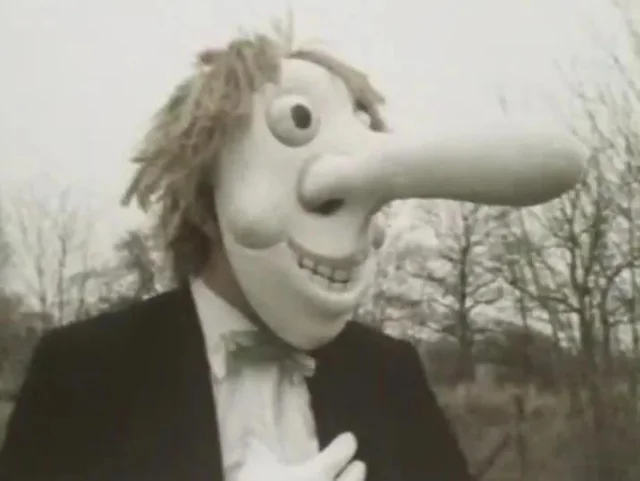
Image of Mr Noseybonk, as played by Adrian Hedley on BBC TV’s “JIGSAW”, under fair use principles.