
MASAOKA GOES BIG
In December of 1933, off the back of the success of the first talkie animation – probably – “The World Of Power And Women”, MASAOKA Kenzō changed his company’s name to the frankly pretentious Masaoka Eiga Bijutsu Kenkyusho, which isn’t any easier to swallow in English as “Masaoka Film And Art Institute”. He went ahead and built a new, two-storey studio with audio recording facilities. He changed over to cel animation as well, and that meant he would have be very successful to pay for it all.
The studio made five cartoons in 1934. At least I think they did. Masaoka made a a film called “Revenge”. But that was too long for his distributor, Shochiku. So it was split into two cartoons; “Vengeance Crow” and “The Gang and The Dancing Girl”. Masaoka also made a version of Chinese literary classic, “Journey To The West”, and a film called “The Three Crows”. In Japanese, “Three Crows” is used to describe trios of talented individuals, in exactly the same way that English uses “The Three Musketeers”. Alas; none of these cartoons made it to the present day.
Lost Cartoon: “Baseball Team In The Forest”
There is one Masaoka Film And Art Institute cartoon from this year that does still exist, although it’s not online. The copyright is owned by the National Museum of Taiwan for reasons I don’t understand. It was the only time that Masaoka’s assistant, HARADA Seichii, would direct a film. It was “Mori no Yakyuudan” / “Baseball Team In The Forest” (Masaoka Eiga Bijutsu Kenkyusho, 16 November 1934), and it came out at exactly the right time.
Because in the winter of 1934, an all-star team of American baseball players were on a 12-game exhibition tour of Japan, featuring noted players Babe Ruth and Lou Gehrig, and noted spy Moe Berg1. The tour was a massive success, and the Japanese team they played against ended up as the Yomiyuri Giants, Japan’s first pro baseball team, who are still going today.
Was it enough to keep his studio going? Well, we’ll see next year.
OFUJI: HIDING IN PLAIN SIGHT
OFUJI Noburo made one cartoon in 1934, under the pseudonym of KOYAMANO Furo. Given that it came out under his studio name, and it uses his trademark chiyogami paper for the backgrounds, I have no idea why he did that. Regardless, the cartoon was called “Tengu Taiji” / “Hyoei And Heibei’s Tengu Hunt” (Chiyogami Eigasha, 1934). Was it any good?
“Hyoei And Heibei’s Tengu Hunt”
We see a peaceful town, with shamisen players and an old man popping out for a smoke. But an arrow slams into the wall; the tengu crow-demons are attacking. They kidnap a woman, kill a guard, and run; thankfully, a pair of heroes are there to get revenge. Hyoei and Heibei are, in order, a samurai with Betty Boop’s head and his dogboy sidekick. But I only know that because this isn’t Heibei The Pooch’s first or last appearance in this blog.
The samurai fights his way through the tengu, and his sidekick plays comic relief. Eventually he gets to the girl, who’s being protected by a more anthropomorphic, long-nosed tengu warrior. The pair combine to defeat the monster; all the humans laugh as the tengu cries, and the cartoon ends.
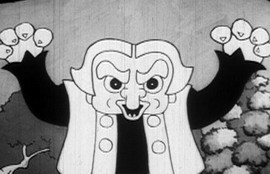
It’s another cartoon inspired by Max FLEISCHER, in the same way that “Cuphead” will eventually be; pie-eyes and inkblots all the way. When Japanese animators copy American styles like this, there’s usually the sense that they don’t fully understand why it works. But it’s hardly a shock that Ofuji gets it. So “Hyoei And Heibei’s Tengu Hunt” gets 6/10.
SEO MITSUYO
It was very difficult to be left-wing in 1930s Japan. Doubly so if you wanted to make animation which supported your views. I’ve already mentioned two members of the Japan Proletarian Film Union, Prokino, in my articles – KIMURA Hakusan, who torpedoed his own career with the first Japanese animated porn film, and TANAKA Yoshitsugu earlier in this year’s reviews.
SEO Mitsuyo also worked with Prokino. He produced a film with them, that’s now lost, called “Sankichi’s Air Travel” (Prokino, 1931). I don’t know if that film was why, but he was arrested by the Japanese Secret Police, tortured, and imprisoned for three weeks.
It didn’t stop his creativity. As I mentioned in my 1933 review, he went to work for MASAOKA Kenzō at his Film and Art Institute in that year and helped make the lost, possibly first, Japanese talkie animation. But he wanted his own studio, too. He set up Seo Vocal Manga in the latter months of 1933, and the studio’s first work came out in 1934. Nihon Manga Film Kenkyusho released them both, and they both have a character called Sankichi the Monkey in them. But the two characters, and films, couldn’t be more different.
“Sankichi The Monkey: Shock Troops”
The first was “Osaru no Sankichi: Totsugeki Tai” / “Sankichi The Monkey: Shock Troops” (Nihon Manga Film, 1934) and it depicts a war between heroic monkeys and enemy bears. The bears dance like cossacks, if the Russian thing wasn’t obvious enough already. Sankichi is woken up when a bearish bullet shoots his tent away, and he jumps on a tank. There’s a bit where he rotates a manual traffic sign that the enemy shells obey that’s quite clever, and then Sankichi flattens a bear and his cannon and mugs for the camera.
The rest of the cartoon is dull, war-normalising rubbish that’s annoyingly well-drawn, with the Three Brave Bombers trotted out before a Japanese flag is hoisted over the bears’ fortifications. The art is fantastic, and Seo is clearly in the camp who understood the “why” of American animation as well as the “what”. But his message is a simple and horrible one; by policy, no score.
The title of his second film, “Genroku Koi Moyou: Sankichi to Osayo” / “Sankichi And Osayo: A Genroku Romance” (Nihon Manga Film, 1934), needs a small explanatory note. I’ll be discussing Japanese era names more completely in a little while. For now, I can draw a comparison. A Western film-maker can say “Victorian” and be sure their viewer knows to expect gaslit streets and horse-drawn taxicabs. When the Japanese viewer reads “Genroku”, they know to expect the late 17th century, a time of great wealth and fantastic artistic creation. Was this more propaganda? And was it any good?
“Sankichi And Osayo: A Genroku Romance”
Sankichi – “Monkey” is his nickname this time around – is just about recognisable in his human samurai form. He has the sumo-wrestler’s haircut, and he’s wearing a kimono and slippers. He sings to us – although the soundtrack is either lost or under copyright – as chrysanthemum flowers and birds sing along with him. We see him remembering plighting his troth to Osayo, in her equally traditional period garb. But she thinks he’s a coward.
A cry of warning goes up, and Sankichi runs to help. But a bucktoothed samurai sees the cry as an opportunity, and calls his ninjas to him. Osayo is dancing for a lord, and he’s enjoying the performance; then the other samurai turns up, wrecks the party and kidnaps Osayo. Sankichi finds an taxicab and gives chase. The fight which follows doesn’t start until he pulls out a record player, either. Sankichi wins with help from his bird friends, and Osayo cuddles up to him as the cherry blossoms fall.
an attempt to establish characters?
Seo isn’t ripping Popeye off, but the incredibly skinny and sinuous Osayo is definitely inspired by Olive Oyl. This is a cartoon that enjoys its anachronisms, even though the way Sankichi hacks through his foes looks almost identical to the way Hyoei did it in Ofuji’s “Tengu Hunt”. Maybe it’s just parallel evolution. It’s also where the first references to the famous ending scenes of “King Kong” (RKO Radio Pictures, 1933) show up, and it was reasonably funny.
So was the whole cartoon. Sankichi-as-human and Osayo feel like an attempt to establish a pair of central characters – like Bimbo and his far more famous girlfriend Betty Boop – that could roll through future animations and settings. It didn’t happen, history and propaganda laws got in the way, but it could have worked. If we had the sound I might have scored this even higher, but the version of “Sankichi and Osayo: A Genroku Romance” that we have is still worth 7/10.
THE UNKNOWN: DEKOBO BEHIND THE WHEEL
The last cartoon I watched for this year’s blogs is “Dekobo’s Automobile Journey” (unknown studio, unknown date). We don’t know who the director or studio were, and the source I’ve looked at aren’t even sure of the date. So I’ve made a choice; I think the animation is far too smooth and Westernised to come from 1930, the other option, which is why I’ve put it here. So, was it any good?
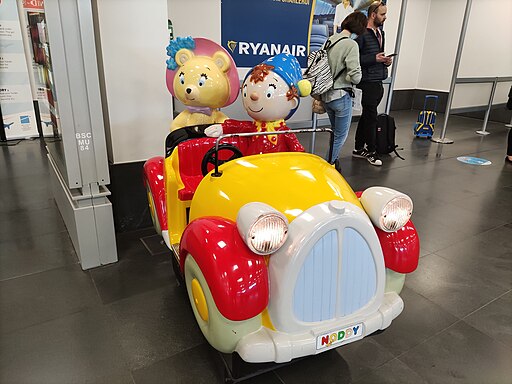
Dekobo is a sad bald man, who drives a car that reminds me of Noddy’s. He takes his dog out for a drive, but the car blows a tyre and sends the poor pupper flying. A passing crow laughs at him, and the dog barks at it. Dekobo leaps into the tree and beats the crow up a bit, and gets it to agree to fly him, the dog and the car somewhere else. But it flies them into a storm and drops them into the sea. We see Dekobo and the dog on the sea floor, and the cartoon ends abruptly.
The animation was fine, I suppose. The sound mix was odd, like they couldn’t decide between using a benshi and a soundtrack and went for both. The dog’s barks are clearly real, too. I’m not going to score it, but I came very close; there’s nearly enough here to warrant an opinion.
fin
That wraps up my look at 1934. I would like to give my usual thanks to this blog’s pillars; AniDB, who have helped me work out what to look for, the Japanese Film Archive, who have given me the material to actually watch, the pairing of Jonathan Clements & Helen McCarthy and their “Anime Encyclopedia”, and Clements’ solo work, “Anime: A History”.
In addition, for this review set, I’d also like to thank Toronto J-Film Powwow. Noddy Ride-In Car image from Toine le voxophile, CC BY-SA 4.0 https://creativecommons.org/licenses/by-sa/4.0, via Wikimedia Commons.
I’ve been Douglas Howell, and I’ve been watching Japanese animation. Join me next time, as one studio starts to fade and another replaces it.