
YAMAMOTO RETURNS
Even when the Ministry of Education had been sending work to YAMAMOTO Sanae, he was never the most prolific animation creator. His last appearance on this blog was back in 1932. At some point between then and 1934, Yamamoto started working for Japan Telegram News Agency. At the time, that company handled both news broadcasts and advertising. Yamamoto’s only surviving animation from this year is “Oira no Hijouji” / “My Big Emergency” (Denpo Tsushinsha Katsudoshashin, 1936).
“My Big Emergency”
All is well in peaceful Frog Land. But on their offshore base, the Devil Land air force are setting out. Funny thing: their pilots are all Bimbo from the Max FLEISCHER cartoons. The planes fly over a blue-plate Japanese sea, to bomb the hell out of the innocent frogs. While the civilians turn off all their lights and run for shelter, the frog army deploys and fights the evil “Americans” off. And it turns out it was all a “happy war dream” that one of the frogs was having.
I contemplated having a strong drink after this cartoon. There’s a lot to hate about it. It’s an eerie prediction of Japan’s future, even though these “Americans” are attacking without provocation. The animation is, of course, brilliantly done. But this is pretty clearly an instruction manual, to teach kids what to do when the bombs start falling. By policy, no score, but the propaganda dial is clearly being turned up.
While Yamamoto kept working, his next surviving cartoon didn’t come out until 1941. And the world was a very different place by then.
OISHI ENDS: ASHIDA BEGINS
OISHI Ikou only made a handful of animated films for public consumption. He was still employed by Photo Chemical Laboratories in 1936, but they were only using him to make line drawings and illustrations. After the company’s merger into Toho Film in 1937, Oishi was drafted to fight against the Chinese. And when he returned, he would be contributing to Japan’s war effort in a very different way.
But his impact on the animation industry was already being felt. His apprentices and students will be showing up in these blogs, long into the post-war period. The first of those is SUZUKI Hiroki, who animated under the name ASHIDA Iwao. In 1936, he was working for Seo Mitsuyo’s studio instead. His first directing credit was “Furudera no Obake-soudou” / “Taro’s Monster Hunt” (Nihon Manga Film, 1936). Was it any good?
“Taro’s Monster Hunt”
We see our hero Taro, an eerily blank-eyed samurai, get pulled into a monster den for no apparent reason. He gets attacked by various different youkai, and eventually something werewolf-shaped fights him. Taro outwits and captures him, and the cartoon ends.
I was initially very unfair to this cartoon, because I watched it in something of a bubble. Yes, this is an obvious copy of some of the weirder, spookier Silly Symphonies. Taro himself is as thinly characterised as the cels he was drawn on. But the cartoon remains a gently surreal and oddly relaxing experience. The jokes aren’t particularly funny to me, but I can see how they would have landed at the time. “Taro’s Monster Hunt” can only really get 5/10, but it’s an encouraging start.
Ashida made another cartoon featuring Taro in the same year, although it’s not clear which came first. It was “Hinomaru Tarou: Musha Shugyou no Maki” / “Taro’s Warrior Training” (Nihon Manga Film Kenkyusho, 1936)
“Taro’s Warrior Training”
This time around, Taro announces himself as a “protector of the helpless and disadvantaged”. While standing in front of a fan with the Rising Sun on it. Right. We see an entire village fleeing from Daihachi, who smelt a little Bluto-y to me. Daihachi kidnaps a girl and throws her grandmother away. Bad move; she fills Taro in and begs for help. Taro chases, only to discover that his enemy knows Summon Ninja.
The chase continues, with Daihachi on a fine horse and Taro on a bullet-proof cow. At least, it does until our villain runs out of bullets, road and henchmen. Unfortunately Taro’s sword is no match for Daihachi’s belly, but the cannon Taro keeps in his trousers is more than enough to win the day. Write your own jokes, please. The princess goes back home on the cow and everyone’s happy apart from the bad guy.
If you allow for a little cutting-enemies-bloodlessly-in-half, this is a perfectly decent kids’ cartoon for a Saturday at the movies. Taro remains a blank, and it’s actually a slight step down from the other cartoon he features in. “Taro’s Warrior Training” is only worth 4/10.
The frankly essential Anime Encyclopedia by CLEMENTS and MCCARTHY tells me that Ashida ran his own studio alongside his wife, and made “The Animal Counter-Espionage War” in 19361. But it’s not available online. There would be plenty more to come from Ashida, though.
MABO RUNS FOR SATO AND CHIBA
The last animation I could find from Japan for this year was a cut-down version of a cartoon called “Maabou no Tokyo Olympic Taikai” / “Mabo’s Tokyo Olympics”. It’s by SATO Kinjiro and CHIBA Yoji. This was the year when Sato founded Sato Seneiga Kenkyujo, the Sato Film Production works. Sato and Chiba were responsible for a string of fifteen works of increasing degrees of propaganda. And all of them starred their boy hero, Mabo.
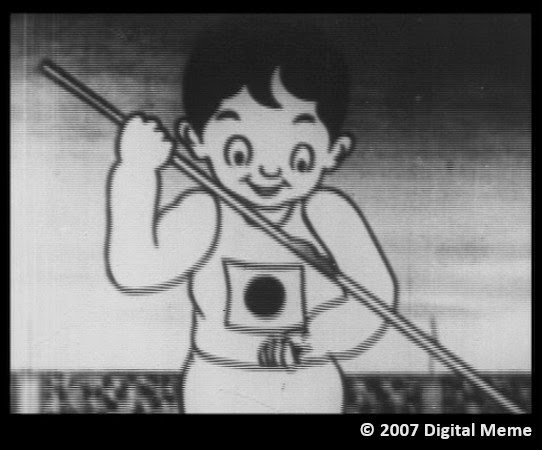
The Olympics referred to in the title were the 12th Summer Olympiad, due to be held in 1940. I think you can probably see a tiny flaw in that sentence. “Mabo’s Tokyo Olympics” is mostly lost, but what survives has been retitled “Maabou no Daikyousou” / “Mabo’s Big Race” (Sato Seneiga, 1936). It’s under two minutes long, and it’s a stadium race.
“Mabo’s Big Race”
Mabo is tiny and clearly out of his depth. While Mickey and Minnie Mouse and Betty Boop cheer the runners on, all of the adult runners crash into each other. Mabo gets inflated into a balloon by a helpful Japanese coach, and he spins and flies his way to victory. There’s a tiny bit of inoffensive pole vaulting, and the cartoon ends.
Everyone in this runs like they’ve crapped themselves, presumably to make them easier to animate. But it’s fine for what it is; 104 seconds of sports animation that barely manages to count as patriotism instead of propaganda. Thankfully, it’s too short to earn a score anyway. Somehow I suspect Mabo isn’t going to be propaganda-free enough to pick many points up here.
fin
And that’s it for 1936. I would like to give my usual thanks to this blog’s four pillars: AniDB, who have helped me work out what to look for, the Japanese Film Archive, who have given me the material to actually watch, and the inseparable pairing of Jonathan Clements & Helen McCarthy and their “Anime Encyclopedia”. Not for the last time, I’d like to thank Crunchyroll for existing, the Nishikata Film Review, and Jess Nevins for their Encyclopedia of Pulp Heroes website.
I’ve been Douglas Howell, and I’ve been watching Japanese animation. Join me next time, please, as I have to explain some terrible history, and some excellent cartoons.
- “The Anime Encyclopedia, Third Revised Edition”, Clements & McCarthy, p. 165, 2015 ↩︎