THE PEAK OF JAPAN’S WAR
I am at best an amateur historian. People with far greater knowledge and skills than I, have covered the details of Japan’s war in the Pacific. But I think Japan’s declaration of war on the United States was based on two assumptions. Firstly, that Germany would successfully knock Britain out of the war before they were ready to counter-attack. Secondly, once that happened, America wouldn’t care enough about south-east Asia to carry on fighting Japan. As Japan would soon discover, they were catastrophically wrong on both counts.
The Doolittle Raid
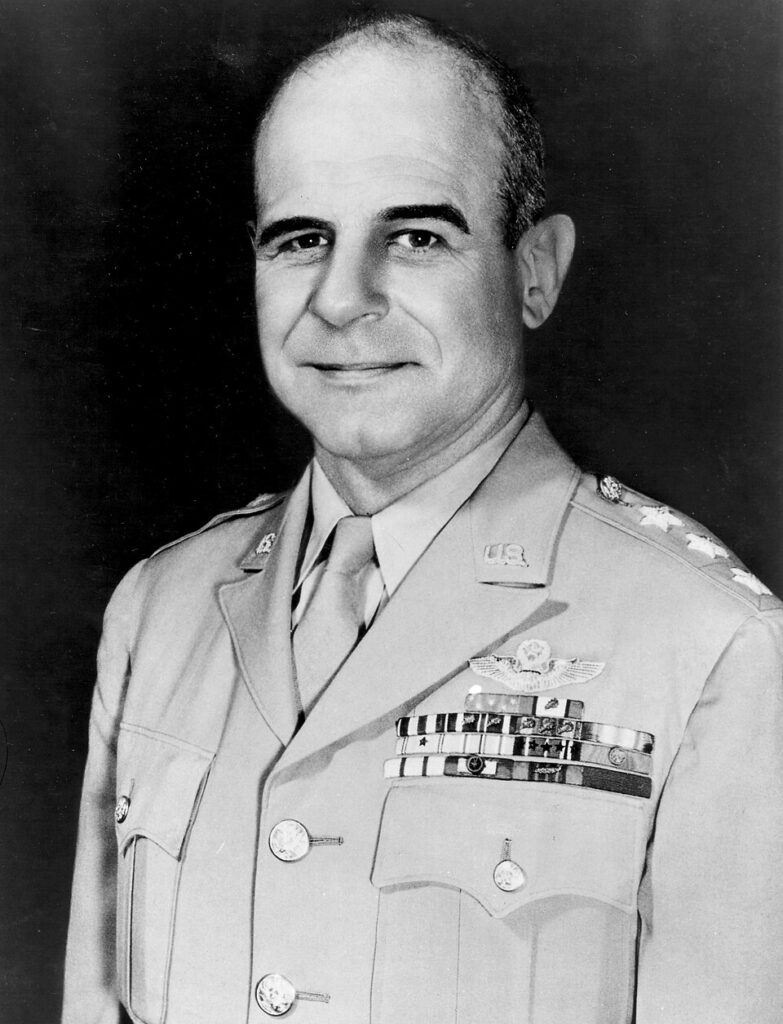
The first six months of Japan’s war in the Pacific went, generally speaking, very well for Japan. But in April of this year, the American Air Force proved that the Japanese mainland wasn’t completely out of reach. Sixteen B25-B medium bombers, led by Lt. Colonel James Doolittle, were able to launch from an aircraft carrier in the Pacific. The Doolittle Raid on Tokyo killed 87 Japanese people, and hit thirteen targets. But the destruction and death was never the raid’s primary goal. The damage to Japanese morale on the Home Islands was significant. So was the joy felt in America, when people learned their Brave Boys had struck a blow against their enemies.
None of the Doolittle aircraft made it to their designated “landing” points in mainland China. All but one crashed in what are now the Chinese provinces of Zhejiang and Jiangxi. Which, in 1942, placed them on the front line between Chinese and Japanese forces. Chinese civilians were able to help the majority of the Americans to get home. Only seven of the eighty airmen died, although all sixteen bombers were destroyed. But it came at a terrible cost to them.
The Aftermath
The Japanese army carried out a huge offensive in those two regions, with two purposes. They wanted to capture as many Americans as possible, and to punish the Chinese for daring to help the enemy. They caught eight of the airmen, executed three, and allowed another to die in a POW camp. The Japanese were far more successful when it came to killing civilians. According to some reports, the Japanese armed forces executed a quarter of a million Chinese people during the three month campaign. Thanks to the presence of the infamous biological warfare Unit 731, they also ended up killing thousands of their own men. So it goes.
America was able to inflict two naval defeats in May and June of this year, at the Phillipines and at Midway Island. And by August, the US Navy was able to support a successful counter-attack on Tulagi and Guadalcanal in the Solomon Islands. The two sides would fight for Guadalcanal for the rest of the year, but in a meeting on December 31st, Hirohito’s chiefs of staff told their Emperor that that battle was lost. And of course, there was far worse to come.
THE THREE STUDIO ERA: THE LOST
Thanks to a new edict from the Japanese government, by the start of 1942, the entire Japanese film industry was reduced to three production companies. They were Daiei, Toho and Shochiku. That didn’t completely wreck the Japanese animation industry, but it certainly didn’t help.
This was the second time in Japanese animation’s short history that only three studios were making cartoons. The first was in the initial boom period of Japanese animation, in 1917 and 1918. Exactly four pieces of animation from that period survive to the present day. A combination of fragile filmstock, time, and natural disaster destroyed the rest. I already suspected that the last years of the war wouldn’t be kind to cartoons. 1942 proved me right: only three cartoons from this year survived.
Directors SATO Ginjiro and CHIBA Yoji made more than that on their own in 1942. They all starred boy hero and propaganda icon Mabo. So my best guess is that the American Occupation forces consigned all five to the flames in late 1945. But it’s just a guess.
Nevertheless, despite a clutch of AniDB users claiming to have seen them, I don’t think a single frame of “Circles Of Fire”, “Bandit Slaying”, “Mabo Fights Hard In The South Seas”, “Mabo’s Test Flight” or “Mabo’s Iron-Blooded Marines” still exist. That last one’s intriguing, too.
I think someone made a version of “Princess Kaguya”, too. Various animators will revisit the story in the decades to come, most notably by Studio Ghibli’s film in 2013. But the details of the 1941 version are so badly crossed up, it’s possible we don’t even have the correct run-time for it. I would love for cans of film to appear somewhere, magically, and prove me wrong about any or all of these films. But somehow I doubt it.
THE THREE STUDIO ERA: THE LOCKED
To make matters worse, at least for someone who wants to Watch Every Anime, a couple of the surviving animations from 1942 aren’t available online. YAMAMOTO Sanae made at least two films in this year. One of them, “Mountain Mobilisation”, is totally lost.
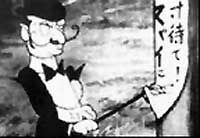
But the second is still out there. In July of 1942, Yamamoto released a propaganda piece called “Supai Gekimetsu” / “Defeat of the Spies” (Sanko Film Eigasha, July 1942). I know for a fact it still exists, because I’ve seen it reviewed. Review website Midnight Eye claims to have seen it and that’s good enough for me. They claimed that it showed Western Devils in top hats and tails, “furtively sneaking around disrupting the bucolic idyll where the Japanese farmer diligently toiled”.
Shochiku Returns, Technically
The other film that probably still exists, which I’ll likely never see, came from another established director, and a studio making its return to the animation business. Shochiku was founded in 1895, but they didn’t make their first cartoon until 1933. That was MASAOKA Kenzo’s “The World Of Power And Women”. That was Japan’s first animated talking picture, probably, and the first of three animated films the company made in that period. But for no reason I could understand, they stopped again.
But then, in 1941, the Japanese government told their film industry that there was “no film left”. They struck the agreement I’ve just mentioned, shrinking the Japanese film industry into three companies. And that seems to have changed things a little.
While Japanese Wikipedia claims that the studio’s head, OTANI Hiroshi, wanted a piece of the “manga movie boom“, I’m not entirely sure one existed at the time. Regardless, he re-hired Masaoka as the studio’s animation production manager in 1941.
And in 1942, they released “Fuku-chan no kishū” / “Fuku-chan’s Surprise Attack” (Shochiku Film, March 1942). The story was written by YOKOYAMA Ryūichi, who’ll become a key figure in the story of anime after the war. Regardless, this isn’t available online at the time of writing. And there’s no way to be sure what it was about.
fin
I would like to give my usual thanks to this blog’s pillars; AniDB, who have helped me work out what to look for, and the pairing of Jonathan Clements & Helen McCarthy and their “Anime Encyclopedia”. In addition, I’ve been using Clements’ solo work, “Anime: A History”. In addition, I must thank Midnight Eye.
I’m Douglas Howell, and I’ve not been watching Japanese animation. Which isn’t really a good thing. So next week I’ll get back to my normal routine, with the cartoons from 1942 I’ve been able to get my eyes on.
Image of Lt. General Doolittle: See page for author, Public domain, via Wikimedia Commons. Image of “Supai Gekimetsu” from SensCritique.
Leave a Reply