
THE TIDE TURNS
By the first week of February 1943, Japan had left Guadalcanal for good. Throughout this year, Japan’s armed forces suffered loss after loss, and by September had established a new naval perimeter. 140,000 of their troops, unlucky enough to be outside it, would now be left to fend for themselves. Japanese divisions from occupied land in China, Manchukuo and Korea were sent on fools’ errands to far-flung islands, in doomed hopes of fending off the better equipped and informed Allied troops.
Japan lost the Solomon Islands completely in December. Things would continue to get worse for the Axis powers. In July, Benito MUSSOLINI, fascist dictator of Italy, was deposed and arrested. While he would re-establish a fascist Italian Social Republic in Northern Italy in September, the reduction to two Axis powers must have been a concern for Hirohito.
In November, President ROOSEVELT, Prime Minister CHURCHILL and Chairman CHIANG of Nationalist China met in Cairo to discuss the direction of the war in East Asia. Chiang was still officially in charge, despite the increasing importance in China of MAO Zedong and his Communists. Plans to retake Burma, today called Myanmar, were drawn up here, and would be successfully acted on in 1944.
TRIGGER WARNING
This week’s article isn’t an easy read. If the idea of children’s voices being used for propaganda purposes turns your stomach, please feel free to leave this one out and come back next week.
SEO‘S SEA EAGLES
Forgive me, dear reader, but I’m forced to repeat myself. After government intervention in 1942, the Japanese film production industry was reduced to three companies – Daiei, Toho and Shochiku. As I suspected when I first found that out, this is a period where a great deal of animation has been permanently lost.
The forces of time, war and censorship have whittled the list of Japanese cartoons I can watch down to three. And the censorship came from both sides. This year’s first cartoon came from an established pair of creators.
Playing Catch-up
In 1942, a team of animators completed the first Asian feature-length cartoon. But it wasn’t Japanese. Despite the utter chaos that prevailed in Shanghai at the time, it was the Wan Brothers who got the 73-minute “Princess Iron Fan” into the cinemas. At least one copy even made it to Japan, despite the censorship laws and other factors.
I don’t know for certain if that’s why established Japanese directors decided to try for longer, more complex stories. But two of the three films I can watch for this year have running times in excess of 25 minutes, and they’re both works of propaganda. Which is a little bit sad. Because the first of the trio I’m looking at is by SEO Mitsuyo. His last work was one of the best things I’ve watched for this blog; 1941’s multiplane masterwork, “Ari-chan The Ant”.
I wasn’t expecting the same kind of joy that Ari-chan gave me from “Momotarou no Umiwashi” / “Momotaro’s Sea Eagles” (Geijutsu Eigasha, 25 March 1943). Seo was working alongside MOCHINAGA Tadahito again. Mochinaga’s multiplane camera was a work of technical genius, allowing unparallelled1 depth-of-field and parallax tricks to be played on the audience.
“Momotaro’s Sea Eagles”
But this film started with two strikes. The titular character here is Japanese mythic hero, Peach Boy Momotaro. Various Imperial governments co-opted him for propaganda purposes quite early. All his animated appearances since 1931’s “Momotaro In The Sky” were pushing messages, instead of portraying anything as helpful as “story” or “art”. So that’s strike one.
Strike two is an early caption: “made with the assistance of the Japanese Naval Ministry”. I didn’t get any help from English Wikipedia, but Japanese Wikipedia confirmed that the film was made with support from the Kasumigaura Naval Air Corps.
Did this film surprise me to the point where I could give it a score? Was this, taken all in all, any good? No. But I watched it anyway.
Starts Disturbing
Jingoistic music plays, as the sea rolls and tosses beautifully and mightily behind the titles. We see a mighty warship. Her crew are silhouetted of long-eared rabbits, preparing a very detailed torpedo bomber for a mission. One of them even sends semaphore with its ears, which in any other context, would be cute.
Momotaro’s traditional army are here; monkeys, pheasants and dogs, many of them wearing hachimaki headbands. Momotaro is the commander, fully dressed for battle, and speaking like a child. We see that they’re flying to Onigashima, the traditional Demon Island of the Momotaro stories. But that’s not where they’re really going.
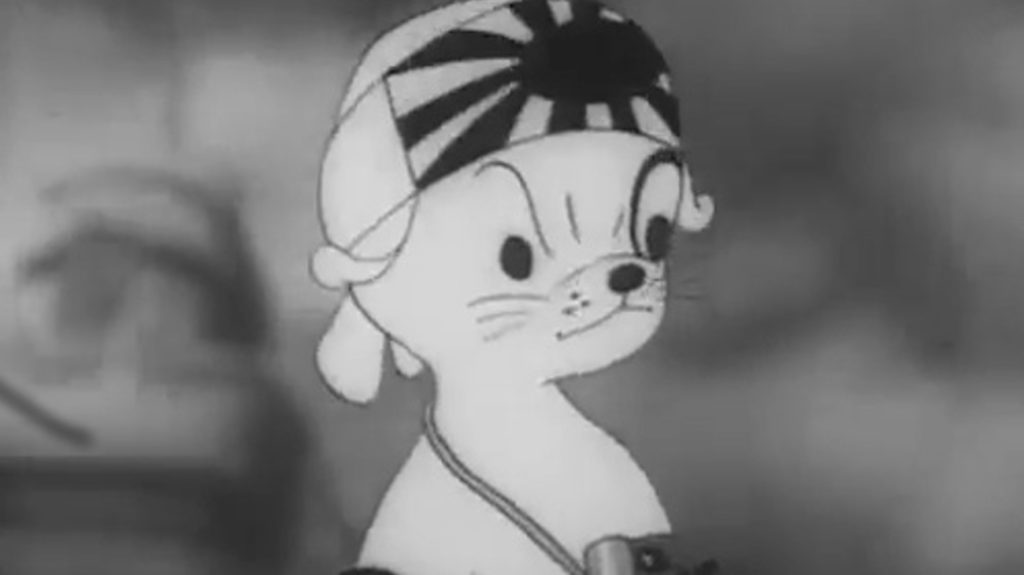
From “Momotaro’s Sea Eagles”, 1943.
The aircraft are as detailed as you would expect, given the help of the Japanese Naval Air Corps. I think that the military elements of the cartoon were recorded directly from the original materiel. But somehow I doubt that the real bomber crews were playing with blocks on their way over the Pacific. The animals here do.
There are some brief vignettes as the aircraft fly over the Pacific, most importantly a bit where one of the monkey pilots saves a passing bird and returns it to its mother. Then the attack begins. The brief use of “Aloha Ie” on a ukelele, played over images of a peaceful island and dockyard made my stomach turn. They weren’t trying to be subtle, this is clearly the strike on Pearl Harbor.
Gets Worse
And then the attack lands. The Americans, led by a beer-swilling Bluto – no, really – scatter in panic. There are supposed to be images of the actual attack on Pearl Harbor used here, but my transferred version wasn’t clear enough for me to confirm that. There is a bit of torpedo-riding, as one of the monkeys redirects a missed attack, that inevitably led to memories of “Dr Strangelove”.
Then there’s a thankfully ahistorical paratrooper drop. But I’m not sure the term applies; there there are no parachutes used, and the attacking chimps simply fall out of a plane. Regardless, once they land, the monkeys pull out matches to burn the American air force to a crisp. As the Japanese forces flee, Bluto grabs a Americanesque flag and shakes the star and stripes off it to leave plain white for surrender. But it’s too late; we watch as one final bombing run sinks his ship from under him.
The rabbits welcome the heroic bombers home, and there’s a victory feast where Everyone Laughs. Bluto’s men manage to shoot one aircraft down, but would you believe it’s the one whose crew helped the bird earlier? So naturally it returns the favour and flies the three-animal crew home. Stirring music plays as the aircraft carrier steams into the distance, and the film ends.
Being As Nice As I Can
Credit where it’s due; the animation here is fantastic, especially considering the constraints that Seo and Mochinaga were working under. The Navy expected them to have the film finished impossibly quickly, and the Doolittle Raid I talked about in one of my 1942 articles literally flew over their Tokyo animation facility.
Thanks to wartime austerity and a lack of animators, Seo and Mochinaga were almost making this film on their own2. They were still clearly still pushing the boundaries of what their new camera could do. Unfortunately, this time it was all strictly about pushing their message. “Sea Eagles” is a high-water mark in terms of animation, but it’s also a new low in terms of propaganda.
And that’s primarily because of the soundtrack. I don’t usually watch if a cartoon has no subtitles. This time around, though, I felt obliged to break that rule. Every Japanese character that we hear speak sounds like a child. Except for Momotaro, where I’m guessing the voice actor was an adult woman, I strongly suspect that actual children were doing the acting.
Hearing children’s voices, gleefully singing about how clever they’re being as they prepare combat aircraft, was frankly disturbing. What made it worse for me was the essential historicity of the cartoon. It’s even worse given that Japan actually carried out this attack, even if it wasn’t cute animals doing the killing. The depiction of child-like, amusing and cute characters, being used to glorify a war crime, stuck in my throat in a way that nothing I’ve seen so far for this blog has managed to.
“Momotaro’s Sea Eagles” is beautiful, superbly animated, terrifying and hideous all at once. By policy, no score.
Aftermath
It was a roaring success at the time, at least as far as the government was concerned. According to the frankly essential “Anime Encyclopedia” by CLEMENTS & MCCARTHY3, “attendances were block-booked for compulsory school outings”. Their entry for this film imply that was the case across the entire Japanese Empire of the day.
Mochinaga was, according to his own memoirs published in 2006, deeply unhappy about this4.
“I heard that many youths volunteered for the flying corps and that while they were on duty they died on air raids. I wonder whether the film we made influenced their decision to volunteer.”
Both men would produce one more cartoon before the end of the war; Mochinaga in 1944, and Seo in 1945. The latter, in particular, was a landmark in Japanese cartoon history. But I’m not looking forward to it.
fin
That’s all I have for this week. As usual my thanks go out to AniDB, who have helped me work out what to look for, to Jonathan Clements & Helen McCarthy and their “Anime Encyclopedia”, and Clements’ own “Anime: A History”.
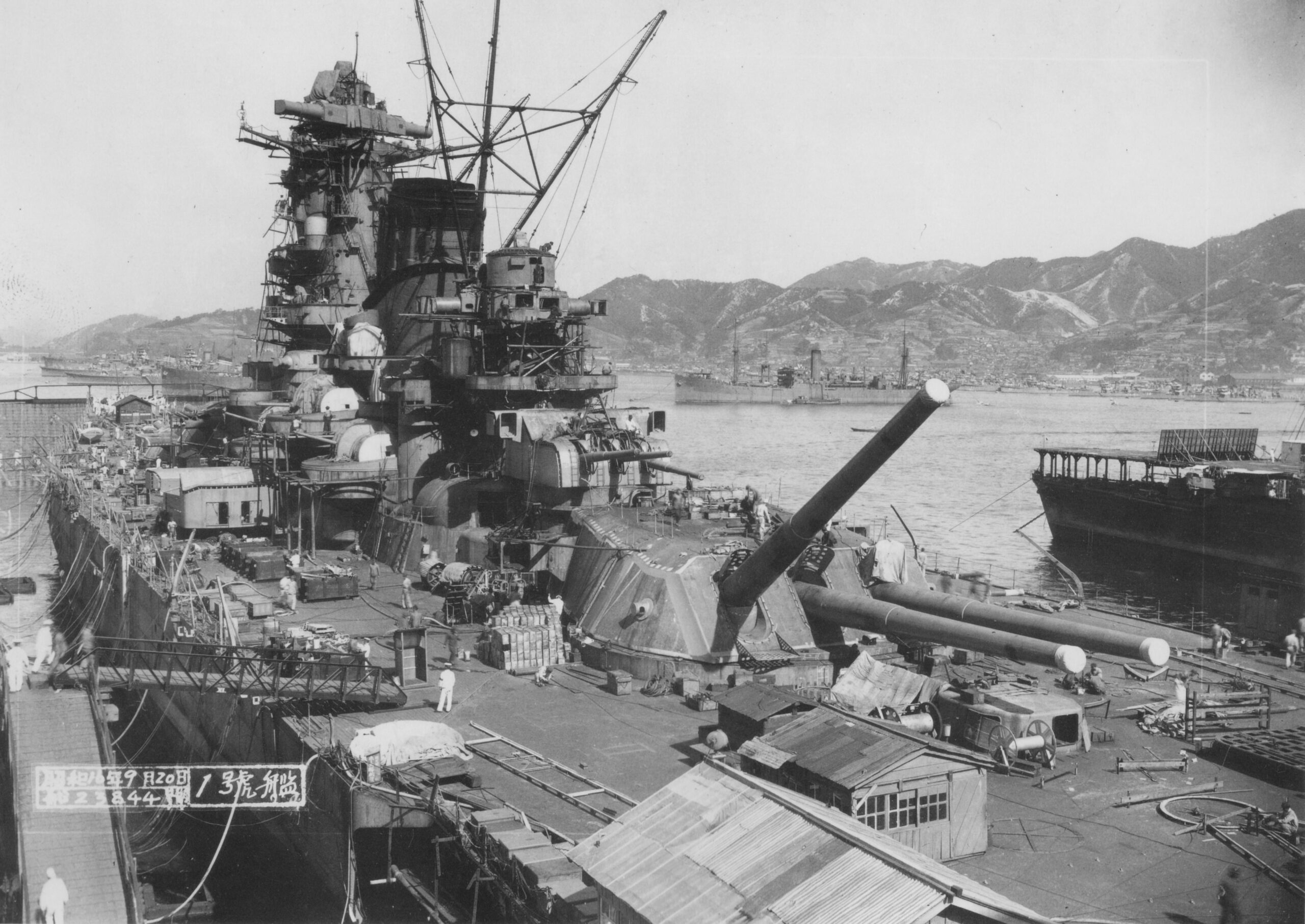
Image of Japanese battleship Yamato from u/DaveScout. Image of dog in headband from Alternate Ending.
- Sorry. ↩︎
- “Anime: A History – Second Edition”, Clements, p. 91, 2023 ↩︎
- “The Anime Encyclopedia, Third Revised Edition”, Clements & McCarthy, p. 1657, 2015 ↩︎
- Mochinaga Tadahito, “Animation Nitchu Koryuki” / “A Chronicle Of Sino-Japanese Animation Interchange”, p. 95, 2006, in “Anime: A History – Second Edition”, Clements, p. 91, 2023 ↩︎
Leave a Reply