
ANOTHER YEAR OF MURATA
Three of MURATA Yasuji’s films from 1930 have survived to the present day. Even if that was all he’d managed, it would still be an absolutely blazing pace by Japanese standards of the time. March saw the release of “Oira no Yakyo” / “Our Baseball Game” (Yokohama Cinema, March 1930). It was a smart move. There was no organised baseball league in Japan at the time, but the game has always lent itself to story-telling.
“Our Baseball Game”
This short is the first time I’ve used Crunchyroll, Sony’s streaming service. And it’s also the first one that uses a benshi, or “narrator”, in this case SAWATO Midori. But she does considerably more than just read the plot to the audience. The role of the benshi was considerably broader than that, as Professor Jeffrey Dym of California State University, Sacramento explains in his “Brief History Of Benshi“;
“During the initial decade of motion pictures, benshi typically appeared prior to the films, giving audiences rather detailed introductory remarks (maesetsu) about the content of the movies about to be shown. Since most of the motion pictures were foreign imports, benshi primarily spent their time explaining Western exotica, customs, and places contained in the film. As movies became more narrative, benshi began summarizing film plots and characters in their introductory remarks. “
So yes, the benshi’s core role was to narrate the film, live-action and animated alike. But they usually added their own dramatic flairs and styles, and it was always over whatever music the film-makers had added.
So Sawato tells us about teams of rabbits and tanuki, facing off in a high-paced farce of a baseball match. It suffers slightly from the Seinfeld Problem, though. If you watch American TV, you’ve seen baseball episodes, in shows as disconnected as Deep Space 9 and Due South. In Japan, though, Murata was on first.
What on earth is a “tanuki”?

A tanuki is a Japanese raccoon-dog. If you’ve heard of them, there’s a good chance it’s thanks to Animal Crossing. The world’s most famous tanuki is grasping landlord and rank bad hat, Tom Nook. But in their home culture, they’re shapeshifting tricksters; more mischievous than evil, and easily fooled themselves. They’re going to show up a lot from now on.
As for the cartoon itself; it wasn’t too bad. There’s a couple of pleasingly punny names, a bit of literal base-stealing, and an intriguingly Yakuza-esque frog near the end. There’s even a suspiciously Babe Ruth-looking tanuki who hits an enormous home run, and it finishes with a bilingual pun.
The animation is up to Murata’s usual high standards, with some clever touches. The rabbits communicate between pitcher and catcher with their long, expressive ears, and there’s a very smart crowd applause shot.
I asked my age-appropriate assistant, Little Ripper, to review it with me. I thought it was a giggle that didn’t outstay its welcome, and she thought it was interesting enough to keep her attention. That said, if you don’t know anything about baseball, this is going to be utterly baffling. “Our Baseball Game” gets 6/10.
“My Ski Trip”
The next in Murata’s series focusing on long-eared rabbits and hefty tanuki was “Oira No Ski” / “My Ski Trip” (Yokohama Cinema, April 1930). It’s a snow day, and a couple of rabbits emerge from their snow-covered houses to go skiing. They pull a reluctant tanuki out of his den, and he tramps along behind them in wellington boots. The rabbits show off their downhill skills, and the tanuki borrows some skis to give it a try With Hilarious Consequences. Then the rabbits do ski-jumps, and the raccoon-dog’s attempt to compete turns the whole thing into a shape-shifting contest.
There’s a flashback in this one, to what I can only presume is a lost cartoon using the same characters. There’s also an utterly inexplicable joke about Russian carriages. But it’s not a very good cartoon; unconnected things happen in a random order without a sniff of a unifying plot to carry them. This was a disappointingly poor effort from a studio which hadn’t been bad in this way for a while. “My Ski Trip” is only worth 2/10.
“The Donkey”
Finally for this year, Murata made “Manga Roba” / “The Donkey” (Ministry Of Education, 1930). This story was first written down by Arabic polymath Ibn Sa’id al-Maghribi (1213-1286), but it’s been included in collections of Aesop’s Fables since at least 1692.
A man and his son try and take their donkey to a horse auction, on a day hot enough to sell cold desserts. As they travel, though, everyone they meet has different advice about how they should look after it. The foolish pair listen to everyone. By the end, the owners end up accidentally throwing the poor donkey into a river, where it drowns. The moral is; you can’t satisfy everyone, so don’t try.
Multi-levelled backgrounds and a superbly-drawn donkey don’t make up for the fundamentally dull way in which the creators tell the story. As the trio slowly walked past a river, I was desperate for a recording of relevant, traditional Japanese music and a narrator. But alas, that hasn’t survived.
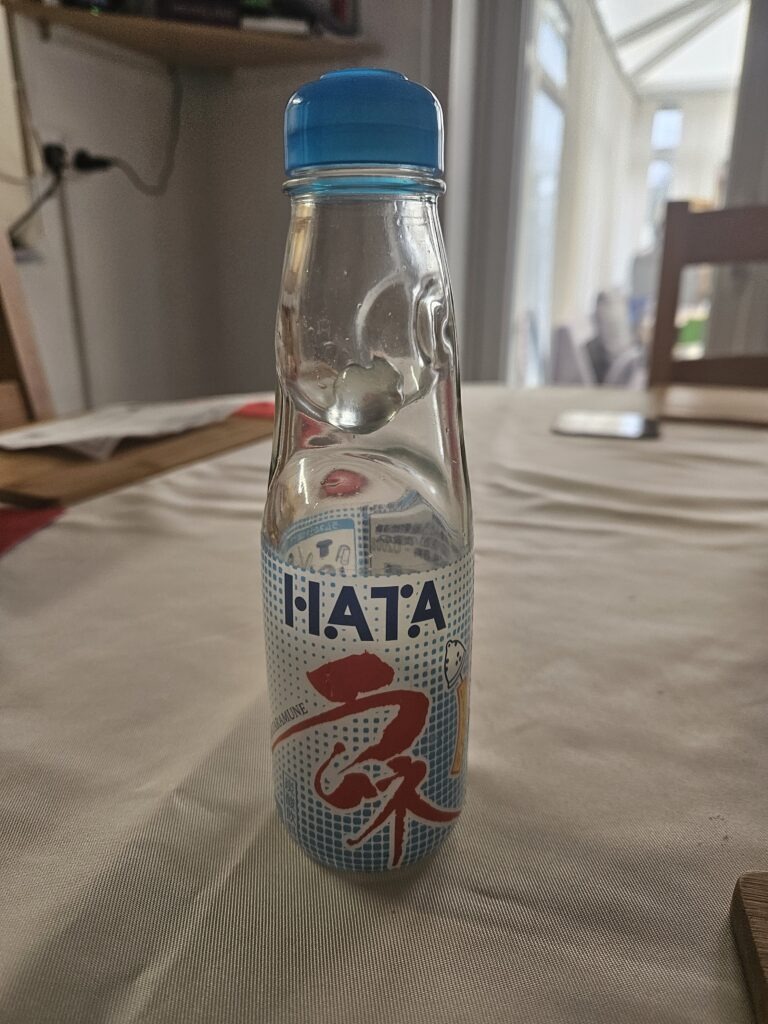
It’s interesting on one level, as a series of vignettes of rural life in Japan in the period. The presence of the Ramune fizzy drink, with its distinctive bottle, places the setting at 1884 at the earliest. But I’m making excuses to buy lemonade. This was a slow plod of a cartoon with exactly one laugh, and a downer ending. Wonderfully animated, sure, but showing this to a classroom full of 8-year-olds would be a recipe for disaster. Great art can’t save a turkey; “The Donkey” scores 2/10.
Of all the creators I’ve watched so far for this blog, Murata is by far the most prolific. It’s clear that the backing of the Ministry of Education has allowed Yokohama Cinema the freedom to create more than anyone else at the time, even if the quality of those shorts has dipped a bit in places.
THE REBRANDING OF OFUJI NOBURO
OFUJI Noburo seems to have spent most of 1929 experimenting with new ideas. He’d renamed his studio after his animation technique, Chiyogama Eigasha, and the Japanese Film Archive says that he’d been trying to film in colour.
“The Golden Flower”
It looks like he only released one film in this year. It was “Kogane no Hana” / “The Golden Flower” (Chiyogami Eigasha, 1929), another outing for Dangobei. He’s from a town called Tanokyu and he’s been invited to perform a Shinto ritual dance involving various complicated masks at a harvest festival. Not like you to do an honest day’s work, Danggers.
On his way home he gets lost and ends up on the dreadfully steep Kuragari-toge Pass – Darkness Pass, which still exists today. To rub the peril in, we briefly visit his worried Dear Old Mum. Dangobei encounters a snake, and declares his name and home – but the snake mishears “Tanokyu” as “tanuki”.
I haven’t mentioned one of their main features yet. Traditionally, tanuki have enormous testicles. Thankfully the snake only asks to see Dangobei’s transformations, and he uses his ritual masks to pull his accidental deception off perfectly.
The snake lets him go, and in relief Dangobei offers him a smoke. The snake hates tobacco, and chases our hero down the hill to his home. The residents of Tanokyu gather together and smoke the monster out, and thanks to a trick worthy of Odysseus, the snake’s spirit makes Dangobei rich.
Ofuji’s first award
Wonderfully, at the start of the cartoon, we see Dangobei assemble out of two round pieces of paper. Ofuji also uses multiple exposures to give a sense of the busy chaos of the festival, and the sequence in Darkness Pass is suitably eerie. All things considered, Ofuji’s already earned the right to show off a bit. This has a solid plot and the animation is excellent, so “The Golden Flower” scores 7/10. In 1931, it would win the Quality Film Award from the Department of Education, which might count as foreshadowing.
1930: “Village Festival” and “At The Border Checkpoint”
Ofuji made two films in 1930, but it makes more sense to discuss them in reverse order. That’s because one of them was a music video of sorts, stitched together using animation from “The Golden Flower”. Ofuji called it “Mura Matsuri” / “Village Festival” (Chiyogami Eigasha, October 1930).
The words to the sweet little song are put up on-screen with various bouncing balls to show the audience what they should be singing. Because of the source material, Dangobei takes the lead. But we also meet Heibei The Pooch for the first time. He’ll soon become a recurring character in Ofuji’s films. It was fun, and I bet the kids loved it, so that means “Village Festival” gets 6/10.
Ofuji’s other film from this year was “Osekisho” / “At The Border Checkpoint” (Chiyogami Eigasha, June 1930). The original was 18-minutes long and featured either singing, orchestral music or both, from what’s now the OSK Japan Opera Company. Unfortunately the first reel and the audio have both been lost, leaving us with an 8-minute silent film.
It’s a real shame that so much is missing. The conversion of what we do have is basically perfect, without the wobbling and fuzzy edges that I’ve got used to from the period. Without the music and the first half, though, what remains is a baffling mess. “At The Border Checkpoint” can only be awarded 1/10, and Ofuji deserved better. But I look forward to more next time.
fin
That’s all for this entry. My next post will wrap up this two year period, with some opinions you’re probably not expecting from 1920s Japan, and some unattributed work that’s still worth watching.
Thanks go out to AniDB, whose peerless database has helped me work out what to look for, and the Japanese Film Archive, who have given me the material to actually watch. I’d also like to thank Crunchyroll, Japan House London, and Japan Travel.
The tanuki picture is from KKPCW, CC BY-SA 4.0 https://creativecommons.org/licenses/by-sa/4.0, via Wikimedia Commons.