
NIHON MANGA FILM
In 1933, SEO Mitsuyo left Masaoka Kenzo’s Film Art Institute to set up his own studio. I thought he wanted to make cartoons about his heroic monkey warrior Sankichi, and he did that in 1934. But something really weird seems to have happened in the meantime.
Yokohama Cinema Shokai and Murata Yasuji were making two kinds of cartoons up until this point; propaganda pieces starring dog soldier Norakuro, and fairytale adaptations for their Athena Film Series. In 1935, Seo’s new Nihon Manga Film Kenkyusho made four films. Seo directed three of them, and those were all either fairytales or about Norakuro.
But Seo had nothing to do with Yokohama Cinema. The only conclusion I can draw is that someone in the Japanese government – who had been funding Yokohama with various levels of subtlety for years – decided to jump tracks for no obvious reason.
WOOF WOOF WOOF
Yes, Seo was highly skilled at animating. But he wasn’t a proven director like Murata was. Something clearly happened. But I have no idea what. Regardless, I think I’m going to start with the dog.
But don’t bark up the wrong tree. Wikipedia claims there was a film called “Private Second Class Norakuro”, but I don’t know if that exists or not. The film with that label online is pretty clearly “Norakuro’s Tiger Hunt” from 1938.
The right tree is therefore “Norakuro Ittouhei” / “Private First Class Norakuro” (Nihon Manga Film, 1935). I suspected that this would be a big dose of kid-friendly propaganda, and I was right; the children sing the theme tune and Norakuro barks along merrily like he isn’t teaching kids about the glories of war.
“Private First Class Norakuro”
Our doggy hero marches past a Danger sign, and gets scared by some owls. Once he comes to, he sees his commanding officer get sent up in an observation balloon. But the idiots didn’t tie it to the ground, and he ends up flying into the distance.
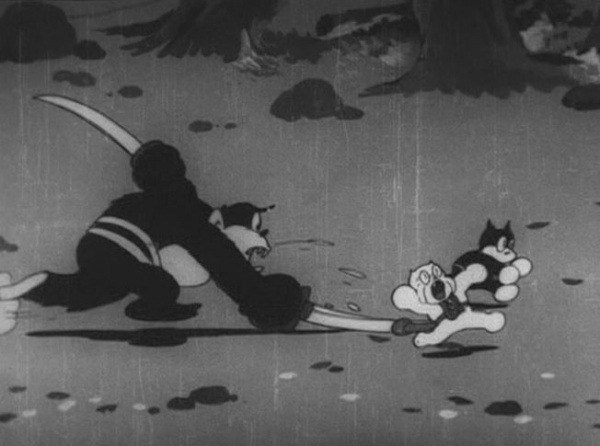
A camp of martial monkeys are dancing and celebrating for some reason, and they see the balloon, successfully capturing the doggy Colonel. They dance even more, to music that’s horribly reminiscent of racist depictions of Native Americans. Norakuro throws a barrel at them – and a tiger’s head pops out on a spring and scatters them! Norakuro frees his commander and they run away, in another jazzy chase scene.
Ok, credit where it’s due; when Norakuro passes out theatrically, it made me smile. It was very well done. And while I suspect they had superficially racist motives for doing so, they use jazz for their action sequences, which adds vigour and punch. And at the end, we see that Norakuro’s been promoted again.
The high production standards, strong enough that I didn’t need subtitles to follow the plot, made watching this harder. So did the fact that Seo was a leftie, to the point where he would be censored by the Occupation forces, post-war, for being too liberal. These cartoons represent a large step towards achieving the quality and style of contemporaneous Disney and Fleischer cartoons, and frankly it made me feel a little sick. And I know there’s far worse to come. By policy, no score.
“The Hare In Inaba”
Seo’s other two films from 1935 were fairytales. Did he indirectly pinch them from Murata? We’ll probably never know. In any case, I’m going to look at “Inaba no Kuni no Usagi-san” / “The Hare In Inaba” (Nihon Manga Film, 1935).
A family of hares are hiding in their house from a flood. The sea whisks the house away, but one hare survives on a floating door. He manages to get to an island, and falls asleep to dream of happier times with other hares. A crocodile emerges, and the hare tricks him into lining his friends up, so he can run across the crocodile bridge and get back home. Furious, the crocodiles grab the hare; he gets away, but loses his skin in the process. Bloody, worn and hurting, the hare finds his friends who don’t recognise him.
A group of travellers pass by, and one stops for the hare, advising him to wash in salt water. This, of course, only makes the pain worse. The sun glares down as the cartoon ends abruptly.
This is a truncated version of a major Japanese folktale. The original story’s hare goes on to meet a minor god called Onamuji, who tells him to wash in fresh water and roll in some bulrushes, which actually helps. In return, the hare predicts that Onamuji would wed a princess, and he does, going on to become Okuninushi, the leader of the gods of the Earth.
Not only is the ending to this cartoon lost, so is the soundtrack. It’s irritating; this is full of clever, surreal touches, and I didn’t know that the James Bond crocodile bit in “Live And Let Die” had precedent. I’d like to score it higher, but “The Hare In Inaba” has a ceiling; 6/10.
“The Japanese Tom Thumb” (sic)
Seo’s other fairytale was “Issunboushi: Chibi Jo Monogatari” / “The Japanese Tom Thumb” (Nihon Manga Film, 1935). And the English title made me very cross. I’ve moved my rant to social media, and I understand why the American translators chose that name, but… hmpf.
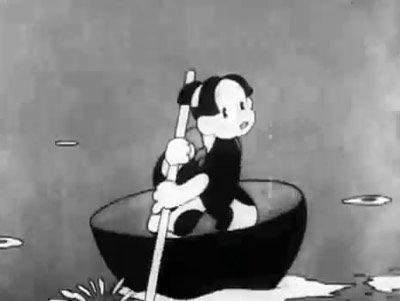
We see our tiny hero – who I’m going to call Chibisuke, because that’s his actual name – punting up a river in a bowl, with his ant, frog and butterfly friends. He makes his way into a town, where he dances on someone’s hand to the delight of a local lord and his court. The official hires him, and he goes with a princess to Shimizu Shrine1.
On the way there, an oni leaps out of a tree, looming into the camera for a jump-scare. He attacks the princess, but Chibisuke stabs him in the foot. There’s a chase scene, and then Chibisuke makes copies of himself. The resultant tiny army chases the oni down and fire lit matches at him, which magically scale up in mid-air. The Chibisukes capture him like he was Gulliver in Lilliput, and they all dive into a pot, from which a full-size Chibisuke emerges.
It’s so good to see Seo exploring his ideas in ways that don’t make me feel ill. There’s a beautiful page-turn scene transition, a sight-gag involving an anchor that actually made me laugh, and while the story stops making sense after a while, for this kind of cartoon that’s probably a plus. I didn’t have any subtitles or music for this one, but it still made me happy; “The Japanese Tom Thumb” scores 6/10.
“Danemon Ban – The Monster Exterminator”
This studio made one more cartoon in 1935, but Seo didn’t direct it. Animator KATAOKA Yoshitaro directed it, but beyond his filmography, I couldn’t find anything more out about him. His first film was “Shoujouji no Tanuki-bayashi Ban Danemon” / “Danemon Ban – The Monster Exterminator” (Nihon Manga Film, 1935). Was it any good?
Well, yes, but I had to do some digging to understand the plot. Our hero, Ban Danemon, was a real-life 16th century samurai who served various lords and died in action. But this mythologised version finds himself hunting down the source of some ghostly sounds, some “Tanuki-Music”. It’s coming from a nearby ruined castle. Danemon pulls out a watch to check he’s got time to help out, and he does.
Danemon bursts in to find a beautiful woman, tied up and defenceless. But as soon as she’s free, she shapeshifts – mostly off-screen – into a hypnotising monster who sends our hero to sleep. All those cobwebs should have been a hint. We see a pair of demons shave Danemon bald and tie him up, and retreat to join a clan of tanuki to celebrate. But as soon as Danemon awakes, he Popeyes the ropes apart, and wipes out the tanuki with his giant club.
excellent work – one small problem
This was a pretty simple story, with an obvious hero/villain dynamic, and a clear three-part structure. I don’t know if Japanese children would have known who Danemon was, unless the Imperial education edict went as far as teaching kids about relatively minor 16th century samurai generals. Which wouldn’t surprise me very much.
But I don’t really think that matters. The animators do a fantastic job of showing us who Danemon is; the thick lines used to draw him and his slow, powerful movements combine to show his toughness and power superbly. I originally watched an edited version on Crunchyroll with SAWATO Midori working as benshi again, and her tone lent him even more strength.
I don’t typically score cartoons without subtitles, unless I can understand them without. And this one managed that, so I was thinking it was sevenish. But then something weird happened.
THE UNKNOWNS
I need to make it clear that the name of the director, animators and even the studio who made the next animations have been lost. We do know that they feature the warrior Hatanosuke, who was created by NAKAJIMA Kikuo for the manga magazine Shonen Club between 1935 and 1941.
“Hatanosuke and the Haunted House” (unknown, 1935) was only 84 seconds long, but it quickly became clear that “Danemon’s Monster Hunt” was based very heavily on it, to the point where I suspected this was a first draft by someone at Nihon Manga Film. It’s beat for beat the same story – Hatanosuke even spends a few moments looking at a wristwatch – although it uses traditional youkai, like the kasa-obake umbrella demon, instead of using tanuki all the time.
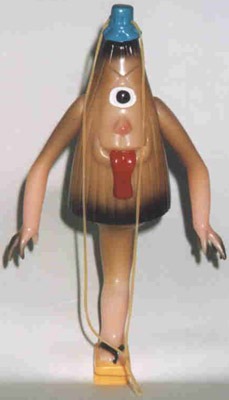
The second film, “Hatanosuke Takes Down The Inazuma Gang”, isn’t available online in full. It’s pretty clearly by the same studio, though.
It’s equally clear that someone, somewhere, was making an animation they didn’t have the rights to. And I have no idea who was crossing the line. As a result, it’s not fair to give any of these three cartoons a grade, which is a shame. The first time I tried to carry this project out, the second cartoon I watched was “Danemon’s Monster Hunt”. But that’s showbusiness.
fin
And that’s it for 1935! I would like to give my usual thanks to this blog’s four pillars; AniDB, who have helped me work out what to look for, the Japanese Film Archive, who have given me the material to actually watch, and the inseparable pairing of Jonathan Clements & Helen McCarthy and their “Anime Encyclopedia”.
Not for the last time, I’d like to thank Crunchyroll for existing, and I’d also like to thank Rachel Thorn again for her subtitling work. I’ve linked to her YouTube page where appropriate. Kasa-Obake image moved from en.wikipedia.org., CC BY-SA 3.0 http://creativecommons.org/licenses/by-sa/3.0/, via Wikimedia Commons.
I’ve been Douglas Howell, and I’ve been watching Japanese animation. Join me next time, for the most confusing year of animation I’ve found for this channel so far.
- The burial place of Shogun Tokugawa Ieyasu, who helped to unify Japan in the 17th century. ↩︎