
SPRINGTIME FOR GERMANY
This was the year when everything started to fall apart in Europe. Austria voted to erase itself and become part of Nazi Germany. The Spanish Civil War turned decisively in favour of General Franco’s fascist forces. And thanks to an unwillingness to trigger a general war in Europe, the French and British governments reneged on promises to defend Czechoslovakia. This allowed Nazi Germany to successfully annex the Sudetenland in that country, and heralded further invasions to come.
In China, the Japanese armed forces continued to attack the Nationalist Chinese forces under Chiang Kai-Shek. They used poison gas on their enemies and committed further atrocities on civilians in the cities they captured, including Juijiang and the Nationalists’ new capital, Wuhan. Kai-Shek retreated further inland to Chongqing, blowing up various dams on the Yellow River as his forces went. While that protected their retreat, it also killed as many as half a million Chinese people, either directly or through the famine and sickness that the destruction of the dams caused.
By the end of the year, China was divided into three. Japan held what they called Manchukuo in the north and east. The Nationalist Chinese government had their stronghold in the south, and the Chinese Communist Party controlled a relatively small area in the west. But Japan was looking for more.
Uncle Walt Gets There First
Among all the terrible news, it is impossible not to mention one huge leap forward in animation. This is the year that “Snow White And The Seven Dwarfs” (Walt Disney Pictures, 4 February 1938) went on general release.1 This was the first full length, cel-animated feature film. This was the day when Disney took an unquestioned place at the top of the world of animation. They’re still there now. It’s not particularly connected to Japanese animation. In 1938, I imagine you took your good news where you could find it.
MABO RIDES AGAIN
Since 1936, the animation team of SATO Ginjiro and CHIBA Yoji had been making at least one cartoon a year featuring their nationalistic boy hero Mabo. Their 1938 effort is the first one I’ve been able to watch in full. That was “Maabou no Kinoshita Toukichirou” / “Mabo As Tokichiro Kinoshita” (Sato Seneiga, 1938). But that title demands a little digging.
KINOSHITA Tokichiro was a minor lord in the Imagawa clan in the late 1550s. That puts him slap bang in the middle of the Sengoku or Warring States period of Japanese history. In later life, having become one of the three Great Unifiers of Japan alongside ODA Nobunaga and TOKUGAWA Ieyasu, he would take his more famous name, TOYOTOMI Hideyoshi (1537-1598). And that explains why he’s been picked to wear Mabo’s face for this cartoon. But was it any good?
“Mabo As Tokichiro Kinoshita”
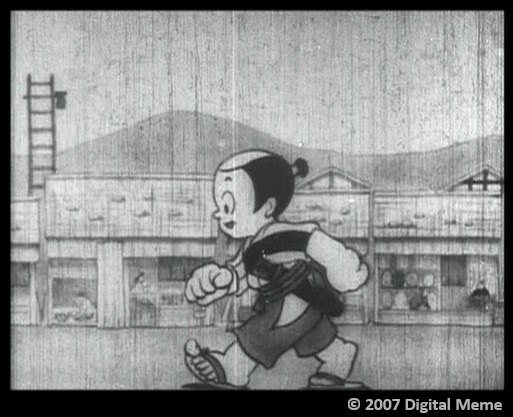
Mabo, clad in traditional samurai garb and haircut, is looking for a lord to serve. He stops at a fortune-teller, who looks at him through a magnifying glass. Magically, she sees him in his old age, as the effective ruler of Japan. Then the story jumps to Kinoshita’s time serving Oda. It’s a horrible winter, and Mabo is brown-nosed enough to put Oda’s sandals under his coat to warm them up.
After an attack destroys Kiyosu Castle, one of Oda’s strongholds, we see Mabo rebuild it in three days. Weirdly enough, this is a feat ascribed to his real-life counterpart2. Mabo successfully defends it against attack, although he gets to use 20th century war technology. Then we see the cameramen who have been filming it all, and Mabo takes his hat off to say goodbye to the audience.
This was an oddly disjointed tale, stitching together the fragments of Toyotomi’s early life – apocryphal and otherwise – to remind their child audience of Japan’s heroic past. But there’s not much actual story there to tell. The animators did clever things, but I can’t smile at Mabo using a machine gun to drive in nails in 1938. “Mabo as Tokichiro Kinoshita” gets 4/10.
EAGLES FLY: KIMURA‘S LAST STAND
That wasn’t the only propaganda work that Sato Seneiga Kenkyujo produced in 1938, though. The other one I know about comes from a familiar director. KIMURA Hakusan was a leftist animator with a significant history of government propaganda under his belt. But if you’ve been reading along, you’ll know what went wrong. Kimura blew his own career to smithereens with 1932’s “Cool Ship”, the first Japanese pornographic animation, which led to his arrest and the cartoon’s confiscation.
I was able to watch his “Yoshichiro Salutes” when I got to 1933, and I enjoyed it. After that one, though, Kimura’s work petered out. He made five more animated films in his lifetime, but they’re all either unavailable online or lost completely. His final animated work was a propaganda piece called “Arawase” / “Wild Eagles” (Sato Seneiga, 1938).
After that, he “produced books of paintings” for Kokushi Meiga Kankokai, which were also propaganda efforts in support of the Second Sino-Japanese War. But then all records of him disappear. We don’t even know when he died. Even though he was a contributor to the Japanese war effort, I can’t help but feel slightly sad that the life of such a superb storyteller didn’t get a proper ending.
NORAKURO BITES THE TIGER: SEO MITSUYO
In 1935, not long after being released from prison for the terrible crime of being a Communist in Japan, OMURA Hidenosuke founded a film company called Geijutsu Eigasha. After making a few live-action documentary films, Omura agreed to buy SEO Mitsuyo’s animation studio. They had both been members of the Japan Proletarian Film Union in Tokyo, but it’s not clear if the two men knew each other beforehand.
Their actual political leanings were irrelevant to the first work they produced together, though. Seo’s first film for his new studio was “Norakuro Nitouhei” / “Norakuro’s Tiger Hunt” (Geijutsu Eigasha, 1938). That Japanese title means “Private Norakuro”, without the additional tags that his earlier appearances had.
“Norakuro’s Tiger Hunt”
Norakuro’s doggy face takes up the entire screen like he’s Donald Duck, and the sun rises over a quiet village. Then a bugler calls out the Fierce Dog Regiment. Norakuro doesn’t do mornings, so he ends up scrubbing out the barracks. After a dose of cleaning hi-jinks, the commander’s radio tells him there’s a tiger loose in town and the army needs to assist.
The dogs march into town, with cannons and tanks in tow. There’s even a choir of children, squeaking out a marching song. There’s even a couple of monkeys reporting on the news with camera and microphone. The dogs end up attacking the tiger, and it turns into a chase scene with Norakuro. The dog steals some paint to camouflage himself as a tiger, and is able to feed the real one a bomb that knocks it out. Everyone laughs, including the tanks, and the tiger gets brought home, crying in a cage.
Bad Wardog, No Bikkit
The rising sun imagery is pretty obvious, and there are some lovely FLEISCHER-esque touches to the animation this time around. But this is a perfect example of how a piece of art can be beautiful, superbly executed and a significant jump in quality and depth in comparison to a previous work in the same series, and still be an absolutely horrible watch. This was disconcerting propaganda, and just because I can see how it worked doesn’t mean I liked it. By policy, no score.
This would be the last appearance of Norakuro in a cartoon for thirty-two years. In 1970, TCJ Video would bring the Dog of War back for a new series. I have absolutely no idea how that’s going to work, but I’ll be writing about it once I get there. As for his director? This wouldn’t be Seo’s last animation for Geijitsu. Or his most infamous. But we’ll get there soon enough.
TARO RETURNS, AND OTHER PROPAGANDA
ASHIDA Iwao was continuing to try and make a Japanese version of Looney Toons star Bosko. His take appeared in “Umi Kunitarō shin Nihon-jima Manzai”/ “Taro Overseas – Long Live The New Japan” (Unknown studio, 1938). The film was credited to HIROMASA Suzuki, but that was one of Ashida’s various aliases. It’s time for my least favourite catchphrase: it isn’t available online.
But you can still see it, if you’re in the right place and time. Jasper SHARP of Midnight Eye was, and he’s discussed it there. Taro joins the navy, and sails out with a team of animal helpers that are very reminiscent of Momotaro’s friends. After getting attacked by “sharks and whales”, they land on an island and save some natives drawn in a deeply racist way from a lion, and discover a large gold nugget. The locals “volunteer” to work in the new gold mine, and the film closes on a sign reading “New Japan Island”.
Sharp thinks this is a huge step down from the other cartoons being made at the same time, both in America and Japan. In the circumstances, I’m not surprised.
Only one more cartoon from this year still exists: “Tekusuke Monogatari” / “Tekusuke’s Story” (Unknown studio, 1938). Except IMDB thinks it was also called “Hinomaru Hatanosuke Sanzoku Taiji”, or “Japanese Flag Hatanosuke: Bandit Confrontation” and that Seo Mitsuyo directed it. That would be very interesting, because it might mean that the previous cartoons starring Hatanosuke might also have come from Seo. But it’s not clear. Anyway; was it any good?
“Tezusuke’s Story”
Our little samurai hero walks through town carrying a big bottle of something. He finds a rock in his path and throws it away, smashing the fire and food of a nearby bandit gang, with another very Bluto-looking leader. A chase ensues, and Hatanosuke gets away with help from a friendly crow.
A very Mickey Mouse-looking tanuki can’t sleep because his neighbour monkey can’t stop her baby from crying. He goes next door to shout at her, which always helps. Hatanosuke turns up and gives everyone some strength-giving food pills. Hurrah! Mummy monkey can make milk for baby now, and the baby loves seeing the tanuki dance around and drum on his stomach.
Another samurai boy turns up with a warrant for the bandit leader’s arrest. Or his head, the lack of subtitles made it hard to tell. So the animals and humans combine to trick the bandits into attacking. Hatanosuke eats some pills and powers up, winning out with the help of aerial tomato bombardment from the crows.
Was This Seo’s Work?
The soundtrack, which is still around, is intriguingly jazzy for the period. There’s a lot of smart usage of repeated cel sequences, but the core of the story is well-told and well-animated. There were times when the quality of the footage dipped a bit, and made it hard to be sure exactly what I was watching. But it was still a very solid cartoon, even if that’s partly because this was very strongly inspired by Popeye the Sailor.
It’s certainly good enough to be one of Seo’s cartoons. But there’s no way to be sure. Regardless, “Tekusuke’s Story” is good enough to earn 5/10, and with a slightly cleaner conversion and some more reliable subtitles, it would have been worth even more.
fin
That’s all there is for 1938. I would like to give my usual thanks to this blog’s four pillars; AniDB, who have helped me work out what to look for, the Japanese Film Archive, who have given me the material to actually watch, and the pairing of Jonathan Clements & Helen McCarthy and their “Anime Encyclopedia”.
I would also like to thank Jasper Sharp of Midnight Eye; I cribbed mercilessly from his review of “Taro Overseas”. The website is still up, but they stopped making new content back in 2015, which is a real shame. I’d also like to thank historian Mary Elizabeth Berry, and Matteo of Animétudes, for their indepth research.
I’ve been Douglas Howell, and I’ve been watching Japanese animation. Join me next time, when the greatest combination of cartoon talent in Japan is put together. Just a pity we’re never going to see anything they made.