
STAGGERING INTO CHAOS
When Prime Minister SAITO Makoto was appointed in 1932, he was supposed to be a safe, compromise candidate. As a career politician and a former Governor-General of occupied Korea, he was a safe pair of hands. As a retired naval captain who fought in the First Sino-Japanese War, it was thought he would keep the ultranationalist factions in the military at bay.
But it didn’t work. A year prior, a group of smart young investors bought shares in an undervalued textiles firm called Teijin. They bought low, and the price soon ballooned. By April of 1934, the ultranationalists in the Ministry of Justice had persuaded themselves that the Finance Ministry and Saito had colluded with those investors in return for bribes. The Vice-Minister of Finance was arrested. and in June of 1934, when Saito heard that further arrests were expected, he resigned as Prime Minister.
Sixteen people were charged over the Teijin Incident. All sixteen were acquitted in 1937. But the general public’s faith in Japan’s democratic system had been damaged again. Saito was replaced as Prime Minister by a man of similar background; retired Admiral OKADA Keisuke.
Another coup attempt was snuffed out in November of 1934; five cadets and two officers of the Army planned to overthrow the government. They were upset that their faction had lost ground after noted fascist loony SADAO Araki resigned as War Minister due to ill health. Thankfully one of the cadets grassed the others up, but it wouldn’t be the last attempt.
Somehow in all the chaos, people kept making animation.
MURATA: A STEADY YEAR IN YOKOHAMA
Yokohama Cinema Shokai and their star director MURATA Yasuji had found their new main character. The studio’s two adaptations of “Norakuro”, TAGAWA Suiho’s manga about a soldier dog, did well enough to earn a third installment. That was “Norakuro Gochou” / “Corporal Norakuro” (Yokohama Cinema, March 1934). Was it any good?
“Corporal Norakuro”
It’s a holiday, and the only dogs left at the barracks are a couple of guards and the newly promoted Norakuro, who as an orphan has no family to visit. He goes out to a yatai, a food cart selling grilled chicken. In a flashback, we see his promotion ceremony. Then he goes to sleep in a dustbin next to a park bench. The poor thing’s still a stray at heart.
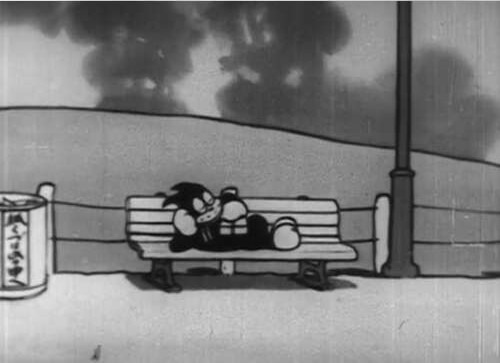
From “Corporal Norakuro”, Yokohama Cinema Shokai, 1934.
A pair of monkeys in what might be Chinese military uniforms steal some “classified papers” from the canine regiment, and take the time to explain the plot while resting on a handy park bench. Naturally Norakuro hears everything and chases the monkeys down; they hijack a passing car and drive off, but tenacious Norakuro grabs a bicycle and pursues them.
They escape to an observation balloon; Norakuro goes into a handy fireworks plant but utterly fails to blow the monkeys up. It’s only when he fires himself up to the balloon that he’s able to stop his foes, taking the papers back and parachuting to the ground. Except it was all a dream, and the papers are actually an order of chicken for Norakuro’s commanding officer.
Captain Subtext Has Left The Building
This has scrolling repeated backgrounds and simple animation, but it works perfectly well on an artistic level. I don’t even have a problem with the surprise parachute, that’s well within the bounds of plausibility for the era. My issues with this cartoon come with the basic plot, the show-not-tell exposition, and the crudity of the propaganda. When your villain says “We’ll massacre them when we go to war” in a cartoon clearly aimed at pre-teen boys, all subtlety has been abandoned, especially because of the It Was All A Dream twist at the end. By policy, no score.
Murata’s next effort was “Kamishibai Kintaro” (Yokohama Cinema, June 1934). And both parts of the title need some explanation.
“Kamishibai”
Kamishibai means “paper theatre”. Once the Great Depression hit, Japan’s cities had a lot of creative minds who couldn’t find work. But they could afford to hire a Kamishibai set; a wooden frame and illustrated cards, that showed the main beats of a children’s story. They would cycle around Tokyo and the other large cities, call out their show’s name, and wait for children to gather round.
The kids’ parents couldn’t usually afford a trip to the cinema, but they could give their kids a bit of pocket money to buy sweets from the benshi who were running the shows, especially because that usually meant they got to sit at the front1. By the summer of 1936, hundreds of children in Tokyo were watching these shows at least twice a day. So calling your cartoon a “Kamishibai” was a good way to jump on a new creative bandwagon.
“Kintaro The Golden Boy”
So what about “Kintaro”? Well, Kintaro The Golden Boy is a semi-mythological character from Heian-era Japan, roughly equivalent to Europe’s Early Middle Ages. Kintaro is a young boy in an apron with the word “gold” on it. He carries a huge axe, and he usually rides a bear. He was superhumanly strong, and managed to make the bear submit in a sumo match. As an adult, he became one of four legendary warriors – the original Elite Four – in service to samurai hero Minamoto no Yorimitsu. Even today, Kintaro shows up in anime, and it’s traditional to decorate newborn boys’ rooms with dolls of the character.
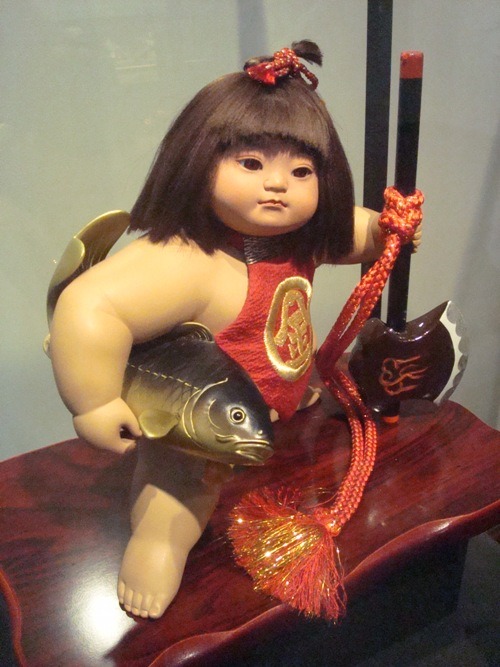
So is “Kamishibai Kintaro” is an animated version of a new artform, telling a traditional Japanese story? Is it propaganda? And crucially; is it any good?
“Kamishibai Kintaro”
We see Kintaro, this time on the back of an deer on wheels. A real deer is pulling them both. Kintaro inspects his army; a bear carrying Kintaro’s axe, a rabbit, a monkey, that poor deer and a platoon of monkeys, carrying sticks like rifles. They’re having a sumo tournament and tests of strength, and everyone gets to eat afterwards. One of Minamoto’s servants has been watching the whole thing, and offers Kintaro some special training. Not that we get to see it. At the end of the cartoon, Kintaro comes back to be celebrated by his animal friends.
This is Kintaro’s origin story, sort of. Except somewhere along the line, it feels like Murata has forgotten how to tell a story. It feels slow, even by the standards of the period, and pads its running time with pointless running. And no, there’s nothing Kamishibai-esque about this version of the tale at all, the studio is just trying to jump on a bandwagon. This was disappointing, but at least it wasn’t pro-war; “Kamishibai Kintaro” gets 3/10.
“Princess Of The Moon Palace”
The studio’s last animation of the year was “Tsuki no Miya no Oujo-sama” / “Princess Of The Moon Palace” (Yokohama Cinema, October 1934). It’s based on “The Tale of The Bamboo Cutter”, the first known monogatari, the Japanese epic prose form. The story would eventually get a faithful interpretation from Studio Ghibli in 2013. Thankfully, the audio of this talkie adaptation survives, with its pleasing trad jazz soundtrack.
A squirrel finds a tiny girl in a flower and treats her to breakfast. She plays with a ball until a passing frog steals it and eats everything including her plate. He proposes to her, and kidnaps her once she says no. Once the squirrel finds out, he sets off an emergency siren which his squirrel community thinks is an air raid. A large squirrel militia forms once they find out the truth, but the frog has had time to send the girl away, and he’s a far superior swordsbeast than the heroic squirrels can manage. Sheer numbers drive him off, but he escapes into a lake.
A goose wearing a medallion turns up. He’s from the Moon Palace and he’s looking for the girl. The squirrels have made some basic rafts, but the frogs have found their people and the two sides have a battle. The goose flies in and chases the frogs away to save the girl. Then the girl and our original squirrel get flown back to the Palace by the goose. The rabbits who, according to Japanese tradition, live in the moon, dance for the happy couple and that’s the end.
Murata had his mojo back here, returning to the detailed flowers and animals that I’ve appreciated in his previous work. There’s a good Roadrunner-style joke in the middle, and while this isn’t the best of Murata’s work, it’s still pretty solid. “The Princess Of The Moon Palace” gets 4/10.
fin
And that wraps this article up. I would like to give my usual thanks to this blog’s pillars; AniDB, who have helped me work out what to look for, the Japanese Film Archive, who have given me the material to actually watch, and the inseparable pairing of Jonathan Clements & Helen McCarthy and their “Anime Encyclopedia”.
Today I’d also like to thank the Hoover Institution Library and Archives at Stanford University.
Image of “Corporal Norakuro” under fair use grounds. Image of Kintaro is by Rodtico21 (picture), CC BY-SA 3.0 https://creativecommons.org/licenses/by-sa/3.0, via Wikimedia Commons.
Leave a Reply