
The One I’ve Been Dreading
Puppets – unless they’re in stop-motion – don’t count as animation. If they did, and if it wasn’t being carefully looked after offline by the Cinémathèque française in Paris, then I would have to discuss “Musume Doujou-ji” / “A Girl At Dojo Temple” (Unknown, 1945) by ICHIKAWA Kon. It’s interesting anyway, not least because everyone – including Ichikawa himself – thought it had been destroyed by the Occupying censors. Nishikata Film Review is still researching the matter, but they believe it was simply misfiled by Toho until its 2008 release on DVD. Please do follow that link if you want to find out more, though.
That’s enough procrastinating. It’s time for the review I’ve been dreading, ever since I fell down a certain animation rabbit hole and emerged in 1917: “Momotarō: Umi no Shinpei” / “Momotaro: Sacred Sailors” or “Momotaro’s Divine Sea Warriors”, (Shochiku/Geijutsu Eigasha/Japanese Imperial Navy Dept. of Information, 12 April 1945). It’s a sequel to 1943’s “Momotaro’s Sea Eagles” by the same studio and director. Animation historians thought the Occupiers had destroyed it immediately following the war. But Shochiku found it in 1983, and released it on DVD the following year.
I want to Watch Every Anime I possibly can. This is anime’s “Triumph Of The Will”, so I’ve considered skipping it for a long time. But over the last few months, I’ve come to deeply respect its director, SEO Mitsuyo, for his non-propaganda work. A quick squint at my spreadsheet for this blog’s next saga tells me that he didn’t want to stop after the war, either. So I realised I had to watch this.
So I did.
“MOMOTARO: SACRED SAILORS”
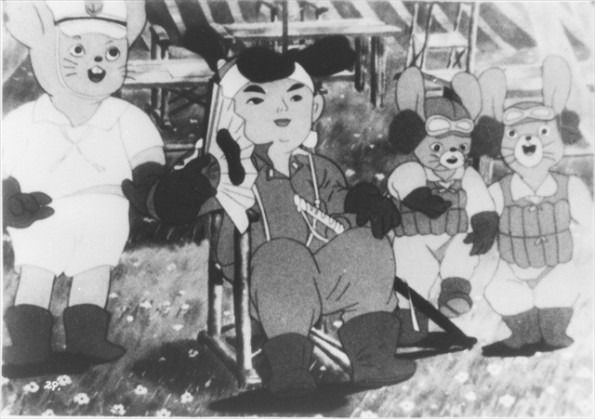
A children’s choir sings. We watch four humanoid animals in naval uniform walk across a beautiful countryside with Mount Fuji in the distance. A bear, a dog, a pheasant and a monkey watch in awe. The animals’ home village turn out to welcome the return of their warrior heroes, and we see them spending time with their families. There’s a little mild peril involving the monkey’s kid brother and a “borrowed” naval cap, and some risky teamwork from the sailor-animals to save him.
Then the film jumps to a Pacific island bay that reminded me strongly of the moments before the attack on Pearl Harbor from “Sea Eagles”. Elephants and rhinoceroses plow the land, and the other animals build a naval base. Meanwhile, a children’s choir sing about working hard while “burning in our little hearts is the power of Japan”. Then we hear the roar of engines, and the rabbit ground crew leap into action to accommodate the exquisitely detailed Japanese bombers.
The native animals watch in a blend of terror and curiosity as Momotaro and his warriors emerge from the aircraft. His very appearance makes them want to eat sushi1, and they quickly adopt the correct level of subservience to their Japanese masters, even down to learning their language.
Prepare For War With Ice-cream
At minute 39, Momotaro finally gets a line, during a mail call. Other animals get gifts, ice-cream – really? – and reminders of home and family. But the enemy is close. A reconnaissance flight gets badly shot up but gets home anyway. Momotaro gives his pilots a morale-raising speech and sends them off to fight. They prepare parachutes for the next day.
Then we jump to a silhouette fairy tale, talking of a good king and a beautiful island which is one day invaded by a Black Ship. The white men aboard her demand a piece of land to live on while they pursue honourable trade, all the while putting the king’s castle under the threat of their cannons. When the islanders refuse them entry, the white men quickly raise the Jolly Roger, and open fire. The Europeans conquer and enslave forever. This appears to be a story told to the animal heroes to rouse their spirits.
The jump back to animals charging around in normal animation is very jarring. The aircraft engines roar into life, and the paratroopers pile into their aircraft. The aircrew cheer their pilots on and away. Another rousing song later, the aircraft approach their target.
Consistently Incongruous
A thunderstorm lashes the Japanese heroes, and rain leaks through into the paratroopers’ seating area. But it clears enough to give them a clear run at the British. An incongrously cute rabbit clambers behind an exquisitely detailed anti-flak cannon, and the paratroopers hand around bento boxes like they’re on the bus to school.
The animals drop into the British base. The animation is horribly accurate. To give him his due, Momotaro is the first person out of the plane, even if the graceful music that plays as they fall is also really out of place. The British sportingly don’t fire at the Japanese until they’ve landed. Somehow the Japanese even manage to land a field cannon. Soon the sounds of war fill the air. Our cute animal heroes with their high-pitched, juvenile voices, grimly bayonet soldiers in stalled APCs, and charge into the badly defended base. The absurdly long-armed white men fall over themselves to surrender, and the Japanese animals capture enormous numbers of unused weapons.
I can’t put the end any more clearly than CLEMENTS and MCCARTHY did in their frankly essential2 “Anime Encyclopedia”, when they say3:
“Back home in Japan, the animals rejoice at the defeat of the British, while children play at parachuting…onto a map of the United States.”
Reviewing To Understand
Let’s not beat around the bush here; for all the skill and beauty of this cartoon, it was the single hardest watch I’ve had so far. I was expecting that; I can’t say I was expecting to feel this ill, this often. Cleverly and horribly, once again Seo has cast real children to play the Japanese animals. There’s a moment during the home-from-war sequence set in Japan when the creators clearly recorded children at play. Any parent, anywhere, would recognise that raucous playground hum. I’m a parent. Normally it makes me smile. In this context, it’s disgusting. I kept track of how many times this 71 minute cartoon made me want to throw up, and it ended up at seven.
The central theme of this cartoon is “isn’t training for war and killing our enemies awesome?”. And yes, it’s impossible not to have a certain sympathy for the fairy tale about Western greed, even if the actual facts of World War II fatally undermine it. But there is a fundamental clash between the style and the subject here that reminded me of the legendary Smurfs UNICEF advert from 2005 that ran in support of child soldiers in former Belgian colonies. Except that was deliberately jarring. If there’s any acknowledgement of the clash here, I couldn’t spot it.
Divided Work
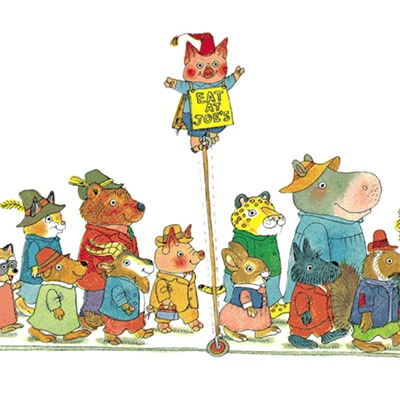
Let’s be positive for a moment. Seo’s art team here are simply superb. The influence of Disney’s work is very strong – some of the birds drawn here are clear homages to Snow White – but the style is unmistakably Seo’s own. That said, this is the eighth cartoon of Seo’s I’ve watched for the blog, and I only just twigged who his animal designs remind me of: American childrens’ author Richard Scarry. Subject matter aside, Seo gives the same sense of naivety and joy to his anthropomorphic animals that you see in Scarry’s. Which is, of course, part of what makes this film utterly horrifying.
There is a giveaway in the credits, which confirms Clements & McCarthy’s theory that this was the combination of work by different teams. Apparently the silhouette work was by MASAOKA Kenzō, who was also signed to work for Shochiku at the time.
I’m pretty sure that the frequent dip into rural beauty and accurate animation of animals and plants were a conscious distraction technique, to get away from the actual pro-war message that the cartoon was pushing to its audience. Maybe even the animators were getting depressed. Regardless, they all carry this out superbly.
Even The Music Doesn’t Help
The music is lovely and clever by turns, especially during the construction of the naval base. The use of “The Song Of AIEUO“, the Japanese alphabet song, is oddly touching, and I’m told it will show up in “Kimba The White Lion”, one of TEZUKA Osamu’s most famous anime4. The visuals accompanying it, with various animals working in harmony, are beautiful. But discomfort was never far away; the vision of everyone working together, as long as they can speak Japanese, successfully undermined several 1960s Disney fantasies that are only achievable if English is the common language instead.
This is the second and final appearance of the Shochiku Symphony Orchestra in animation. After the war, the Occupying forces would disband them. Their choir is used superbly as well. Despite myself, when I heard men singing on behalf of elephants and rhinos hauling timber, I felt the power of it in my chest. Propaganda is doubly dangerous when it’s made this well.
Reality Intrudes
As with “Sea Eagles”, there’s obvious real war materiel recordings used to build realism into the film’s world. I agree with Clements and McCarthy that “native English-speakers” were used to play the surrendering British officers, but I’d be willing to bet they were Indian POWs and not from the British Isles themselves. The surrender speech sounds like a parody of a Brit, not a real one, and the speech patterns are all over the place. But all the blood-curdling British death screams sounded legitimate enough. I don’t want to think about that any further.
My fears about this cartoon all ended up justified. If anything I was too confident about my ability to handle it. But it’s done. “Momotaro: Sacred Soldiers”: by policy, no score. And it isn’t going to be the last time I write that.
There was a terrible irony at the end, though. Momotaro thumps the table and demands an immediate and complete surrender from his enemies, and they fold like a house of cards. He was predicting the future; just not the one his writers thought he was.
FIN
And that just leaves a little historical tidying up to do next time. As usual my thanks go out to AniDB, who have helped me work out what to look for, and the inseparable pairing of Jonathan Clements & Helen McCarthy and their “Anime Encyclopedia”, and Clements’ own “Anime: A History”. Without them, this project would have been impossible.
I’d also like to thank the King County Library System of Washington State, for their sweet version of “The Song Of AIEUO”. Image of Momotaro is public domain, via Wikimedia Commons.
Leave a Reply