
SURRENDER
On July 14th, 1853, Commodore Matthew PERRY – no, really – was allowed to land his Black Ships – four cutting-edge steam-powered warships – at the port of Kamakura, in what’s now Yokosuka, at the mouth of Tokyo Bay. While his fleet arrived under a flag of truce, he carried a letter making it clear that if he wasn’t allowed to visit, he was ready to fight. And the Japanese knew they would lose. And so Japan began to open diplomatic relationships with the rest of the world.
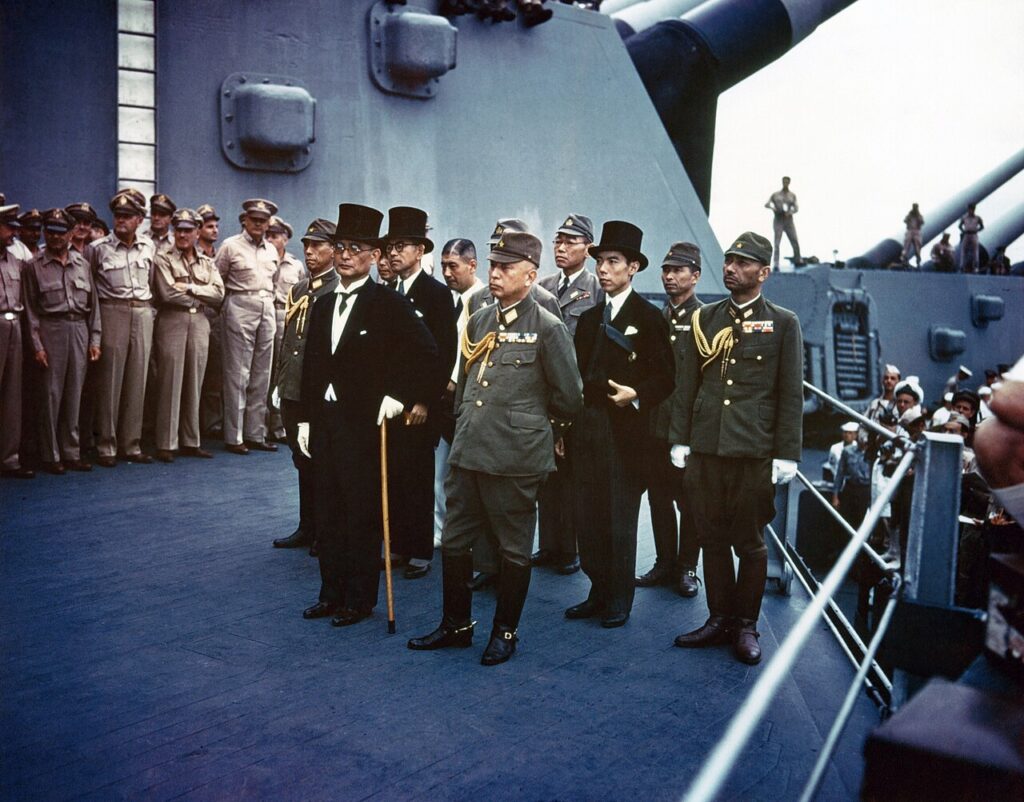
On August 29th, 1945, the USS Missouri moored at Kamakura. In addition to her usual complement, she also carried the 31-starred American flag that Matthew Perry – yes, really – had flown when he went ashore. After rough weather delayed the ceremonies for a day or two, the two sides met aboard the Missouri on September 2nd. General Douglas MACARTHUR of the American armed forces, and Japanese Foreign Minister SHIGEMITSU Mamoru, signed the Instrument Of Surrender. Japan had offically surrendered to the Allied Powers, and ended World War II.
Occupation
Strictly speaking, however, Japan remained in a state of war with the United States until 1952, and with the Soviet Union until 1956. The wheels of international politics can grind exceeding small, sometimes. For the next seven years, the USA occupied Japan. The Occupying Powers upended the country’s legal system and entire framework of governance. But they kept Emperor Hirohito in his place at the top.
One of the many things the Occupiers did was cancel the strict, censorious Film Law of 1939. Instead, they replaced it with a new Press Code – which was arguably even stricter and more censorious. Japanese filmmakers were now enjoined to avoid criticism of the Occupiers, the Allies and their leaders. They couldn’t even hint at fraternisation or black market activity between the Occupiers and the Japanese. And mentioning the widespread post-war food shortages was right out. And I’m only skimming the surface.
Still An Animation Blog
While I am a history buff, this blog came out of an effort to watch lots of anime. Believe it or not, I started with one from 1971. But Professor Litten‘s article about the beginnings of Japanese animation threw me all the way back to 1917. Before it’s anything else, this is a study of animation in Japan. So I have to mention some of what’s to come.
Countless future anime creators would, one way or another, set their work during Second World Wars of various historical fidelity. The most famous ones are 1983’s “Barefoot Gen” which covers the nuclear attack on Hiroshima, and 1988’s “Grave Of The Fireflies” which examines the firebombing of Kobe. Some of the others would concentrate on the innocent children and other civilians killed in the war. Others would choose to engage in historical revisionism, and refight the war to ensure a Japanese victory. Others would invoke what the Alternate History community calls “Alien Space Bats”. I suppose that’s humanity for you.
Still A History Blog
But writing this blog reminded me that I’ve found the study of history fascinating for years. Yes, I’m an anime fan, but as my heading says, this is a history blog. Of sorts, anyway. My research for these pieces is the first time I’ve studied World War II in the Pacific. The overwhelming sense that I’ve got from it is one of despair. None of the Powers involved had clean hands and everyone committed war crimes, but Japan’s ranked among the worst.
From a strategic and military point of view, Japan’s entire war, from 1937 onwards, bordered on disastrous. Her armed forces handled matters appallingly badly from start to finish, despite their many successes. Quite a lot of the time, they did so with little to no input from their supposed masters in Tokyo.
Japan was clearly completely wrong-footed by Nazi Germany’s decision to attack the Soviets. While their hand may have been forced by a lack of fuel oil, they chose completely the wrong time to go to war with the Allies. Most damningly, Japan seems to have conducted the war in an absolute certainty of victory. That is, until the bombing of Hiroshima. I am no expert, but by that point Japan’s defeat had appeared likely for at least a year.
I have no answers. There aren’t any. But the tenacity and determination of Japan’s animators to keep working, even in the face of destruction and defeat, is admirable in the abstract. Even if some of the animation they produced has actively repulsed me. And for the men and women who survived, the beat went on.
fin
The War is over. But this blog will follow Japan into its new era. The Occupation has begun, and Japan’s animation directors and creators are about reforge their industry into something new. At least, they are until a film that will never see the light of day derails everything.
As usual my thanks go out to AniDB, who have helped me work out what to look for, and the inseparable pairing of Jonathan Clements & Helen McCarthy and their “Anime Encyclopedia”, and Clements’ own “Anime: A History”. I must also tip my cap to the Japanese Animated Film Archive, who carried me through the pre-war period superbly, and of course to Professor Litten, without whom this version of my blog would never have existed.
I’ve been Douglas Howell, and I’ve been watching Japanese animation. Join me next week, please, as the changes to Japanese society begin, and begin to be reflected in the art its people create.
Japanese surrender party photo from Army Signal Corps, Public domain, via Wikimedia Commons.