
MACARTHUR PARKS ON JAPAN
While, quite famously, a small number of Japanese holdouts on remote islands didn’t get the memo until 1974, Japan surrendered on August 29th, 1945. The Fifteen Year War, that started with the invasion of China back in 1931, was finally over. Peace in our time, at last.
After their surrender in May 1945, the map of post-war Germany immediately changed. The Allies dissolved the Nazi government, and largely returned the territory they had captured to its original owners. Except for the parts the Soviet Union was camping on, of course. Then they broke the country into four occupation zones, one for each of the largest Allied powers. No-one German was officially in charge.
Japan, on the other hand, remained Japan. General MACARTHUR, now the effective leader of the country, was completely upending it. But he chose to use as much of the existing framework of the state in place as he could to enact the changes needed to democratise the country. And controversially even to this day, upon gaining Emperor Hirohito’s agreement that those changes would take place, McArthur insisted on leaving the Emperor in place and absolved him of any war crimes.
The Modern World
The island of Taiwan was given to China, and that’s all I have to say about that. The Kuril Islands to Japan’s north were now Soviet. The Korean peninsula was split between the USA and the Soviets, and both halves would eventually become independent. That’s also none of my business. Long-time readers will remember the Kwantung Leased Territory on the Asian mainland. It was the flashpoint that began Japan’s Fifteen Year War; by 1945 it was occupied by the Soviets. In 1955 it would return to Chinese control and remains so in the present day.
Hirohito was now an Emperor, and Japan an Empire, in name only. The Allied bombing campaigns, regardless of the two atomic attacks, had brought the country close to the brink of starvation. Despite the best efforts of the Occupiers, that wouldn’t change properly for years to come.
War is hell, and life is hard. But art endures. Despite all these tribulations, most of the people who had been making animation in Japan had survived the war, and wanted to get back to work.
So that returns me to the questions at this blog’s heart, reframed for the Occupation years. What did Japanese animation look like under Allied – let’s face it, American – rule? What made Japanese animation unique, as compared to what was being made in other countries? Who was making it, and why?
MEET THE NEW BOSS
Almost as soon as the Occupying Forces arrived, General EISENHOWER made sure that occupied Japan would become a bastion of that most American of values: free speech. A mere 25 days separated the signing of Japan’s surrender and the signing of a new edict. SCAPIN 66 “render[ed] inoperative the procedures for enforcement of peace-time and war-time restrictions on freedom of the press and freedom of communications.”1
Almost immediately after that, the Occupiers set up three organisations to make sure that the Japanese exercised their new rights in the correct ways. The Civil Communications Section looked after the technical and administrative aspects of Japanese media. The Civil Censorship Detachment “protected” the Japanese people from anti-democratic ideas. Finally, the Civil Information and Education Section taught the Japanese media about their new, pro-democratic responsibilities.
No stone was left unturned, to make sure that the Old Ways which led Japan into their war, were stamped out as hard as possible. Even the kamishibai paper theatre performances for children didn’t escape2. I’m a little surprised to find out that it was still going in 1946, given the form’s reliance on sugary sweets.
To a degree, this was necessary, given the sheer volume of propaganda that the Japanese had been subjected to across their Fifteen Year War. I’ve been writing about it for months now, and that was just the cartoons. On the other hand, Japan had rather fallen from the frying pan into the fire. There aren’t many countries who expect their children to salute their flag every morning.
MASAOKA JUST WON’T QUIT
I have mentioned my sometimes grudging admiration for MASAOKA Kenzō before. When you look at the animation he produced to this point and the names of his studios, it’s clear that his desire to Make Animation was basically inexhaustible. It’s clear that he was a remarkably stubborn man. So it doesn’t come as a surprise to me that he was among the first of Japan’s animators to get back on the metaphorical horse and start making cartoons again.
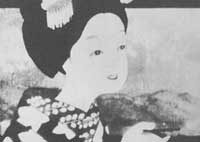
Granted, he was based in Kyoto, Japan’s former capital city, which the Allies hadn’t bombed at all to preserve its historical buildings. And the Occupiers were keen to put Japan’s animation back on track in a small handful of easily censorable places3. So Masaoka rifled through his Book Of Impressive Studio Names again and picked out “New Japanese Animation Company”, for his “Sakura: Haru no Gensou” / “Cherry Blossom: Fantasy of Spring” (Shin Nihon Dogasha, 1946). This film also saw YAMAMOTO Sanae begin his second animation career, now as a producer.
Normally I would ask my favourite question at this point; was it any good? But unfortunately the answer was, even at the time; no, not really. I watched it anyway.
Cherry Blossom: Fantasy of Spring
A pair of butterflies with child-like human bodies take flight as cherry blossoms fall around them. Tinny classical music plays. A pair of Japanese women in traditional dress play with the fallen blossoms. A boat gets punted through a river by an equally classically dressed man. Dogs jump and play. One cat gets annoyed as another tries to catch the butterflies. Kimono-clad girls join the dance. A balloon is lost and flies away, but the butterflies chase it down. Rain falls for a while, and then stops, and we see our butterflies relax, surrounded by a distinctly Japanese beauty.
Nothing happens in this cartoon, but it fails to happen in a very beautiful way. From a purely artistic point of view, this is quite a relief from what I’ve been watching for this project recently. But the issues with the version I watched have nothing to do with the conversion process. It’s impossible to give a cartoon this thin a particularly good score. “Cherry Blossom: Fantasy of Spring” gets 3/10. But that was better than nothing.
That was not, unfortunately, the view of the film’s supposed distributors, Toho. “Cherry Blossom” was doomed from the start. The classical music score was part of “Invitation To The Dance” by Carl Maria von Weber. In line with pre-war policy, the studio hadn’t paid for it4.
That was never going to fly with the Occupying censors. The cartoon was never shown publically thanks to a “combination of poor materials and damaged cels”5. In addition, the cartoon’s central image of the cherry blossom had been fatally corrupted by its usage as “a poetic allusion to kamikaze pilots”6.
UNION AND DISJOINT
Masaoka’s future remained bright, though. He would give a series of lectures on animation to some forty Toho staff, called the “Cartoon Film Special Education Course”, which would ground their new animation department in sound practice. Apparently, beaten-up copies of his lecture notes would be passed around the industry for decades to come.
But that meant, in his continuing efforts to Make Animation, Masaoka had got into bed with Toho. For their part, Toho were desperate at the time to, as animator USHIO Soki put it in his autobiography7;
“think of projects that were in line with the GHQ Occupation policy, in order to feed various people including Japanese and Western-style artists…and animation cameramen.”
As a result, while animation staff continued to be used for subtitles and title sequences, Toho also stuffed animated sequences into otherwise live-action films. This appears to have been to give their staff something to do, and therefore justify their paychecks.
I’m All Right, Masaru
But as part of their efforts to “democratize Japanese industry”8, the Occupation forces had allowed the forming of unions. A Communist faction in the Toho branch of the newly formed Japanese Motion Picture and Theatrical Workers Union had successfully pushed for a fifteen-day strike in early 1946, to ensure better pay and union representation on production committees. I don’t mind any of that. The problem came in the spring of the same year, when the union published a list of “war criminals” to be drubbed out of the film industry immediately.
This was absurd on several levels. Firstly, Japan had been at war for fifteen years. As I hope my reviews have made clear, scrubbing out anyone in the industry who hadn’t been involved in propaganda cartoons at some level would have left Toho with a staff of three men and a dog. Given the leftist leanings of some of the participants, especially those who had worked with Prokino in the 1930s, it also would have meant throwing out the Socialist baby with the bathwater.
Finally, it was in direct conflict with the stated desires of the Occupiers. Fully aware of their own nation’s efforts in that area, they made it clear; “the creation of propaganda is a natural by-product of war”9. It was official; making “Der Fuehrer’s Face” or “Momotaro: Sacred Soldiers” was no more a war crime than shooting someone wearing a different uniform than you.
Breakaway: The Birth Of Shintoho
Another strike would follow in October 1946. The Communist faction had been aggressively expanding their presence in the industry, and eventually won a closed-shop demarcation deal. If you weren’t in the union, you couldn’t work for Toho.
This was the final straw for many in the company, and a group of ten live-action stars quit to form a new studio, Shintoho – literally, “New Toho”. Clearly displeased with the whole affair, the Occupiers issued an expulsion order that forced Toho Prime to fire and replace their entire management team. And that order had serious consequences.
FIN
But I won’t be looking at those for a couple of weeks. Next time, I’ll be looking at the other Japanese cartoons I was able to find from 1946. As usual, my thanks go out to AniDB, who have helped me work out what to look for, and the inseparable pairing of Jonathan Clements & Helen McCarthy and their “Anime Encyclopedia”, and Clements’ own “Anime: A History”. Without them, this project would have been impossible.
I’d also like to thank Japanese railhead Tanner, for helping me with a certain studio name, and Mark McLelland, whose article “Sex And Censorship During The Occupation Of Japan” was incredibly helpful.
- Rubin, “The Impact of the Occupation on Literature or Lady Chatterley and Lt. Col. Verness,” in The Occupation of Japan: Arts and Culture, edited by Thomas W. Burkman, Norfolk, Virginia: General Douglas MacArthur Foundation, (1988): 167–74, 169, from “Sex and Censorship During the Occupation of Japan”, Mark McLelland, 2012. ↩︎
- Mary Louise Pratt, “Arts of the Contact Zone,” Profession 91, New York: MLA, (1991), from “Sex and Censorship During the Occupation of Japan”, Mark McLelland, 2012. ↩︎
- Hu Tze-yue, “Frames Of Anime: Culture And Image-building”, p. 79, 2010, in Clements’ “Anime: A History, Second Edition”, p. 108, 2023 ↩︎
- Hu Tze-yue, ibid. ↩︎
- Tsugata Nobuyuki, “Nihon Animation no Chikara: Hachijugo-nen no Rekishi o Tsuranuku Futatsu no Jiku” / “The Power Of Japanese Animation: Two Axes Running Through An 85-year History”, p116, 2004, in Clements’ “Anime: A History, Second Edition”, p. 108, 2023 ↩︎
- Hu Tze-yue, ibid. ↩︎
- Ushio Soji, “Tezuka Osamu to Boku” / “Tezuka Osamu And I”, p. 210, in Clements, “Anime: A History, Second Edition”, p. 109, 2023 ↩︎
- Hirano Kyoko, “Mr Smith Goes To Tokyo: Japanese Cinema Under The American Occupation, 1945-1952”, p 213, 1992, in Clements, “Anime: A History, Second Edition”, p. 113, 2023 ↩︎
- Clements, “Anime: A History, Second Edition”, p. 113, 2023 ↩︎