
BATTER UP
This is a strange week for this blog. While there’s only one cartoon from the year that’s available for me to watch, it’s arguably the most important and difficult year in Japanese animation history. The events of 1949, and specifically the total failure of one specific film, would negatively impact the industry for years to come. So I’m going to start with whatever fragments of positivity I can find.
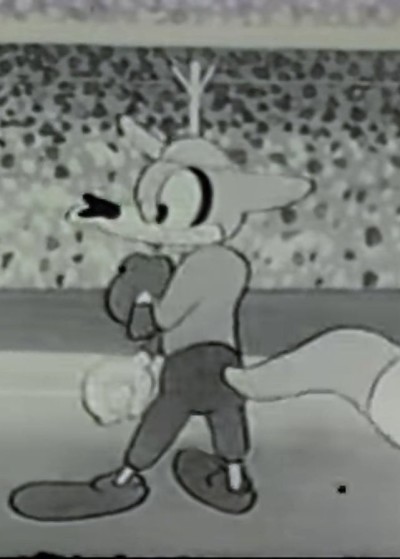
And that means watching and reviewing “Kitsune no Homerun Ou” / “Seventh Inning Stretch” (Kindaieigasha Co., September 1949), although that title’s probably better translated as “Fox, The Home Run King”. MORINO Satoshi has returned with his hero fox, and it’s the third baseball story to come out of a Japanese animation studio. So: is it any good?
“Seventh Inning Stretch”
This is another dub from East-West TV and Medallion TV in 1957. As with Morino’s previously imported work, there is English narration, and I could hear fragments of unedited Japanese narration under that in places. But I can still wriggle under my no-dub rule, because once again, the action is telling the story.
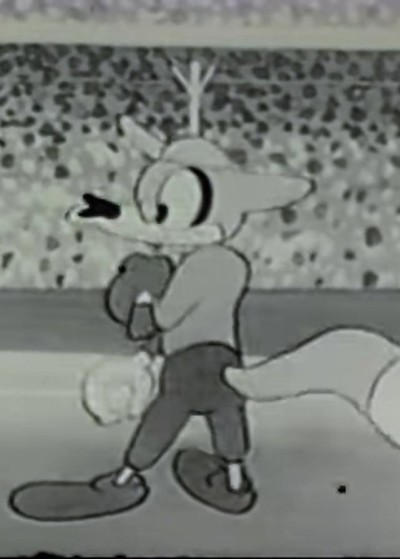
But the review is going to be very short. The Foxes play the Rabbits at the old ball game, and Homer Fox is his team’s best hitter. And baseball comedy happens; a failed stolen base here, a ball that dodges the bat there. Until Homer takes to the plate with the bases loaded, and hits a home run. And then more baseball comedy ensues, until Homer faces Lucky, the Rabbits’ best pitcher.
The cocky devil takes two strikes while showing off for the crowd (and one vixen in particular) before buckling down to work. But there was no joy in Foxville – mighty Homer has struck out. And the cartoon ends as the vixen walks away sadly.
On The Reserve List
This was more than a little weak. The narrator was ok, but her script had a couple of avoidable blunders in it. Whoever wrote it doesn’t seem to have understood baseball at all, which is odd. I do have to applaud whichever American censor let the first ever anime’s nut shot go through. One of the rabbit pitchers hits a fox batter right in the groin, much to the rabbit fans’ delight.
There’s a lot of obviously repeated sequences, presumably to cut costs, but the actual animation isn’t too bad. I’ve been spoiled lately by MASAOKA Kenzō‘s marvellous Tora-chan cartoons. But this cartoon doesn’t tell much of a story – we didn’t see the scoreboard once – which is disappointing given how story-making baseball can be.
“Seventh Inning Stretch” scores 4/10. A better cartoon might have launched Lucky Rabbit and Homer Fox into fame and ongoing success. Kindaieigasha should have done more.
LOST ANIMATION: CELLOS AND KITSUNE
Normally, discussing the animation that either hasn’t made it to the present day, or simply isn’t available online, is the saddest part of my writing week. That isn’t the case for 1949; frankly, this feels like a welcome pause before the crash.
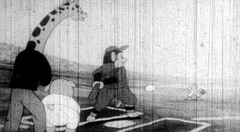
I could only find a single very well-drawn still of “Doubutsu Dai Yakyuu Sen” / “Animal Baseball Battle” (Nichido, December 1949) by KUMAKAWA Masao and YABUSHITA Taiji. This time around, so AniDb tells me, a squad of gorillas blasts a multi-species animal team clear off the diamond. Perhaps it’s available offline somewhere, but it’s unclear exactly where.
Back in 1934, the highly regarded Japanese poet and children’s author MIYAZAWA Kenji wrote a short story called “Cello Hiki no Gorsch” / “Gorsch The Cellist”. Four different directors would animate the tale between 1949 and 1982. TANAKA Yoshitsugu directed the 1949 version; unfortunately, it’s lost. The other three are still around, and hopefully I’ll eventually get to see and review the most famous take, an award-winning film from 1982, by future Studio Ghibli icon TAKAHATA Isao. His animation debut can’t come soon enough.
Miyazawa’s work would be adapted at least nineteen times between 1949 and 2016, and I have a personal soft spot for the 1985 version of his “Night on the Galactic Railroad” from SUGII Giasaburou and Group TAC. But we’ll get there eventually too.
Finally for this section, there’s “Furuike Emaki: Kaeru to Kitsune” / “Furuike’s Story: Frog And Fox” (Unknown, February 1949), directed by NISHIO Yoshiyuki. It’s also completely lost, and appears to be Nishio’s only directorial credit. I couldn’t find out anything else about him.
THE WORST OF YEARS: JNR AND POPPOYA-SAN
Sometimes, when I’m doing my peripheral research about Japanese history to do my best not to make too many silly mistakes, I fall across a story that’s too weird, too funny, or too disturbing not to share with my readers. This is one of the latter.
Any list of “worst years in railway history” probably starts with the British Panic of 1847. But Japan National Railways’ 1949 has probably got to be in the top three, not least because they only existed for half of it. The Japanese Ministry of Railways created JNR as a semi-private company on June 1st, 1949. But the job of running it was seen as a poisoned chalice. One source suggests, and I am paraphrasing the machine translation here so have your pinches of salt at the ready, that anyone who wanted the job “would have to be a martyr, very brave, or an idiot.”1 If the prediction was real, it would come horrifyingly true, very quickly.
Former civil servant SHIMOYAMA Sadanori drew the short straw and became the company’s first president. The Japanese railway unions immediately called for a month of strikes. I think they were so severe that the Occupying forces pushed the Japanese government to use emergency powers to break them. Two days after the strikes ended, on July 4th, Shimoyama sent notices of dismissal to thirty-seven thousand railway workers.
How To Disappear Almost Completely
While being driven to work the following morning, at roughly 9:30 am, Shimoyama ordered his driver to stop outside a major department store. He went inside. He was meant to be at a meeting half an hour previously. Instead, he vanished.
Later, after the police started asking questions, various people claimed to have seen him over the next eighteen hours. The final claim saw him entering a train station in northern Tokyo, in the last few hours of July 5th.
At 1:00am on the morning of July 6th, Shimoyama was found dead, on a train line. A freight train had hit him. It literally tore his body apart, but the autopsy showed that he was already dead when it happened. After months of investigation, the police and coroners declared an open verdict; they didn’t know if it was murder or suicide. And they still don’t.
On July 15th, an unmanned train with the operating handle tied down crashed into Mitaka Station in East Tokyo. Six people died. While conductor TAKEUCHI Keisuke was imprisoned for life for causing the accident, the facts of the case, and the validity of his guilty verdict, remain questioned to this day.
On August 17th, a passenger train derailed in Fukushima Prefecture in central Japan, killing three crew members. Twenty people were imprisoned for sabotaging the train; after two re-trials, in 1961 all twenty were found innocent. The case was closed without result in 1970.
Why Is All This Relevant, Douglas?
I’m glad you asked.
In June of this year, Nichido Eiga delivered the second of their two animated JNR training films. Like the first, it was directed by KUMAKAWA Masao: “Poppoya-san Nonki Kikanshi” / “Poppoya-san the Carefree Railroad Man” (Nichido Eiga, June 1949). But when Nichido asked for payment, the answer was simply, “no”. Apparently there was no written contract.
Quite understandably, neither of the Poppoya-san cartoons are available online, and the second one appears to be lost completely. Unless it’s lurking in a Japanese Railways Group warehouse somewhere.
FIN
That was a whole lot of hardly any cartoons. But that seems fitting for 1949. Next week, I’ll be discussing the feature length film that ended careers, destroyed companies and nearly killed the Japanese animation industry: “The King’s Tail”.
As usual, my thanks go out to AniDB, who have helped me work out what to look for, and the pairing of Jonathan Clements & Helen McCarthy and their “Anime Encyclopedia”, and Clements’ own “Anime: A History”.
Images from “Seventh Inning Stretch” and “Animal Baseball Battle” taken from AnimeSchedule.
- Yuji Moronaga, “The Buried Summer: Tracking Down The Mountain Incident”, p. 34, 2002. But I remain unsure of this title. ↩︎
Leave a Reply