
MORINO SATOSHI: BIG TOP FUN
A lot of cartoon directors from this period were essentially one-and done. I feel that’s a fair assessment of MORINO Satoshi, creator of “Kitsune to Circus” / “The Big Top Crime” or “The Fox And The Circus”1. IMDB disagrees with me, saying that he made three more fox-related films in this year. Given the struggle that other, established animators had to get even one short film out in this period, I’m dubious. Regardless; was it any –
Oh. It’s the dub made for import into the West by East-West TV and Medallion TV in 1957. And I have a policy for this kind of thing; Unless I have a very good excuse, I only watch subtitled anime. Thankfully I have one this time; this has no voice actors, just a narrator. So I can still ask the question; was this any good?
“The Fox And The Circus”
The shadow of a thief with suspiciously foxy ears cracks open a huge safe and steals the – yeesh – CantHawkMe Diamond. They paint and bury it to look like a rock with plans to come back later for it. But the circus is in town! We watch a mouse, a dog and a donkey set it up as actual jazz plays, until their work leads them to accidentally dig up and steal the diamond, using it – and a hundred other rocks – to hold the circus equipment together.
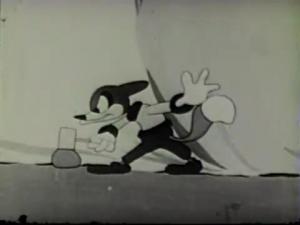
Naturally, the fox has to check every stone that the other animals used to fix the circus tent. Naturally, shenanigans ensue, including an amusing comedy routine where the fox is forced to play the straight man to the donkey’s clever tricks. After a traditional chase, the fox is captured and the diamond is recovered. And the ending is very abrupt.
Japanese Silly Symphony
The animation was decent enough, and the cost-saving measures the creators took were smart and as well-disguised as you could hope for. At the start they made a virtue of their lack of funds, by essentially making the first minute or so silhouettes painted on to cels, to hide the identity of the master criminal.
The music is jolly enough, and fits my Western expectations of this style of slapstick-heavy cartoon. It’s an attempt to make a Silly Symphony or Merrie Melodie for a Japanese audience, and given a little luck, it’s easy to imagine this as the start of an equally long-running series.
This is fine. No particular message beyond “don’t be a thief” is being stuffed down children’s throats, and as part of a larger day at the cinema, I imagine the audience liked it. But I doubt they remembered it for long. “The Fox And The Circus” scores 5/10.
One wild stab in the dark: I don’t think the original cartoon had a narrator. It didn’t need one. The story is told by the animation. Alright, the single untranslated Japanese text isn’t readable by English speakers, but a circus poster looks like a circus poster everywhere. Most of the narration was pointing out the obvious to an audience that’s assumed to be too thick to pay attention. Oh well. Morino’s Fox will return again next year.
MASAOKA AND TORA: THE CAT COMES BACK
I try not to give out perfect scores. But 1947’s “Tora The Stray Cat” from Nihon Dogasha and the Most Stubborn Man In Anime, MASAOKA Kenzō was just too good. Giving it anything but a 10 would have been silly. It clearly put bottoms in seats, because Masaoka’s reclaimed stray hero returned in 1948 with “Tora-chan to Hanayome” / “Tora-chan And The Bride”2 (Nihon Dogasha, February 1948). Was this one any good?
“Tora-chan And The Bride”
Tora and Miike are playing on a roof, while we watch their un-named, suddenly aged-up Sister Cat prepare for her wedding. She’s getting married to a bespectacled cat in a Western three-piece suit. But disaster is literally on the horizon in the shape of a boat carrying Grandfather Cat, a stern-looking figure in traditional Japanese clothing. A letter arrives from him, saying that the wedding’s off!
The fiance decides they’re going to have the ceremony before the old cat gets there1 and for some reason that involves loading wardrobes and drawers into a horse-driven carriage. Tora and Miike help make it happen, and not in a cute “aww, they’re trying” way either. The party flee, and Fiance tells the two kittens to stay behind to stall Grandfather2.
When he arrives, Tora and Miike try to cute their way out of the mess their step-uncle-to-be has put them in. They don’t do too badly, even if Tora gets stuck in the family’s upright piano and has to dodge its hammers for a while.
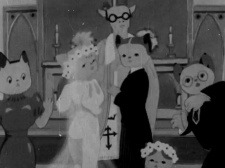
Then the chapel bells ring; the wedding is starting, and Grandfather is furious. He grabs the kittens and bolts for the chapel. But when he arrives, he changes his mind; with a “well, the times are changing!”, he gives his grand-daughter a necklace and laughs hugely.
Itty Bitty Indistinguishable Kitties
There’s a characteristically smart Masaoka moment at the start. Miike and Tora are goofing around on the roof and fall off; they’re safe, but we’re shown their dizziness with some fantastic manipulation of the background. Cheap and effective. Grandfather Cat is drawn and voiced with weight and dignity, which allows the kittens to strip him of some of it for comic effect.
But I keep saying “the kittens”. Tora and Miike have lost some of their individuality this time around. Tora’s tiger-stripes aren’t as visible and the pair are more obviously using the same model. While this is still as good as you were going to get in Japan in 1948 – unless the next director pulls out a miracle, which he just might – it’s still a noticeable step down from last year’s superlative effort. “Tora-chan And The Bride” is still worth your time though, and scores 8/10.
Before the actual cartoon rolled, though, there was something worth noting. Although it’s the only time they used it as far as I can tell, Nihon Dogasha Kyokai3 has a logo; a trio of vaguely bird-like figures, each one holding different animating equipment, standing over a graphic reading NDK. They’re clearly meant to be Masaoka and his two studio co-founders, YAMAMOTO Sanae and MURATA Yasuji. From the earliest frames, this was a statement of purpose. Even if this was distributed through Toho, Nihon Dogasha wanted to be seen as the big dog in Japanese animation.
OFUJI NOBURO: BEAR WITH US
Finally for this year, groundbreaking artist and director OFUJI Noburo got back into the studio to make “Kuma ni Kuwarenu Otoko” / “The Bear Dodger” (Sanko Studio, September 1948). Oddly, the Japanese Film Archive that I leaned on so heavily in this blog’s early days don’t make any reference to it. No idea why; was it any good?
A samurai and a peasant are walking through a forest. They’re looking for companionship in a dangerous time and place. They start travelling together, but the peasant accidentally hits a baby bear with a stone. He laughs at it, and when a frog laughs at him, the peasant decides to bully that instead. Thankfully the samurai protects it. The bear cub, in floods of tears, goes and gets Daddy Bear – who has a snout for some reason – to sort the nasty humans out.
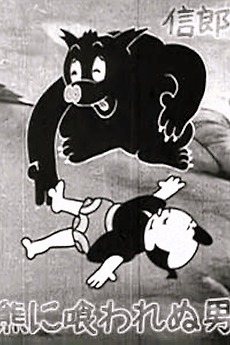
The peasant decides he’s had enough of walking and slumps over. Then the bear shows up and suddenly he’s got enough energy to climb a tree. The samurai flees, but everything turns against him; an apparent bridge is actually a snake, that sort of thing. But the frog he saved in the first half saves him in return; lie down, bears don’t eat dead things. The bears wander off looking for food, and the humans – after the peasant apologises – carry on over the mountain pass. And that’s it.
Bearly Ofuji
This was odd. The backgrounds show Ofuji’s usual attention to detail, with his chiyogami paper artistry in full flow. But none of the characters are up to his usual standard. His usual lazy-hero samurai Dangobei was the central character in this film, but I couldn’t tell because his design was simply too different. This looks like a creative misunderstanding of Max FLEISCHER’s work, and frankly, given some of the things he’s done up to this point, I’ve come to expect better from Ofuji.
The voice acting and music are both fine. But the re-use of animation sequences was obvious, and the story was distinctly flat. Ofuji can be brilliant, but this time around he was just disappointing. “The Bear Dodger” is only worth 4/10.
fin
That’s all I have for 1948. As usual, my thanks go out to AniDB, who have helped me work out what to look for, and the inseparable pairing of Jonathan Clements & Helen McCarthy and their “Anime Encyclopedia”, and Clements’ own “Anime: A History”. In addition, I’d like to thank the Japanese Film Archive.
1949 would be a turning point in Japanese animation history. But not for a good reason. SEO Mitsuyo, the director of “Momotaro: Sacred Sailors” was trying to make his post-war return. It would fail spectacularly. Come back next week, when I’ll be talking about “The King’s Tail”, arguably the greatest flop in anime history.
Image of “The Fox And The Circus” from FilmAffinity.
Leave a Reply