
THE DOLDRUMS CONTINUE
1955 marks the second low point for Japanese animation. Things hadn’t been this bad since 1918, when three Japanese studios discovered that making cartoons didn’t mean making money. The demand was there though. It was just being filled by imports. Daiei Film’s deal with Disney was continuing to pay off for everyone involved.
This was the year that “Peter Pan” (Walt Disney Productions, 1953) and “Fantasia” (Walt Disney Productions, 1940) offically got to Japan. So did “Toot, Whistle, Plunk and Boom” (Walt Disney Productions, 1953). That was the first animated widescreen Cinemascope film, and it picked up an Oscar in 1954.
The thirst for Western animation in Japan didn’t stop at America, though. In France, in 1952, animator Paul GRIMAULT had been partway through making “La Bergère et le Ramoneur” / “The Shepherdess And The Chimney Sweep”, an adaptation of a Hans Christian ANDERSEN story. But his producer decided to release it unfinished, much to Grimault’s fury. He wouldn’t be able to make a version to his own satisfaction until 1979.
But it’s a good job the release happened. When it got to Japan in 1955 as “Yabunirami no Bokun” / “The Mistaken Tyrant”, a lot of Japanese animators fell in love with it. Most notably, TAKAHATA Isao and MIYAZAKI Hayao enjoyed it enough that it became a key influence on their future work. You will, of course, recognise their names as the core of Studio Ghibli. Their animation debut together can’t come soon enough for me.
oh joy: politics!
I have to get the real world stuff out of the way next. In November of 1955, two existing political parties merged to form the conservative and nationalist party, the LDP. It’s been in power ever since, except for blips between 1993-6 and 2009-12. You may think that a political system that doesn’t have an effective opposition party of any kind is a bad idea. I couldn’t possibly comment.
It was also the year that the Vietnam War began. Japan was in something of a cleft stick over the conflict. They had no armed forces of their own. Their government was trying to expand trade across the world, to stabilise their economy. The last thing they wanted was another proxy war between America and the Communists, basically on their doorstep. The one in Korea had only just finished.
On the other hand, the US had turned the Ryukyu Islands into an enormous military base. Their stations in Okinawa would be used as a major staging post throughout the war. Vietnam would be a warzone until 1975. Because very few people in Japan were involved in, or directly affected by the war, there was exactly one manga and zero anime made about it. So apart from these two paragraphs, I’m not going to talk about it.
Television Innovation
Radio Tokyo TV was launched in 1955 as well. That’s a very ambiguous name in English, so I’d better make it clear that it was a TV station. They started out showing a mix of American imports and sport to the people of Tokyo. The station would one day be the home of “Sasuke” / “Ninja Warrior” and “Takeshi’s Castle“. But I won’t talk about them again until 1962, which is when they re-entered the world of anime.
It was also when Japan Telegraphic Communicatio, changed it’s name to Dentsu Advertising. They were already one of Japan’s biggest radio and film advertising companies, and they wanted into TV. Dentsu achieved their goal by getting involved in making the TV programmes that ran around their adverts. By the end of this decade, they had their hands in “60% of primetime”1.
Japan’s Single Cartoon
Between the demand from cinema and the expanding television market, animated adverts were the entire Japanese animation industry in 1955. Well, almost. Japanese animators made exactly one proper “cartoon” in that year, and it was only seen once.
It came from the pen of successful mangaka, YOKOYAMA Ryūichi. He started his newspaper career back in 1929, doing single-frame gag comics which sold reasonably well. But in 1936 he hit the jackpot with a new character: Fuku-chan. He was a cheeky little urchin with a wide head, a big hat and a cheeky grin. He started life in Yokoyama’s ongoing yonkoma or four-panel comics, called “Edokko Ken-chan” / “Edo-Era Kenny” in the Tokyo Asahi Shimbun newspaper. Yokoyama had to shove poor Ken-chan to one side, and he renamed the strip after Fuku-chan.
The strip was successful enough that the Imperial Japanese government turned it into a trio of wartime propaganda cartoons. They were 1942’s “Fuku-chan’s Surprise” which I haven’t seen, 1943’s “Fuku-chan’s Increased Force” which is lost, and 1944’s “Fuku-chan’s Submarine” which was a reasonable enough example of its kind.
Yokoyama Meets Uncle Walt
After a period of ill-health after leaving the Japanese Navy, Yokoyama got back to work, moving his strips to the Mainichi Shimbun. In 1951 he went to the US as part of the delegation which eventually agreed the peace treaty between most of the Allies and Japan, and managed to sneak in a meeting with Walt Disney himself. And that might just have sparked something in him.
According to the indispensable “Anime: A History” by Jonathan CLEMENTS, he got home and bought a 16mm camera, and enough colour film to make a 25-minute long cartoon. He “called in numerous favours from famous friends” and threw a screening at a famous cinema in Tokyo that appears to have been a red-carpet affair2.
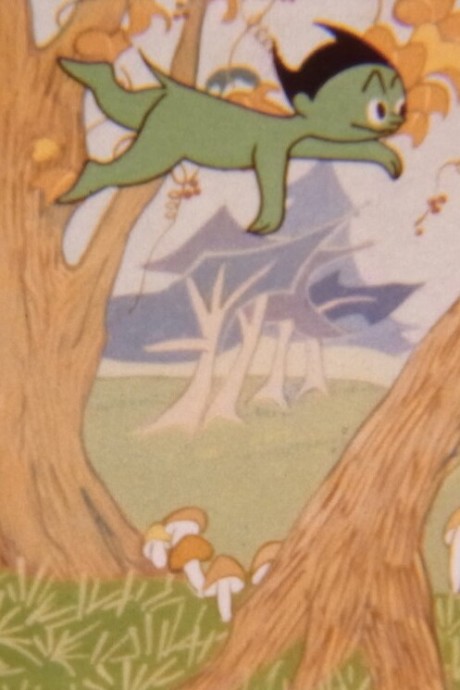
The film was “Onbu Obake” / “Piggyback Ghost” (Independent, 26 December 1955). It was never shown again. Everything else I know comes from the research of Thorgott2, a forum member at AniList. The original film was donated to the National Film Archive of Japan in 2018, and is in terrible shape. Exactly three frames of it still exist for public viewing. If it wasn’t for Thorgott, this article would have no pictures at all.
While his film hasn’t got much of a footprint left, it would all work out for Yokoyama in the long run. But I’ll talk about that in a couple of weeks.
The Lost Violin
The only other cartoon made in this year that I could find out anything about was “Ukare Violin” / “Violin Exam” (Unknown, 1955). It was by YABUSHITA Yasushi, who was working for Nichido at the time, and ran for 13 minutes. There’s is a print still in existence, because the National Museum of Modern Art in Kyoto showed it at an animation history event in 20113. But it’s not online, and references to it are pretty sparse.
fin
And thankfully, the low is over. 1956 wouldn’t exactly be a banner year for Japanese animation, but it would be better than this. As always, my thanks go out to AniDB, who have helped me work out what to look for, and the inseparable pairing of Jonathan Clements & Helen McCarthy and their “Anime Encyclopedia”, and Clements’ own “Anime: A History”. I must also thank Thorgott2 again, for helping me keep the SEO gods happy.
I’m Douglas Howell, and I’ve barely been watching anything at all. Come back next week, where there will be enough material for me to start doing one year at a time again.
Leave a Reply