
1954-1959: The Empty Years
Japanese animation wasn’t quite at rock bottom in 1954, but it wasn’t far away. As far as I can tell, Japanese animators only made three watchable films in 1954.
However, when it came to live action films, it was a monster year for Japanese cinema. Literally: this was the year when Toho Films made “Godzilla”, starting the longest running film franchise in history, and beginning the first wave of Japanese tokusatsu or “special effects” productions. It looks like firing a certain person as chairman was a good idea. Who knew? The company wouldn’t get around to making an anime with Big G in until 2017. But even if they hadn’t, it would be ridiculous not to mention the King Of The Monsters. So I have.
1954: THREE AVAILABLE FILMS
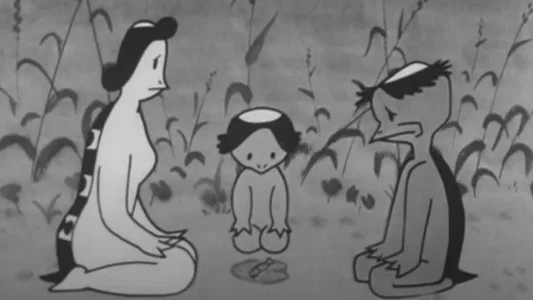
But I could find a trio of films from this year. YABUSHITA Taiji directed the first one I’ll be looking at. It was his second film, although the first – 1949’s “Animal Baseball Battle” – is lost. He also worked with MORI Yasuji on “Story Of The Little Rabbit”. So the first of his cartoons I could actually watch was “Kappa Kawatarou” / “River Taro Kappa” (Nichido Eiga, April 1954).
The kappa are one of the big three kinds of youkai, alongside the oni/demon and the tengu/bird-monster. Kappas are slimy, green, child-sized creatures, with duckish beaks and long hair everywhere on their bodies. Except for the tops of their heads. There, they have a dish-like structure that must always be kept full of water. If it dries out, the kappa loses its strength, or sometimes dies. And I’m very surprised that it’s taken until the mid-fifties for a kappa to show up in a surviving animation. Anyway: was it any good?
“River Taro Kappa”
We begin with live-action, as an animator draws a kappa with a traditional brush-pen. Then, of course, the kappa comes to animated life and the story begins. We meet first a family, then an entire village of kappas. They entertain themselves with sumo, all quacking away happily to each other. A nearby dog steals the village’s fishbones, and then a storm comes in.
One of the kappa sounds an all-clear – no, really – and the entire village starts looking for fish in their river with little success. Sad music plays, and the family give their child the only sardine. The village has an angry meeting which solves nothing. The family try and hunt bugs to eat. They only find the dog, who chases them into a forest.
But that’s where they learn that a landslide has cut their river off and wrecked their food supply. Armed with this knowledge, the kappa swim upstream, clear the blockage, and live, one must presume, happily ever after.
Subtext Is For Cowards, Again
It’s a very benshi driven story, which ought to make this old-fashioned and sweet. But the kappa aren’t doing spooky youkai things in this. Instead they’re standing in for the Japanese people, their homes wrecked by the storm of Allied attacks. A crowd of kappa fighting over a single fish could have been a slapstick joy. Instead, Yabushita ends up reminding the audience of the food shortages in their country following the War. And the finish, where the audience is told that they can and have fixed their problems by working together, is also a little unsubtle.
It’s a beautiful piece of work, though. The storm is brilliantly portrayed, the dog looks a little strange to Western eyes but is animated well, and the music bounces along very nicely. I found myself wondering if I was going to have to deny this a score, for being propaganda.
Cake Or Propaganda?
Nichido Eiga and Yabushita were trying to tell a good, emotionally powerful story about the struggles of Japan’s civilians in the post-War period. They were also encouraging the viewer to think that their future was in their own hands. But I think this cartoon falls between two stools. It would have been too emotionally draining for even 1950s children, and too obvious for any adults in the audience. So I had to go out for a metaphorical smoke before I wrote the next paragraph.
This was a fascinating cartoon from a historical point of view, speaking as it does to the challenges and resolve of Japan’s people, after their defeat. But I don’t score things as a historian, and beautiful animation can only take you so far. So “River Taro Kappa” scores 4/10. This was the first surviving work from a man who would become very important to Nichido Eiga, and to the company that would soon buy them out.
Doggy Dialogue
Next from this year was “Cinterrier-jou no Hanamuko” / “Miss Cinterrier’s Bridegrooms” (Motion Times, July 1954). I came in knowing three things. Motion Times never appear to have made another cartoon, I couldn’t for the life of me work out who directed it, and “Cinterrier” is a terrible joke on “Cinderella” that only lands if you try and say Cinders’ name in Japanese. So: was it any good?
“Miss Cinterrier’s Bridegrooms”
We are quickly introduced to our heroine, and the various other anthropomorphic dogs who will feature in the film. There’s a few here that I can’t see making it past the first rose ceremony. Former Miss Wan Wan1, Cinterrier is well-off enough to powder and perfume herself for the day ahead. She walks through some Japanese streets, distracting every male dog that she meets.
We see Akita Kenji win the world boxing title, and unsuccessfully plight his troth to Cinterrier, ending up as her bodyguard instead. She isn’t interested in Bull George’s wealth, or the prestige of Duke Airedale’s pedigree certificate. But when a nearby dog suddenly turns rabid and attacks our heroine, and Akita turns tail and flees, only one dog stands up to protect Cinterrier. That’s the appropriately licenced and vaccinated Ted Regist – oh god, Regist Ted, registered, I saw the name but I didn’t work out the pun until it was too late. Then Cinterrier hits the audience over the head with it. And marries him, dear reader.
Shaggy Dog Licence Story
The version I was able to see was jerky and the sound was very stop-start too. Unfortunately, those weren’t the real issues. Some of the character work was excellent, and at least one of the stills looked to be manga-quality. But the actual animation, the backgrounds, and even the music, were all put together very cheaply.
This cartoon wanted us to think it was an adaptation of a manga. Maybe it was: thankfully it doesn’t matter. This is a public information film telling you to vaccinate and register your pets, and while it wouldn’t have scored very highly if I’d had to, I don’t. “Miss Cinterrier’s Bridegrooms” counts as propaganda: by policy, no score.
Ofuji Flutters By
Finally for this year, there’s the welcome and almost inevitable cartoon from OFUJI Noburo: “Hana to Chou” / “The Flower And The Butterfly” (Chiyogami Eigasha, October 1954). When Ofuji lets himself, even this far into his esteemed career, he can still be very good. I don’t feel he’s managed to reach the heights of his skill pre-war, though. But was this one any good?
“The Flower And The Butterfly”
A white-winged girl butterfly, with a very Fleischer Studios body, slowly wakes up. She joins her two red and yellow sisters to sing a pretty song in three-part harmony about butterflies all being the same underneath. The trio visit their uncle and aunt for a flowery breakfast, and rescue a crow who’s managed to fall out of his tree. But there’s a storm, and the butterflies’ uncle only lets one of them into his safe flower home, because their wings are the wrong colour.
So White leaves to be with her sisters, and they try at their aunt’s place – who only wants to let Red in. Yellow has a briefly similar opportunity, but the girls want to stay together. In the finest fable tradition, the crow they helped earlier is able to help them in return, covering them with leaves. Then the storm passes, and the butterflies sing their song again, and now the lyrics – about how our differences are irrelevant – make more sense.
Fair For Its Time?
The plot is clever; it can be viewed on the surface level as a let’s-all-get-along story of the kind that still gets shown today. But given that the three colours involved are Red, White and Yellow, it’s very hard not to think that Ofuji is suggesting that the Soviets, Americans and Asians should be trying to get along with each other. It’s a crude and frankly racist metaphor by modern standards if I’m right, but this was 1954. And it has its heart in the right place.
This is the cartoon, I think, where Ofuji manages to integrate his old skills and his new technology. The music drives the plot without making it into a music video, and he’s finally able to make his cel animation character work look up to date and smooth. Naturally, the backgrounds are as sumptuous and detailed as they ever were, and the overall effect is very good indeed.
So “The Flower And The Butterfly” scores 7/10, although it satisfies the historian in me more than it does the anime fan. Still worth your time, though.
FIN
This isn’t the absolute worst year for Japanese animation. That would be 1955, so I’ll get that out of the way as quickly as I can. As always, my thanks go out to AniDB, who have helped me work out what to look for, and the inseparable pairing of Jonathan Clements & Helen McCarthy and their “Anime Encyclopedia”, and Clements’ own “Anime: A History”.
Image of “River Taro Kappa” from TMDB. Image of “Miss Cinterrier’s Bridegrooms” is from Letterboxd.
- “Miss Woof Woof”, probably playing on the Japanese title of “Lady And The Tramp” again. ↩︎
Leave a Reply