
1941: PEARL HARBOR
On January 27th, following a diplomatic reception, Joseph GREW, the US ambassador to Japan, sent a secret cable back home. It read, in part, “Japan military forces planned a surprise mass attack at Pearl Harbor in case of ‘trouble’ with the United States.” All the right people read it; all of them ignored it.
On April 13th, once enough time had passed for their border war to be forgotten, the Japanese-Soviet Neutrality Pact was signed. For nearly the entire course of the war, Japan and the Soviet Union would “fight each other’s allies, but not each other”. On June 22nd, Nazi Germany began Operation Barbarossa and attacked the Soviet Union. On the 30th, the Germans asked Japan to join the attack. But Japan refused, instead concentrating their military efforts across South-East Asia.
Japan’s army was now eight times the size it had been in 19371. Prime Minister KONOE Fumimaro chose to prepare for a possible war with America and the British Empire. This didn’t go down very well with Japan’s foreign minister, MATUSOKA Yōsuke. He believed that war with the Soviets was the correct move, and refused to resign. Konoe couldn’t legally reshuffle his cabinet – there was a war on! – so he resigned instead. Naturally, Konoe was immediately reappointed, and that meant he got to pick a new cabinet. Guess who got left out of it.
Katanas And Sabers Rattle
America and Britain had already placed sanctions on Japan, but that wasn’t far enough by the summer. All Japanese assets in both countries were frozen by July 26th. The Americans rejected a Japanese request for a summit in September. At the same time, the Japanese Navy were calling for war with the US while they still had reserves of fuel oil to support it with.
On September 3rd, Konoe presented a government document to the Emperor. It didn’t abandon diplomacy with Japan’s western enemies. But it was also clear that war was available as an option if diplomacy had failed by October. Bix is clearly of the opinion that any suggestion from Emperor Hirohito could, at this point, have kept Japan out of a new war. He could have ordered a focus on their Chinese conflict, which was still essentially deadlocked in 1941. No such suggestion was made.
Prime Minister Konoe did not want war with the US. When it became clear that neither his Emperor or his armed forces agreed with him, he resigned for good on October 16th. He was replaced by General TOJO Hideki, who would remain in office until July of 1944. The rest of October and November, diplomatically speaking, were taken up with a complicated dance with the USA. Both partners knew that a war was coming, but it suited everyone to pretend their discussions were honest.
Day Of Infamy
On December 7th, the Imperial Japanese Navy attacked Pearl Harbor. By the end of the next day, Japan had also attacked Hong Kong, Shanghai, the Phillipines, British Malaya and Thailand. The Allied Powers declared war on Japan in response. On the 11th, Germany and Italy declared war on the USA. This has been called “Hitler’s most puzzling decision of the war“, and there’s quite a lot of competition for that title. Naturally, America responded in kind. Japan was now in World War II, right up to it’s collective neck.
MICKEY SWEEPS THE SHADOW STAFF
But unknown to most, this was the year that a certain cartoon mouse struck Japan hard. In 1941, twelve of Japan’s best animators, including SEO Mitsuyo, future Godzilla creator TSUBURAYA Eiji, and USHIO Soji, met in a “private Tokyo screening room”2 – for a special film showing. Somehow, the Shadow Staff had obtained an illegally imported copy of Disney’s “Fantasia”.
Barry IP and Jonathan CLEMENTS suggest in their 2012 paper, “The Shadow Staff”, that Disney’s frankly exquisite animation “may have been one of the most powerful tools of American propaganda“. As Clements puts it in his later “Anime: A History”,
“The majority of the men in the screening room were makers of short, black-and-white documentaries and instructional films: they could not have competed with “Fantasia” on equal terms, even if they had wanted to.”
Ushio, in his 2007 work on his career, says that at the film’s end, he wept3. I’ve watched every frame of animation made in Japan up to this point that I could get my hands on. I get it. I’ve enjoyed a decent chunk of what I’ve watched. But “Fantasia” was so far ahead of the Japanese “competition” that it’s barely the same art form.
“Competition” isn’t a fair word, either. Disney were setting Japan’s animators an impossibly high bar. Quite literally impossible: while the twelve viewers couldn’t have known it, “Fantasia” didn’t turn a profit until 19694. The Japanese government wanted results now. Pressure may make diamonds, but most of the time it just crushes you.
NIKKATSU CLOSES
All the way back in 1917, three Japanese film companies decided to give the whole “animation” thing a shot. They were Kobayashi Shokai, Tenkatsu, and Nikkatsu. As I discussed in my first article, Kobayashi Shokai collapsed within a year of being founded. Their owner, KOBAYASHI Kusaburo, bounced back to form a new studio called Kokukatsu. He bought Tenkatsu out – and drove them into bankruptcy in 1925.
That only left one original studio, and Nikkatsu left the animation business between 1918 and 1928. Their involvement after 1928 had been sporadic at best, but would come to an end in this year. And they weren’t alone. On the 16th of August, 1941, the Japanese government gathered the heads of every film studio in Japan and told them; there’s no film left. If you want to keep making movies, you’re going to have to cut down.
The Three Studios Era
By September, an agreement of a sort had been reached. There would now only be three film distribution companies in Japan; Shochiku, Toho, and a brand new one called Daiei. NAGATA Masaichi was running a small studio called Shinko Kinema at the time, and managed to persuade the government to let him form Daiei. He essentially stole Nikkatsu’s production facilities out from under them. While their chain of cinemas went independent, this was when Nikkatsu as a film studio effectively ceased to exist.
Granted, a new version of the company would emerge in 1954. Somehow Kobayashi, who you’ll recall had already driven two animation studios into bankruptcy, ended up working for them for a while as an auditor. That version of Nikkatsu did eventually return to anime with 1981’s “Yuki”, but the company name is merely stolen valour. There’s no real link there to Japanese animation’s history. But I’ll review it fairly if I can. Probably, at the rate I’m going, by 2030.
SEO & MOCHINAGA’S MULTIPLANE ANT FILM
In late 1939, a significant meeting took place in the offices of Geijutsu Eigasha. The company had hired a new wave of animators, and one of them was MOCHINAGA Tadahito. According to a speech that his daughter Noriko gave to the Association for Chinese Animation Studies in 2017, Mochinaga had fallen in love with Western animation, while at school in Osaka. He emerged from Tokyo’s Japanese Art School with a degree in “applied arts” . Those arts were, of course, animation.
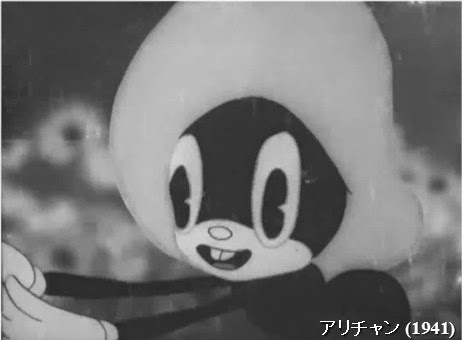
On looking at Mochinaga’s portfolio, Geijutsu snapped him up and introduced him to their favourite director, SEO Mitsuyo. The pair began building Japan’s first multi-plane camera. This allowed the pair to shoot multiple cels at the same time, giving their films extra complexity and depth. By 1941 it was finished. Seo shot the first Japanese multi-plane animation; “Ari-chan The Ant” (Geijutsu Eigasha/Ministry of Education, 1941). Was it any good?
“Ari-chan The Ant”
It’s a typical day for a troop of ants, and little Ari wants to join in and help. But the work of excavating fruit and getting it back home is too hot and heavy for her. So she gives up in disgust and goes to play. She finds a violin – which is nearly as big as she is – and smacks it around at random in a way that any guitar owner with kids will recognise.
The violin belonged to a grasshopper, who we briefly see in tears over the loss of her instrument. But Ari knows none of this, and meets up with some other bugs5. One of them bribes her with some nectar, and she lets them play with her new toy. The butterfly plays it like a harp, a ladybird and mantis combine to turn it into a steel guitar, and the rhinocerous beetle nearly smashes it.
The sun is blazing down on Ari-chan, and the grasshopper string ensemble is one member down. Ari pretends to join in from a distance, but the bugs all have to scatter as a huge, pudgy-fingered human hand comes down on them, ready to trap anyone who can’t flee. Once the threat has passed, the orchestra leader comforts little Ari. But then they strike up again. Ari quickly realises the beauty of what the instrument can do in the right hands, and she’s filled with grief.
She sprints back to where she found the violin and quietly gives it back to the weeping grasshopper. Light of heart, she goes back to her usual play. The film closes with that grasshopper, back to work with the orchestra, and with Ari-chan in her mother’s arms.
Multiplane Perfection?
This is frankly a tour de force. Inside the first twenty seconds, Seo shows off the new technology, making an ant drive a car right across a sumptuous background, and he doesn’t stop showing off until the last frames. This was a major coup for his studio, and he clearly knew it. Arguably he goes a bit overboard in the last two minutes, but he’s made his point by then.
The music, which is thankfully intact, fits all the action superbly. That action does mean we’re whiplashed a bit between factory toughness and rural beauty. It’s also notable that, musically speaking, what we see on-screen broadly matches what we hear. That’s unusual in a lot of cartoons today, never mind 1941. The music here is helmed by HATTORI Tadashi, who had already worked on Seo’s previous film “The Quack Infantry Troop”, although this is far more in Hattori’s orchestral wheelhouse.
When I originally watched this a few years ago, I was concerned that the scene where the ants are digging into the pumpkin was too military and too regimented. I was wrong; these are ants. The sequence I was bothered by is drawn to resemble iron smelting, and it feels like it’s there to keep the Ministry of Education on board with what’s mostly a sweet, soothing piece for the younger kiddies. In my defence, I hadn’t seen any of the actual propaganda of the period at the time.
Doing Everything With Nothing
As Nishikata Film Review noted; getting all this done so well, with so little in the way of resources and using a brand new filming technique, borders on genius. But the real skill at play here has nothing to do with the new camera. While Seo does show off, he remembers to give his story proper emotional heft. The realisation that plays out on Ari’s face when she realises what she’s done is a high-water mark of emotive expression; no-one’s done this as well in Japanese animation before.
If I’m going to be consistent, there is only one score I can give this. Take a bow, Seo-san; your work joins cartoons from Murata Yasuji and Ogino Shigeji at the top of the tree. “Ari-chan The Ant” scores 9/10. Perfection will have to wait.
fin
I would like to give my usual thanks to this blog’s pillars; AniDB, who have helped me work out what to look for, the Japanese Film Archive, who have given me the material to actually watch, the pairing of Jonathan Clements & Helen McCarthy and their “Anime Encyclopedia”, and Clements’ solo work, “Anime: A History”.
In addition, this time around I’d like to thank Nishikata Film Review, and Mr Clements’ co-author on the “Fantasia” paper, Barry Ip. I also want to tip my hat to The Cine Journal, the Association of Chinese Animation Studies and Ad Blankestijn. This one took a lot of help.
I’m Douglas Howell, and I’ve been watching Japanese animation. Next week, I’ll bring my look at 1941 to a close, with cartoons from directors we know, we don’t know, and from China.
- “Hirohito And The Making Of Modern Japan”, Herbert P. Bix (2000), p. 396 ↩︎
- “Anime: A History – Second Edition”, Clements, p. 88, 2023 ↩︎
- Ushio Soki, “Tezuka Osamu to Boku”/ “Tezuka Osamu And I”, pp 193-5, 2007, in Jonathan Clements “Anime: A History – Second Edition”, p. 88, 2023 ↩︎
- “Anime: A History – Second Edition”, Clements, p. 89, 2023 ↩︎
- I needed some help with bug identification here. ↩︎