
MINDING THE STORE: OGINO SHIGEJI
Not every animator was a studio employee, even in Japan in the 1930s. One in particular was happily running a fuel store in north-west Tokyo instead. OGINO Shigeji was a hobbyist film-maker working with various small film cameras. Apparently, he was equally happy to let his security team look after the store while he made stop-motion films. My research says he was inspired by the work of German Absolute Film creators, like Hans RICHTER and Oskar FISCHINGER.
Before his son donated Ogino’s collection to the Japanese Film Archive in 1992, only one of his films was extant. That was 1937’s “Agar”. There were 476 films in that collection. When I said every anime… Thankfully for my sanity, most of them aren’t online. The Archive holds four of his films from 1932.
“?/Rhythmic Triangles/Fighting Cards”
The first is a medley of three of them, with original titles in English; “?/Rhythmic Triangles/Fighting Cards” (independent, 1932). I’m not going to tell you what happens in “?”. Ogino wanted this to be a puzzle, and I’m going to leave it as one. Don’t worry, Ogino gives the viewer the answer at the end. Provided you can read Japanese, or have Google Lens like I do.
“Rhythmic Triangles” is exactly what it says on the tin. I was reminded of the dance music videos of my nineties youth. You know, the sort made for people who are, um, intoxicated in some way. That’s a compliment, by the way. “Fighting Cards” is a similarly gyrating work using playing card suit symbols to hypnotic effect.
And they’re totally ungradable. Not because I didn’t like them, I did. But these are pure art pieces, of the kind that everyone interprets in their own way. I urge you to watch them; just don’t go in expecting plot.
Why Don’t I Care About Stealing?
Ogino’s other work from this year is much more conventional in two ways. Firstly, it has a story. Secondly, it steals the character of Felix The Cat wholesale from his American creators. I would normally write something stern and disapproving about copyright theft here, but for once I don’t care.
One of his creators was a convicted child molester. He was also an unrepentant racist whose alcoholism had reduced his work on the cartoons to zero. The other creator was Otto Messner, and he utterly fumbled Felix’s transition from silent to talkie.
I don’t know exactly when Ogino made “Detective Felix In Trouble” (independent, 1932). But it was probably the first Felix cartoon in a year. Besides which, the Japanese title sounds beautiful; “Felix no Mei Tantei”. So; was it any good?
“Detective Felix In Trouble”
The action opens in springtime, with various toys moving on their own. There’s an “infinite” water mill, a rabbit run by falling sand, and a clockwork car spinning aimlessly. Then Hanako, a doll animated through stop-motion, discovers that some bounder has stolen her shoes.
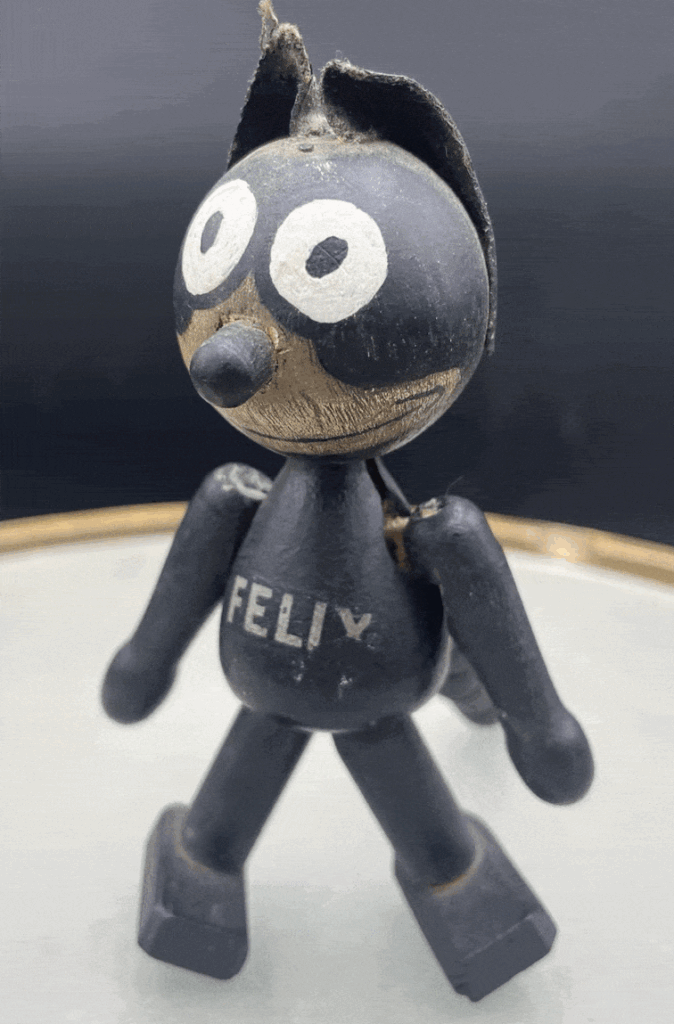
Image from Swiftcart sale.
She calls private detective Felix – clearly a 1920s Schoenhut toy imported from the US! – who takes one look and blames the dog. In fairness there are pawprints leading off into the spring snow.
He interrogates a nearby pig, who tells Felix that he’s climbing up the wrong tree. Put on the right trail again, Felix interacts with various other toys which look quite scary, even in 2026. But the matchstick skeletons aren’t scary. They’re just well made.
Felix then gets chased into a doghouse by a tiger toy. A literal cutaway shows us that the shoes are in the doghouse, so he grabs them and runs for it. Literally – the dog shows up, so Felix puts the shoes on to hide them and legs it. Hanako is so happy to get them back, that she gives Felix a medal with a French cockerel on it. But it’s not quite big enough to cover the letters FELIX, written on his chest.
Clever Kitty, Felix
The opening titles, which use matchsticks to spell out “FELIX” in English and then the rest of the title in Japanese, are superbly clever. So is the entire film, using less than nothing to achieve its effects. Technology being what it is, my daughter Little Ripper is doing similar things to this with her own toys and the HD camera on her tablet. So she watched it too, and enjoyed it, although she said that animation isn’t usually this quiet.
Grading this on a curve with the professional studio products that make up most of these reviews initially felt a bit silly. If this came out from an actual studio, I couldn’t give it more than a three. That still means the plotting and structure of this amateur work puts quite a few of those pro cartoons to shame.
But I refuse to punish such joy with a score like that. Ogino does an incredible amount with almost no resources. The characters here are pretty clearly his kid’s toys, repurposed. He has a vision and determination that I’d previously thought was reserved for eccentric English gentlemen. You know, the ones who spend decades in their sheds trying to invent a warp drive. “Detective Felix In Trouble” earns every bit of 8/10. It’s nice to know Japan and the UK have even more in common that I suspected.
THE UNKNOWN, INVISIBLE AND LOST
The next two films are partly lost to time, and neither has a director’s name. But that just means the production credit for “Armies Of The World” is doing all the heavy lifting: (Sakura Film/War Dept. Newspaper Unit, February 1932).
“Armies Of The World”
This 28-minute monster of a film is very crudely animated. Mr Circle and Mr Square sit down under blooming flowers with glasses of wine to tell each other facts about the world.
Just facts about the sizes of various armed forces and their military stockpiles, that’s all. And Japan the smallest, every time. Sounds like it might be a good idea to increase Japanese military spending, says the War Department Newspaper Unit. You know. Just in case.
In fairness, using the characters’ heads next to what they’re saying in the intertitles is a smart move. But “Even peace won’t last forever” is a bit rich coming from Mr Square when you realise that in 1932, the Japanese Empire was still digesting a big lump of China. Then the two chumps climbed into a lift marked “to poison gas observation deck” and grinned at the camera. I lost my temper and turned the thing off. No score, and no link.
“Olympic Games On Dankichi Island”
The other unattributed cartoon from 1932 is “Dankichi-jima no Olympic Taikai” / “Olympic Games On Dankichi Island” (1932), which needs a little unpacking. “Adventure Dankichi” was a newspaper cartoon, starting in… that’s odd, 1933. I wonder who’s wrong there?
Anyway, “Adventure Dankichi” was the story of a good little Japanese boy who ends up as king of an uncivilised southern island. Full of racially offensive stereotypes. Who Dankichi slowly “civilises” over time. Blearch. I don’t want to watch this!
Various badly-drawn animals and a couple of racist stereotypes head into a festival area. King Dankichi stands in front of a sharply divided crowd and declares an Olympic Games, between dark-skinned humans and pale-skinned animals. This would be crap even if it wasn’t racist. And it is inarguably racist. It’s irredeemable, I’m not dignifying it with a score, and my link doesn’t go to the cartoon.
“The Plane Cabby’s Lucky Day”
That’s two of my three partly unattributed cartoons for this year. One has been propaganda, and the second was racist crap. Will third time be the charm? For a while I thought that “Ooatari Sora no Entaku” / “The Plane Cabby’s Lucky Day” (unknown studio, 1932) was out of my reach. But I was wrong. It’s TEIZO Kato’s only animation credit, and it’s a science fiction piece about a flying taxi driver. Was it any good?

It’s the distant future year of 1980, and talking animals rule the land. Humanity has fled to tall buildings instead, and aircraft zip along intersections like flying cars. A young man pulls food out of a machine and passes it to his elderly mother. Then he jumps into his two-seater aircraft to work as a cab driv- um, flier.
Our hero has to literally fight bad weather. Then he helps out a passing eagle which some bounder has shot, until an oni sitting on a cloud forces him out of the sky. After driving off a hungry bear that was clearly inspired by a certain Mouse, he manages to find a cache of diamonds that will set his mother up for the rest of her life.
The bounder returns and tries to shoot the hero. But he only manages to shoot a monster, set off an earthquake, and get himself killed. The bear and our hero flee for their lives. Thankfully, the eagle arrives to rescue them, allowing them to go home with the treasure. There’s even a moral, but I didn’t trust my translation software enough to know what it was.
Sweet, Dramatic and Satisfying
The soundtrack to this was modern; a stylophone plays to assert the sense of lost futurity. When our cabby’s plane takes off, I swear I heard the fanfare from “Battlestar Galactica”. But the story is sweet, and the animation is fantastic. It’s studded with little Western-style jokes interpreted in Japanese ways, instead of just being lifted without thought. It’s also quietly interesting that a cartoon made in 1932 has a Japanese human working together with the symbols of America and Russia. No idea if there was a deeper meaning there.
I think I understand why the only online review I could find slated this. But in the context of the other Japanese animation that survives from the same year, this is simply excellent. “The Plane Cabby’s Lucky Day” scores 8/10.
A Lost Ofuji Epic?
Was there a good reason that OFUJI Noburo and his studio hadn’t made a lot of cartoons recently? Italian animation historian Enrico GIANERI seemed to think so. He insists that Ofuji spent three years working on a 32-minute long version of “Pinocchio”. Gianeri claims it was “suggestively coloured thanks to a special chemical process” and involved “52 refined designers”.
If even a frame of this cartoon existed, I would be very happy. But nothing’s survived, and none of the Japanese sources I looked at mentions it. Not even the Japanese Film Archive, who have an Ofuji Memorial Museum online.
Besides, this is a man who built his own camera stand because buying one would be too expensive. The idea of Ofuji finding the money and the space to employ fifty other people for three years is absurd. I don’t know what Gianeri was watching, but I don’t think it was Ofuji. Hopefully some lucky researcher will find a can of film and prove me wrong.
fin
Next time on the blog, I’ll take a look at the cartoons that MURATA Yasuji managed to produce in 1932, with the help of Ministerial money. Hopefully it won’t all be propaganda.
Thanks for this article go out to Nishikata Film Review for help with “Adventure Island”, and to Signor Gianeri for his work, even if I disagree with him. And as always, I must thank AniDB, who have helped me work out what to look for, and the Japanese Film Archive, who have given me the material to actually watch.
Images have been taken on Fair Use basis from SwiftCart, and a public domain image from Dr. Grob’s Animation Review.