
TANAKA TURNS TO PROPAGANDA
In 1933, Jenkins Osawa Studio decided to add an animation division to their existing live-action film company. And since their Princeton-educated founder, OSAWA Yoshio, had a long-standing bee in his bonnet about talking pictures, they had to be soundies. But there wasn’t a lot of money flying around. On the other hand, government-funded propaganda was very hot in 1934. So Osawa made two choices that feel odd, when you look at them together.
The first was to take that government money to make a trio of animated propaganda films called “The Toybox Series”. Given the political climate in Japan in 1934, that makes a lot of uncomfortable sense. The second was to hire TANAKA Yoshitsugu to make them. Which is weird. Because the last time Tanaka showed up on this blog, it was 1930. And he was helping a team of young Christian leftists from Doshisha University make an anti-war cutout animation.
Alas, everyone needs to put food on the table. So it was Tanaka who took the lead on J.O Studio’s first animated work. The first two “Toybox Series” films were “Express Fleet” and “Black Cat Banzai”. Both of them still exist, at least partially. But neither is available online.
“Toybox Series: Picture Book 1936”
However, the third film is watchable. That was mis-identified for years as “Black Cat Banzai”, but that’s been fixed now. The real title is a bit of a mouthful: “Omochabako Series Dai 3(san) Wa: Ehon 1936-nen” / “Toybox Series: Picture Book 1936” (J.O Studio, 13 April 1934). I’ve watched it; was it any good?
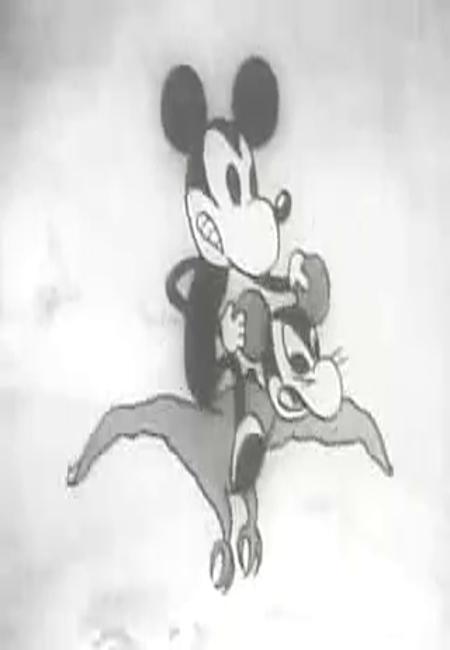
It’s 1936, and on a desert island, a group of badly animated toys are dancing. One is a dead ringer for Felix the Cat. They’re interrupted by the buzz of an aircraft; it’s Mickey Mouse riding a pterodactyl, which also has Mickey’s face. Mickey throws down a message which reads “Open the island”. I Can’t Believe It’s Not Felix burns it. A furious Mickey immediately sounds a trumpet, to summon a squadron of other Mickey-headed flying not-dinosaurs to attack.
Snakes and crocodiles join in; bombs fall, and the snakes spit bullets at the poor defenseless toys. Mickey kidnaps one of the dolls, and it’s enough to make a toy tiger open a book with Japanese folk-hero Momotaro inside. The invading armies have tied the doll to a post, and are dancing around like stereotypical American Indians.
open the box?
Momotaro calls forth four more Japanese fairytale figures. Most importantly for the plot, one of them is Urashima Taro and his box Which Must Never Be Opened. Golden Boy Kintaro is there too; more of him later. The heroic toys, laden with their own bombs, counter-attack. Mickey and Momotaro duel, club against sword, on a handy cloud. Mickey loses and falls, getting zapped by Western devils on the way down, until he lands in front of Urashima.
He opens his box and smoke billows forth. Mickey ages a century in five seconds, and the Japanese heroes laugh at him in disturbing unison. Then the Blossom Man makes the cherry trees blossom, and the Japanese toys dance for joy.
So Far Right They’re In The Next Cartoon
Dear heavens. As the Encyclopedia of Science Fiction notes, it’s bizarre that Tanaka uses so many uniquely American animation tropes to propose a war with America. Mickey’s message about the island is a reference to the arrival of Commodore Matthew Perry – yes, really – in his Black Ships in 1853. That eventually led to the opening of Japan to large-scale foreign trade and the introduction of democracy. This cartoon strongly implies that the war-mad ultranationalist right, who wanted a return to direct imperial rule, saw this opening as the first betrayal of the Good Old Ways.
This is a terrible cartoon unless you’re a historian. The animation is lousy, the conversion is dreadful, and the use of Felix and Mickey in a for-profit cartoon is blatant copyright theft. Sure, the Disney Company would help to wreck copyright in the West in the decades to come. But this is 1934, and Walt Disney is only 33 years old. Even if it wasn’t propaganda, I’d be giving this a kicking, but by policy, no score.
OISHI : THE LAST GASPS OF PCL
It’s not the most glamorous of studio names, but Photographic Chemical Laboratories were still in the animated film business in 1934. OISHI Ikuo was directing for them. He made two films in 1934, and the first was “Ponsuke no Haru” / “Spring Comes To Ponsuke” (PCL, June 1934).
“Spring Comes To Ponsuke”
Ponsuke – Little Drum – is a tanuki child who’s digging for food in the snow, and not getting very far. Some crows harrass him and he pulls out a gun, managing to shoot and de-feather one of them. But it’s skin and bones so he throws it away. So the bird puts his feathers back on like a coat, then marches around using a useful long feather like a rifle.
Ponsuke finds a bamboo shoot that’s bigger than he is and takes it home to his dad. Alas, once they strip the outer leaves off there’s only a tiny bit left. The leaves turn into an adult bamboo shoot with eyes, the tiny bit turns into a child, and they open the door and leave. There’s a blizzard outside and it turns the tanuki into snowbears. The tanuki chase the bamboo shoots, and by the time they’re all exhausted from running, spring has arrived. Some random bees share a big pot of honey with the tanuki, and everyone dances to close the film out.
This is missing the title page and credits, but the actual body of the cartoon seems to be intact. It’s another inkblot work, but it lacks the proper, playful insanity of American cartoons from the period. You can’t get away from the basic militarism of the period, either. “Spring Comes To Ponsuke” is fine, I suppose, and that’s 5/10.
Lost Cartoon: “Firecrackle Mountain”
The other film that Oishi completed in 1934 was “Kachi-Kachi Yama” / “Firecrackle Mountain” (PCL, August 1934). Presumably it’s the same story as the fairytale that shares the name. A tanuki gets trapped by a farmer, and then uses its shapeshifting powers to confuse and then kill his wife. But the farmer is friendly with a rabbit, who torments the tanuki. Most notably, when the tanuki is carrying kindling, the rabbit sets fire to it. He then says, “Oh, that’s the sound of Firecrackle Mountain, we’re so close I’m not surprised you can hear it!”
As the late Sir Terry Pratchett once noted; it’s the little things that tell you it’s a story for kids.
Regardless of how Oishi was able to sanitise the story to get past the censors, this one hasn’t survived to the present day. Neither have the last two cartoons made by Photographic Chemical Laboratories. Those were “Beer Banzai” and “Ari to Kaeru” / “The Ant And The Frog”, both from 1935. But by that point, PCL had refocused their animation department on providing still images and title sequences.
On September 10th, 1937, PCL joined J.O. Studio and a distribution company called Toho Eiga to form Toho Studios. This would eventually become the behemoth that would make the Godzilla films, and more than a few anime. Oishi himself wasn’t there for that, though; he’d been drafted.
interlude – jazz
It was while I was watching “Spring Comes To Ponsuke” that it finally dawned on me what was missing from these cartoons. The Japanese stories are just as strong as their American peers. There’s a different flavour of surrealism at play, but it’s still there. Heaven knows, the art is usually good. But more often than not, the music is the problem.
It was hard to work out for a while. That’s because the soundtracks that ought to be scoring the cartoons I’ve been watching have been lost, or caught up in copyright snarls. But when the tanuki were chasing the bamboo shoots through the blizzard, the music was gentle and calming. An American cartoon coming from a studio with jazz musicians on the books would have played something exciting and chaotic, and that’s what’s been missing.
Jazz was, relatively speaking, popular in Japan at the time; in 1933, coffeehouses playing jazz records and the occasional live performance sprouted up in Yokohama and Tokyo. But it was far too American to be acceptable to conservative Japan’s mainstream, and up until this point that’s meant it hasn’t shown up in my viewing. I’ll be keeping an ear out for it, going forward.
Nice.
TANAKA: NIKKATSU TRIES AGAIN
Nikkatsu Studios, perhaps because of their place in animation history, kept trying to make it pay without government support. There was, of course, their initial foray in 1917, and a second go in 1928, hiring Masaoka Kenzō. But given that he left to set up his own studio, it’s fair to say they didn’t work out.
The studio’s third attempt came in 1934, with a trio of cartoons starring Ninja Fireball Boy, another attempt to create a hero with deeply Japanese roots that still used the inkblot style of Max FLEISCHER. And I think they were also directed by TANAKA Yoshitsugu. IMDB truncates his given name to “Yoshi”, but Tanaka’s entry on Japanese Wikipedia says that “In 1934, he cooperated with the manga department of Nikkatsu Kyoto Studio.” The timing is right.
Lost Cartoon: “Ninja Fireball Boy In Edo”
Only one of the cartoons survives: “Ninja Fireball Boy In Edo”. And it’s only 74 seconds long. It’s a chaotic mess that hasn’t been helped by a bad transfer – although I’m sure the team involved did everything they could with the little they had. Mind you, I think it captures the spirit of the Western cartoons that clearly inspired the pie-eyed, shapeshifting story that’s lurking under the surface. No score, but the quality that the full short film had still shines through.
Tanaka’s work on these shorts – assuming I’m right, of course – marked the end of his animation career. He was involved in “Princess Kaguya” in some capacity, although it’s not clear to me exactly how. Tanaka would go on to write the script for Japan’s first full-length puppet film, “Princess Urushi and Amanojaku” (Dentsu Film, 1956). He spent the rest of his career, both pre- and post-war, making live-action educational and documentary films. He passed away in 1982.
fin
As always, I would like to give thank to this blog’s pillars; AniDB, who have helped me work out what to look for, and the Japanese Film Archive, who have given me the material to actually watch. This time around, I’d also like to thank the people at Toho Kingdom, the Lost Media Wiki, and the Encyclopedia of Science Fiction.