WAR TRIALS & IMMUNITY
1947 was a year of enormous political change in Japan, thanks to the orders of General MACARTHUR and the Occupying Forces. New, fully democratic elections happened in April. On May 3, the new Constitution of Japan came into effect, replacing the Meiji Constitution of 1889. The Occupiers had taken the entire system of governance – courts, the peerage, even the legal status of the Imperial Family – and thrown them out. Japan was now ruled by a Western-style, Cabinet-led government. It was only in 2015 that any Japanese government managed to amend it in the slightest.
On November 12th, the International Military Tribunal for the Far East concluded. They sentenced seven men to death for “war crimes and crimes against humanity”. All seven were executed by hanging on December 23rd, 1948. One man was found mentally unfit for trial. Two more died during the trial. The Tribunal sentenced a further fourteen men to life imprisonment. Three of those died in prison. The remainder were released between 1952 and 1958.
Unit 731 and Hirohito Escape
Other Allied nations held their own, separate trials. However, the members of Unit 731, Japan’s bacteriological and chemical warfare unit, escaped justice completely. The Occupying Forces gave them total immunity – ironically enough – in exchange for their data on germ warfare. The Americans also gave the Japanee Imperial Family full immunity from prosecution. Both American President TRUMAN and General MacArthur needed Emperor Hirohito in place. According to historian Herbert P. Bix,
“Their relationship became one of expediency and mutual protection, of more political benefit to Hirohito than to MacArthur because Hirohito had more to lose—the entire panoply of symbolic, legitimizing properties of the imperial throne.”1
So Hirohito kept up his side of the bargain. Legally speaking, he was now a constitutional monarch. He gave the orders to dissolve Japan’s armed forces. The Japanese naval docks which had built the nation’s navy were now busily taking it apart again. But there was an army in Japan. The Occupiers had brought over 350,000 American troops, officially to keep the peace and distribute food aid. And unofficially? Well, you can draw your own conclusions.
THE FINAL FRAMES – ARAI WAGORO
From 1939 to 1943, a small team of independent animators, led by dentist ARAI Wagoro, had been making roughly one, ten minute long, silhouette cartoon a year. If that was his name; in their frankly essential “Anime Encyclopedia”, CLEMENTS and MCCARTHY say that the Japanese sources sometimes call him Arai Kazugoro and even they’re not sure which one is right.
Arai and his team would only release five films after the war. All of them are either lost or not available online, and two of them don’t even have clear release dates. Two came out in 1947: “Yashinomi” / “Coconut” and “Matchi Uri no Shojo” / “The Little Match Girl” (Independent, 1947). In the following year, Arai would release “Ohana no Ohime-sama” / “The Flower Princess” (Independent, 1948). And then, as far as I can tell, he stopped. There are so many potential reasons why that could have happened in post-war Japan that there’s no point even speculating.
The only evidence for his other two cartoons comes from the Hiroshima International Film Festival. It was founded in 2009 and runs each year in November. In 2016, one of its strands focused on Japanese animation, and they showed three of Arai’s works; “Madame Butterfly” twice, an undated cartoon called “Old Tale”, and “Mukashi-banashi Nagori no Futomeno – Otsuru wakare no ba” / “Twilight Crane” or “A Japanese Folk Tale: The Crane Returns a Favour” (Independent, 1989-93). Which is the least useful dating I’ve ever seen. I hope to see them, one day.
Arai would pass away in 1994.
TOHO EDUCATIONAL FILM’S TRIPLE BILL
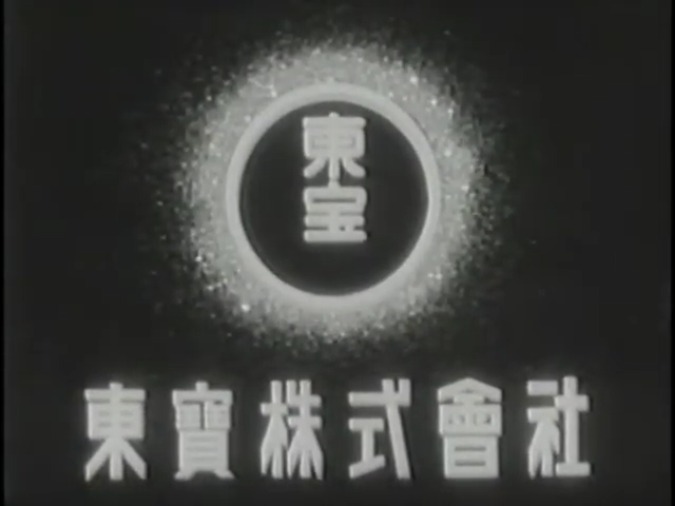
Toho Pictures started their in-house animation career on September 25th 1947, with a triple-header of new films at Tokyo’s Hibiya Cinema2. First up was live-action: a fifty-minute bird-watching documentary called “Chidori” / “Plovers”. For reasons lost to time, Toho chose to throw in a mixed media segment. For three minutes, Pinocchio leaps into the frame and starts dancing with the birds. I’m all for giving animators paid work, but even without seeing it, this feels rather crowbarred in.
The other two pieces were fully animated. I’ll start with “Muku no Ki no Hanashi” / “The Tale Of The Grey Starling’s Tree”. MURUYAMA Shouji wrote and directed this, his only foray into animated direction. Murayama tapped into the rich tradition of Japanese puns in his title. According to Clements, they left “muku” written in katakana. The word therefore means “starling” and “enduring purity” at once. It’s not the first pun I’ve seen in this project: I know it’s not the last.
Toho definitely wanted this cartoon to succeed, bringing all their biggest names on board. HAYASAKA Fumio wrote the score, and he was already an esteemed composer. He would eventually work closely with Japanese directing titan, KUROSAWA Akira. But did that make it good?
“The Tale Of The Grey Starling’s Tree”
We open with, for the first time in my viewing, Toho’s disc logo, and the music swells. It’s epic throughout. A model tree stands in a beautiful landscape, and we’re told it’s part of a vibrant ecosystem, although of course they don’t phrase it that way. Bugs and frogs dance at the tree’s base, and the starlings perch at the top.
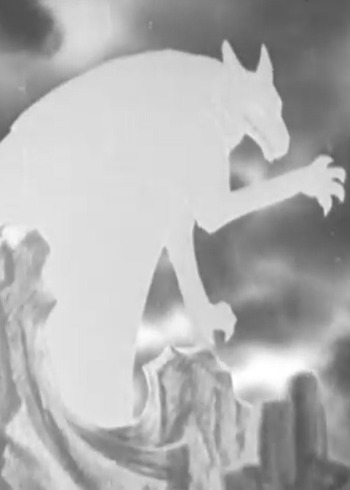
One starling flies in and warns the rest; an ice demon is coming! The birds flee, and then the ice storm strikes. It rips every leaf away. Night falls, and a great, ghostly ice-wolf huffs and puffs his destruction down. Snow covers the denuded tree. The rest of the forest comes to resemble soldiers, hunched over their rifles, as the storm of war passes over them. A crane freezes into a solid missile. Smaller demon-wolves twist another tree’s branches into a swastika and nod in approval.
Enter Columbia
But then the ice demon starts to melt. And what the subtitles call “the light of freedom” appears. Day dawns, and the ice-wolf rears back in horror. An intense light fills the screen, and a beautiful woman with Western features appears, with the spring around her. The ice-wolf and his minions try and fight, but all their efforts fail; their spears dissolve in the sun, and the soldiers and swastika melt back into trees. Even the missile returns to being a crane again.
The starlings follow the crane back to their tree. The mountain melts and falls on the ice-wolf, and it crumbles into nothing. The spring-goddess dances, and grass grows wherever she walks. New sprigs poke from under the snow, and the tree has grown new leaves. Baby birds cry for food, and the countryside grows again. The last text on-screen reads: “If Winter comes, can Spring be far behind?”
Subtext Is For Cowards
This is not a subtle film. The winter is obviously the war, and the spring goddess’ Roman nose tells us that the West represents peace. The metaphor is very simple, but you can’t say that about the film itself; it’s an enormous leap forward in terms of quality and style. I had to watch it twice to get used to the style. I think Toho threw every technique and style of animation at the wall, to see what stuck and met with their new masters’ approval.
This cartoon made me go outside to have an argument with myself. Was this propaganda, or an art film that was simply exploring its place and time, from an animation distributor that was doing exactly the same thing? I came to the conclusion that the only people who Toho were trying to manipulate were the Occupying censors. Look at us, they’re saying, we’re a safe set of hands, we’ll portray you and ourselves the way you want us to, without any of the symbols of Japan that the previous government twisted into something awful.
So I need a score. And it won’t be kind, because in trying to satisfy their new masters, I think Toho and Muruyama might have forgotten about their audience. I imagine the Japanese people who watched this on first release must have been desperate for a little entertainment in their lives, a couple of hours of escape from the grim realities of post-war Japan. And for twenty minutes, they would have found themselves reminded about the war and their “rescuers” from it. A beautiful message about an ugly reality is still no fun at all. “The Tale Of The Grey Starling’s Tree” gets 3/10.
fin
Hang on, Douglas, I hear you cry. Why are you ending the article here? You said there were three films. Well, gentle reader, that’s true. But this is the point where Toho’s mini festival got complicated. The third film was branded as Toho’s, but it was made almost entirely by Japanese animation’s most stubborn man, MASAOKA Kenzō. And he had a plan. Come back next week to find out what it was.
As usual, my thanks go out to AniDB, who have helped me work out what to look for, and the inseparable pairing of Jonathan Clements & Helen McCarthy and their “Anime Encyclopedia”, and Clements’ own “Anime: A History”. In addition here, I’d like to thank the USS Elmore Project, and Nishikata Film Review.
Image of “The Tale Of The Grey Starling’s Tree” from Anime Planet. Image of Toho Pictures logo from the Audiovisual Identity Database.