
OFUJI AND THE SPIDER
It wasn’t surprising, last week, to see MASAOKA Kenzō back at work quickly. It also wasn’t a shock to learn that OFUJI Noburo made it into the studio in 1946 too. His cartoon was made by the largely invisible Sanko Studio, and it was the first animated version of any work by “the father of the Japanese short story”, AKUTAGAWA Ryunosuke. It was “Kumo no Ito” / “Spider Thread” (Sanko, 1946) and saw Ofuji return to the silhouette work that he’d last experimented with in 1931’s “Kokka Kimagayo” or “National Anthem”. Was this any good?
“Spider Thread”
Flowers open after rain, and nymphs dance in them. Fire comes, and the flowers and nymphs burn. It passes, but one nymph survives to stamp furiously on a passing spider – only to catch himself at the last minute. Then the fire returns to torture the nymphs. A human woman – I think – takes a spider thread and drops it down, and the nymphs try to pull themselves to safety. But the thread snaps, and throws them back into beautifully animated water.
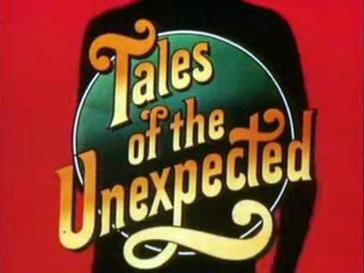
This was beautiful and baffling by turns. The more feminine nymphs reminded me of the salacious dancer in the opening titles of peerless British thriller series, “Tales Of The Unexpected” (Anglia/ITV, 1979-88) only not as obviously sexual. But there were no subtitles to explain the plot, and if I can’t understand a work properly, I can’t review it fairly. So, by policy; no subtitles, no score.
THE THIRD WAVE BEGINS: KUMAKAWA
The third and final film I’ve been able to watch from 1946 – and in the circumstances, three is a pretty decent tally – comes from a new director. His name is KUMAKAWA Masao, and before the war, he’d been one of Masaoka’s regular animators. While Kumakawa would only ever dabble as a director, his animation career didn’t end until the mid-80s. Why did they keep him around so long? Are there any answers to that in his directorial debut, “Mahou no Pen” / “The Magic Pen” (Kyoto Pictures, 1946)? Was it any good1?
“Mahou no Pen”
A boy called Su-chan2, wearing a shirt, shorts, booties and a baseball cap, is skipping through the rubble of a destroyed city, as cheerful music plays. A floppy-eared spotty puppy is playing in a skip, and manages to find a squeaky doll to play with. But it flees when the child appears. He goes home with the toy, if you can call a triangular shelter made of corrugated iron “home”, to meet some very Disney-esque small flappy birds, and then gets some needle and thread to repair the dolly. Then the kid pulls out a book and starts reading out loud. In English. Even the birds are interested in that.
And that’s when the doll comes to life, starts giggling, and gets off the table. Magically, she’s the same height as the now blushing boy. She pulls out the titular pen and draws a plate of apples, which also become real. Soon the table is full of bananas, grapes, wine bottles and tinned food. The pair emerge into the Japanese wasteland, and the doll-girl quickly redraws the shelter into a two-story Art Deco masterpiece of a home.

Understandably, the boy is ecstatic. He imagines using the pen to rebuild his country into a modern copy of what America portrayed itself to be in 1946. And then he does it; blocks of flats, skyscrapers, a nice car, the works, all laid out in neat square blocks like Uncle Sam used to make. The forest outside the city comes to life to sing its thanks. The doll drives off in the car to share her magic further, and then.
The boy wakes up, holding the inert doll, in tears. The puppy barks at him. He kisses the doll, and heads back outside. Once again, the boy is skipping through the rubble of a destroyed city, as cheerful music plays, only now he carries the doll with him, and the dog runs happily alongside him. And the film ends.
How Not To Support Your Occupiers
This was meant to be cheerful and supportive of Japan’s new, American future. It’s in nearly every scene; the doll is American, the food is American, the house was American. But I felt that it missed the mark completely. This is a tragedy. Nothing’s changed. And frankly, even though it’s a dream sequence, showing a magic pen what makes food to a literally starving young Japanese audience must have felt like a slap in the face. Just because this is American propaganda instead of Japanese doesn’t make it good. By policy, no score.
But “no score” doesn’t mean “not interesting”. I had to lean on CLEMENTS and MCCARTHY’s frankly essential “Anime Encyclopedia” for Su-chan’s name, and I have no idea if the doll had one. The “gentle orchestral music” was so loud, I could only barely hear the English that both characters spoke. I couldn’t pick their names out at all. While there are two reasons I wasn’t able to score it, from a purely artistic point of view this was an excellent cartoon. It easily explains why Kumakawa would stay in the industry for decades. But I’m less interested in the quality of the animation than I am in the style.
1946 – Moe?
There’s a word I haven’t been using, to talk about Japanese cartoons. It’s because I haven’t seen anything I recognised as “modern” on the screen; the cartoons were their own, uniquely Japanese thing, but they didn’t have any obvious descendants on the 21st century screen. But look at these kids.
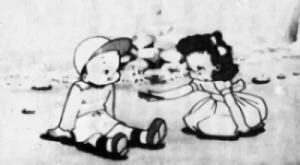
He, and the doll girl both, are clearly moe. In a way I haven’t seen up until this point, these characters are overwhelmingly cute. Not simply child-like, but an almost disturbing parody of childhood. This is it. For the first time, I’ve watched something that is a direct and obvious ancestor of the thousands of Japanese cartoons that were to come.

This is, in my tiny opinion, another of the first sprouts of what would become anime. And it’s fascinating to note that it came out of a hybrid; a Japanese director trying to meet American and Japanese needs at the same time.
fin
There was, completely understandably, a mere trickle of animation coming from Japan in 1946, and someone was waiting to turn the tap off good and hard in a few years time. But even this early into Japan’s new era, the changes that were in the country’s future are spilling over into the art of its present day.
I’m Douglas Howell, and I’ve not quite been watching anime yet. But I’m getting closer. Next week I reach 1947, which is the year when Toho’s animation department was made to look very silly indeed.
As usual, my thanks go out to AniDB, who have helped me work out what to look for, and the pairing of Jonathan Clements & Helen McCarthy and their “Anime Encyclopedia”, alongside Clements’ own “Anime: A History”. Without them, this project would have been impossible.
Image from “Mahou no Pen” from Anisearch. Image of Art Deco property from Wowhaus. “Chara-chan” by Snow64, Public domain, via Wikimedia Commons.
Leave a Reply