A NEW COMPANY APPEARS: NIHON DOGASHA
The list of companies selected to make propaganda for the Occupying Forces in 1947 was very short. The three names I expected to see were there, the Big Three formed by the Imperial government in 1942. But alongside Daiei, Shochiku and Toho was a much smaller name: Nihon Manga Eigasha. And that was MASAOKA Kenzō’s firm.
But Masaoka had spent most of his time since the war training Toho’s animation staff. So anything that came out under Nihon Manga would would have been distributed by Toho. And they weren’t going to push any other companies too hard in the process.
This is where YAMAMOTO Sanae re-enters our story. He had worked steadily as a director until the middle of the war. And now it was over, he wanted back into the industry. So he set up a new company, and hired Masaoka as an animation director. He also brought another stalwart of this blog on board as managing director: MURATA Yasuji. Murata’s pre-war work at Yokohama Cinema Shokai had been stunningly prolific until it came crashing to a halt in 1936. I still don’t understand what happened there. Anyway.
According to CLEMENTS’ “Anime: A History”, the new company’s name has been tripping up better historians than me for decades. They called it “Nihon Dogasha” / “Japanese Animation Company”. The two company names are so similar that Clements thinks it might have been on purpose. In any case, the key point was “to establish a division between the creatives on a production and the corporation that owned the production”. And it pretty clearly worked.
FILM THREE: A CAT OUTPLAYS A KING
Last week, I told you about a triple bill of films from Toho Pictures, shown in September 1947, launching their animation studio. One was a live-action affair with a little Pinocchio on the side, and the second was a toweringly depressing work aimed clearly at the Occupiers. But the third film on the bill was Masoaka’s “Suteneko Tora-chan” / “Tora The Stray Cat”, and it had the most complicated credit list I’ve seen so far. The studio credit was split between Toho Educational Film and Masaoka’s Nihon Manga Eigasha, and the production was credited to… Masaoka’s Nihon Dogasha.
Masaoka had double-dipped, making it clear that while the money and distribution came from Toho, all the creative work on the cartoon was down to him and his staff. I couldn’t help but notice that the opening credits spent more time on Masaoka’s name than they did on anyone else’s. So Nihon Dogasha was open for business, but that only means anything if the cartoon is good. Was it?
“Tora The Stray Cat”
The titles roll, and a choir sings as snow falls in the background. Anthropomorphic kittens dance and play around a Christmas tree. Then we jump to summer, and a mother cat taking her three kittens out for a walk. Plaintive cries ring out; it’s little tom-cat Tora, uncollared and alone. Over the selfish complaints of Miike, one of her own kittens, Mummy Cat pulls out a bottle of milk to feed all four, and sings about how we should help each other in troubled times.
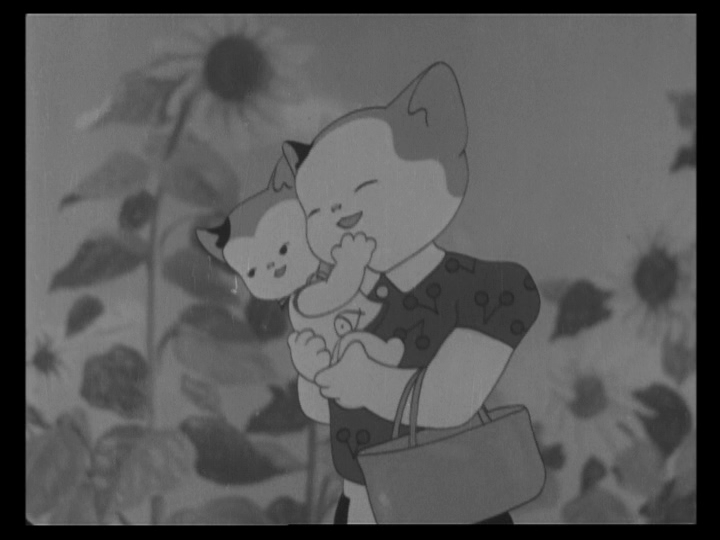
Tora goes home with the family, and gains a collar and some clothes. The kittens play together, but Miike still doesn’t like him at all. After she bullies him for a bit, Tora ends up left alone outside, and sings a beautiful little song. Mummy Cat sings her kittens a lullaby while Tora chases bugs outside. Then she goes and rescues him again. Everyone else is asleep; Miike sings a song about how she feels left out, and runs away.
Tora grabs a bottle of milk, drops off his bell, and goes out hunting for Miike, singing about how he’ll leave if she wants him to. Miike watches him run off into the distance looking for her, and plays in a pond. She nearly falls in, and lots of frogs laugh at her. So she runs away, sings a traditional nursery song, and feels sorry for herself. Tora finds her but she rejects him; then a storm comes over, and lightning goblins throw bolts around. That’s enough to send her running back to Tora, and they hide.
After that, Miike keeps getting into mild peril, and Tora keeps getting her back out of it. And the cartoon ends as it began; snow falls, it’s Christmas, and Tora’s best present is a new home and family. It’s wonderfully done and manages to be sweet without falling into syrupy nonsense.
Basically Perfection
This cartoon goes back to the same core, will-be-anime visuals that were on show in last year’s “The Magic Pen”, except this time around, the clumsy attempts to reassure their viewers that Occupiers Good have gone. Masaoka and the studio have replaced them with central themes of found family and dealing with the pain of loneliness. Those are universal themes, yes, but but they were particularly acute in this place and time. This cartoon is squarely aimed at children, with cute songs, cute animals, and an excellent choir.
From a technical point of view, Masaoka was able to pull off something remarkable for “Tora”. For reasons of economy and practicality, even today TV animation is usually shot “on threes” – the image only changes on every third frame. There are ways to make that look better by changing lip-flaps more quickly, but as kids and as anime-viewing adults, we’ve all watched cartoons made on threes and barely noticed.
Despite post-war shortages and not being Toho’s favoured children, Masaoka and his team animated “Tora-chan” on twos, at twelve frames a second. And by god, does the quality show. The scene where the cat family run to rescue Tora is the smoothest cel animation I’ve seen for this project so far. Some of it’s so smooth, compared to what I’ve become used to, that it’s a little uncanny.
There’s a pan shot near the end which is clearly the animation team, simply showing off. There are no voice actors credited, but there is a full vocal cast and obvious lip-flaps being used, both to bring down the cel count and to humanise the characters. It still works.
Adult Tears
What I find remarkable from a kids’ cartoon is that things aren’t easy for Tora. The idea that one of the kittens would kick off at the new adoptee would be unthinkable in a cartoon today, but any parent (and especially any foster parent) will tell you; that kind of resentment is one of the most natural things in the world. And Masaoka, you magnificent bastard, your “little song” about a child dealing with being alone, “Manmaru Otoki-san” / “Big Round Mister Moon”, made me cry.
Scoring the last cartoon was hard; scoring this one was ridiculously easy. It may well have been an audition tape for the future of Japanese animation. That doesn’t matter. Quality tells. I am very pleased to give “Tora The Stray Cat” this blog’s first perfect score. 10/10; please go and find this cartoon.
Nihon Dogasha’s name had served it’s purpose, and was shortened into “Nichido” in the best traditions of the Japanese language. Eventually it would become Nichido Eiga. I’m sure you won’t be at all surprised to hear that Masaoka and Nichido will return next year. And Toho were about to have the worst eighteen months I think any studio’s ever faced, that didn’t involve being actively bombed. More of that next week.
OFUJI’S DREAM
Finally for this year, we have OFUJI Noburo returning to his old studio name for “A Snowy Night’s Dream“, which has such a beautiful Japanese name I’m breaking my format for it; “Yuki no Yoru no Yume”1. (Chiyogami Eigasha, 1947).
“A Snowy Night’s Dream”
In the middle of a traditional Japanese village, in the dead of winter, we see a young girl get thrown out of a house. She begs from door to door and no-one helps, and she can hear people laughing and playing inside. Children bounce gleefully in front of a Christmas tree, and get a cake. You can tell it’s a Christmas cake, because it has a cross on top of it.
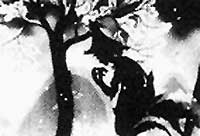
She lights a candle and tries to warm herself by it, praying to god for help. I’m not sure if that’s capital-G God or not. A female ghost appears and comforts her, at which point the girl appears to die, and the two ghosts walk away together. Cherubs fly around as the two spirits talk, and the young one briefly sounds happy, until the older one leaves again. Then the girl wakes up in her body, and cries bitterly. At last, another woman appears from a Christian church – you can tell it’s Christian, because it has a cross on top of it. And they walk off together.
This was a toweringly depressing cartoon. My immediate conclusion is that this was Ofuji’s reaction to the loss of the war and of the Japan he knew. Until the very end, I wondered how the censors let it through. It was well made, and the music was solid even if my version’s sounded a bit tinny. Because there were no subtitles, I have the option to avoid scoring it. But that’s a cop-out, because the plot and story beats were all very clear. It’s Ofuji, that’s not a shock.
Unfortunately, that doesn’t make up for a grim and unpleasant nine minutes of animation. So “A Snowy Night’s Dream” gets 6/10.
fin
And that concludes the votes from the Swedi- um, that wraps things up for 1947. As usual, my thanks go out to AniDB, who have helped me work out what to look for, the pairing of Jonathan Clements & Helen McCarthy and their “Anime Encyclopedia”, and Clements’ own “Anime: A History”. The latter book has become so important to understanding this period that I’m going to have to invent a new running gag for it.
I’ve been Douglas Howell, and I’ve been watching anime. Next week I’ll be talking about 1948, which is the year when Toho’s problems went from “bad” to “invaded by the US Cavalry”. Yes, really.
Image of “Tora-chan The Stray Cat” from Nishikata Film Review. Image of “A Snowy Night’s Dream” from Anime News Network.
- The Japanese title for “A Midsummer Night’s Dream” is “Natsu No Yo No Yume” and I’m certain Ofuji is riffing on it. ↩︎
Leave a Reply