
THE FIRST TALKIE: MASAOKA’S CHEATER
After the success of his two “Nonsense Films”, MASAOKA Kenzō used the profits to set up his own studio. So Masaoka Eiga Seisakusho needed a film to make. Meanwhile, Shochiku Studios had won the race to make Japan’s first live-action talkie, a film with a properly synchronised soundtrack. The studio’s director, KIDO Shiro, didn’t believe in all this old-fashioned benshi rubbish. He thought all Japanese films should be talkies.
Inevitably, Kido’s raw fish found its way on to Masaoka’s sushi rice. Masaoka was the first Japanese director to make a talking animated picture. That was “Chikara to Onna no Yononaka” / “The World Of Power And Women” (Shochiku Kamata Studio, 13 April 1933). It’s a lost film about a man who’s unhappy at home and has an affair with his secretary. Naturally his wife finds out, with Hilarious Consquences involving a boxing match that quickly turns into a tickle fight1.
I wish I could watch this, but not because I think I might have enjoyed it. There are two pieces of history in it; yes, it’s the first talkie, but it’s also the first time that the name SEO Mitsuyo has appeared on this blog. He would set up his own studio next year to make a popular series starring Sankichi The Monkey. That wouldn’t be his most famous work, though. Or infamous.
And that ought to be the story of the first animated talkie from Japan. But I’m not totally convinced that it is. You see –
THE AQUATIC LIFE OF OFUJI NOBURO
While I was writing about Japan’s history in 1932, I mentioned The Shanghai Incident. That’s a very dismissive name for a five-week war between the Empire of Japan and the Republic of China, that saw at least 5000 deaths. A story came out of it, though. During the fighting, a trio of Japanese sappers made a suicide attack with the explosive section of a Bangalore torpedo. That’s an explosive on a stick used to clear barbed wire out of the way. It’s supposed to have worked, but in the circumstances there’s no way to know what actually happened and what didn’t.
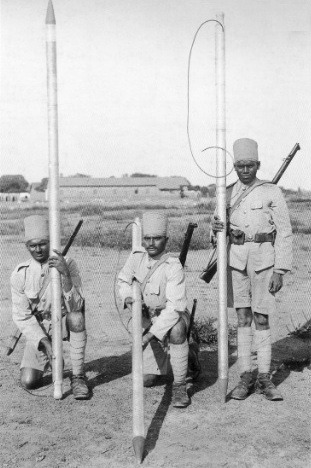
Naturally, a victory like this needs to be celebrated in a time of war. OFUJI Noburo made a child-friendly version of the story as a propaganda piece. I shouldn’t be surprised, but I was, a little. He was, of course, still experimenting with new techniques. This was the first time he got to make a proper talkie or use cel animation. Japan is finally catching up with the West in a way I can celebrate!
“The Three Fearless Frogs”
The cartoon was “Kaeru San Yuushi” / “The Three Fearless Frogs”, (Chiyogami Eigasha, 1 April 1933). And I double-checked with the wonderful people at AniDB; that’s the date they quote. Which is a week and a half before “The World Of Power And Women”. If that date is correct, then this is the first Japanese animated talkie, not Masaoka’s. I’m going through various intermediaries so it might well not be. And yes, the soundtrack hasn’t survived and this is a 1937 recut. If someone with access to offline information could set the record straight, I would really appreciate it.
Anyway; a battleline of frogs march toward the enemy. One of them, Commander Pyonshichi, meets his sister Osode. They climb a tree, at which point an enormous catfish uproots it and steals Osode to eat her. The next morning, the sun cries for Osode, and magic happens to rescue her. The catfish chases the siblings up a tree again, and Pyonshichi calls for help. So his frog allies spawn out of the background – sorry – and attack the fish.
It doesn’t help; even a passing aircraft’s lobbed bombs don’t hurt the thing. Eventually the titular frogs grab a Bangalore torpedo and ram it into the fish. The subtitles make it clear there was a song about it. Because it’s a cartoon, the fish dies but the frogs survive. And that’s it; the cartoon ends abruptly there.
Understanding American Artwork
Ofuji does still use his signature chiyogami paperwork, but only for the backgrounds. The actual characters look like they stepped out of an American inkblot cartoon. But they’re inspired by the West, not plagiarising it. That said, this still wasn’t very good or complicated even before the propaganda elements kicked in. By policy, no score.
Ofuji’s other work this year was “Numa no Taisho” / “General Of The Swamp” (Chiyogami Eigasha, 1933). As the Japanese Animated Film Archive suggests, it’s something of a companion piece to “Three Fearless Frogs”.
“General Of The Swamp”
Visually, the two cartoons are very similar. Various fish dance around underwater in front of a chiyogami background. At least, they do until Otama, a familiar gluttonous catfish, spoils the party and eats everyone. He decides to leave his familiar pond and travel to the ocean, where there’s even more food. But Otama quickly discovers that he’s literally out of his depth. He only just avoids being eaten by a whale. So he flees back to his pond, where a frog waving a Rising Sun fan holds Otama’s mouth open so all the fish can escape his belly.
I didn’t enjoy this one at all. The move to cel animation, even though it’s not complete, has robbed Ofuji’s work of a lot of its charm and personality. I’m being a bit kind because the transfer on the version I watched was iffy. I still can’t give “General Of The Swamp” any more than 4/10.
OISHI VERSUS GODZILLA
In 1929, Photo Chemical Laboratories, who were a post-production company for film studios, decided to branch out. They opened a pair of live-action stages in what was then a suburb of Tokyo, to make films of their own. And for whatever reason, they decided they needed an animation studio as well.
It was OISHI Ikuo who hit the historical jackpot. Presumably based on the quality of his now-lost animation, PCL bought Oishi’s studio out. And that’s important because PCL weren’t independent for long.
In 1937, Toho Company would buy PCL. Toho will eventually make anime like 1981’s “Belle And Sebastian” and 2016’s “Your Name.”. And they are, of course, most famous as the company behind the literal and metaphorical kaiju in the room, Godzilla. But their path into that future ended up being very uncertain, especially just after the War. I’ll talk about that when I get there.
Oishi’s only film to survive in full from 1933 was “Ugokie Kori no Tatehiki” / “The Fox And The Tanuki Compete” (Photo Chemical Laboratories, 31 December 1933). By inheritance, it’s Toho’s first animated film. It’s a talkie, it’s mostly cel animation, and the conversion on the copy I’ve seen is great. Was it any good?
“The Fox And The Tanuki Compete”
A pair of shapeshifting animal spirits play against each other in a battle of wits, that I didn’t entirely understand because I didn’t have any subtitles. The voice acting is simple but seemed to be good, and you can’t knock any of the animation. It’s the most Fleischer-y work I’ve seen so far. But Oishi only borrows the style; the story explores uniquely Japanese themes.
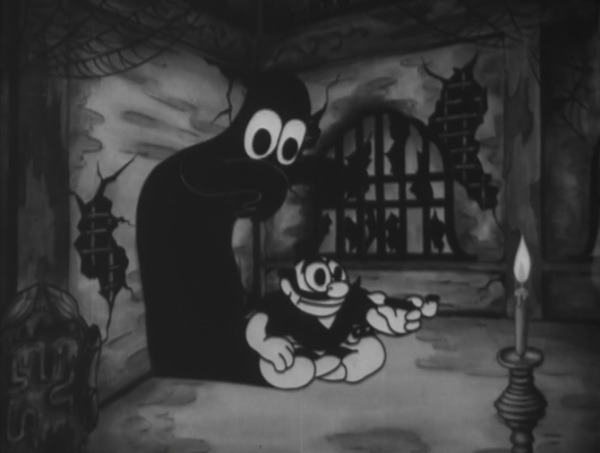
The parallax scrolling – different layers of background moving at different speeds – is excellent. The new cel animation technology allows both animals’ shapeshifting powers to be shown in a fluid and powerful way. Oishi does this all very cleverly, although I have to knock a little off because so much of the plot rests on the absent soundtrack. Nevertheless, “The Fox And The Tanuki Compete” gets 6/10.
Oishi did make another film in 1933, presumably before he signed for PCL. It’s a short called “Shoujouji no Tanuki-bayashi” / “Belly Drum Dance At Shojoji Temple” (Unknown, 1933). Unfortunately, this has no clear date and the production credit is illegible. If anyone reading or listening reads Japanese, I’d appreciate it if you could take a swing at that particular link. It’s a “music video” short, and it’s only 72 seconds long. So I won’t score it, but I do expect plenty more work from Oishi to appear in these blogs.
fin
That ends today’s blog. I would like to give special thanks to this blog’s pillars; AniDB, who have helped me work out what to look for, the Japanese Film Archive, who have given me the material to actually watch, and Jonathan Clements’ excellent “Anime: A History.”
Special thanks today go out to Jackson van Uden of History With Jackson.
- “Anime: A History – Second Edition”, Clements, p. 72, 2023 ↩︎