
A FAILED COUP
On February 26th 1936, a group of young military officers attempted to overthrow the Japanese government; a coup d’etat. They were part of a faction who were convinced that their brand of ultranationalism was correct, but was losing the internal struggle for the ear of the Emperor. They tried to kill seven key figures in Prime Minister OKADA Keisuke‘s cabinet, and to seize the Imperial Palace. Their plan was to purge both the government and military of their political enemies.
They failed in their goal of seizing power, but they took a terrible toll in their failure. The rebels killed two former Prime Ministers, SAITŌ Makoto and TAKAHASHI Korekiyo. They also killed JŌTARŌ Watanabe, the Inspector General of Military Education. Emperor Hirohito was infuriated by the coup attempt, and ordered the rebellion to be crushed. The officers hadn’t carried many men with them to begin with, but most of them deserted once it was clear they had failed. At 1pm on February 29th, the officers involved sent the rest of their soldiers home. Two of those officers killed themselves immediately afterwards. A kangaroo court was convened in April, and nineteen of the men involved were sentenced to death.
The military quickly purged itself of the officers who supported the coup without getting involved. This included former minister of state and noted fascist loony, SADAO Araki. Ironically, once the political infighting within the military stopped, they were able to influence the government far more effectively.
The information about animation from Japan in 1936 is, frankly, splintered and confusing. Given that Tokyo was under martial law from February 27th until June 20th, it’s understandable that the animation that was being made would have been stifled, to say the least. Neverthless, art endures.
THE END OF MURATA
But life is short. MURATA Yasuji, who had been the most prolific figure in Japanese animation, was nearing the end of his career. Somehow, when SEO Mitsuyo left MASAOKA Kenzo’s studio to create his own in 1935, he ended up with all of Yokohama Cinema Shokai’s government contracts. And it took the wind completely went out of Murata’s creative sails. Murata would only make one more film for Yokohama. That was “Izakaya no Ichiya” / “A Night At The Bar” (Yokohama Cinema, 6 June 1936).
“A Night At The Bar”
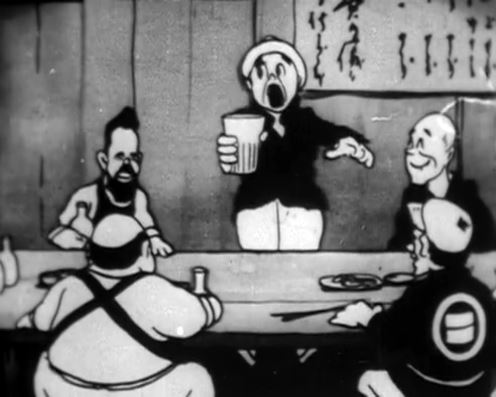
A young unemployed man wanders the streets, and finds his way to a bar, which literally drags him in. Four men get him drunk, and he passes out. Then he dreams of travelling to the bottom of the sea to find sunken treasure. He gets into a fight with a pair of traditional samurai, but he manages to persuade them that he’s a good Japanese person. The trio sneak up on the treasure ship and get into another fight with a skeletal, foreign1 guardian; our hero gets beaten up and awakes in the bar.
Murata’s sea-creatures were always one of his strengths, so I see why he picked an underwater tale. But the central conflict of Japanese culture of the time is also at the centre of the cartoon; one of the samurai asks “What will happen to the Japanese if they just give up so easily?”. It’s a reasonable enough bit of work; “A Night At The Pub” gets 5/10.
While the Japanese Animated Film Classics website insists that he moved on to his own studio, Murata Manga Seisakusho in 1937, nothing that they produced has survived to the present day. He would become the “arts section chief” of Nihon Eigasha, the newsreel company founded in 1940 to provide propaganda films for domestic consumption, and eventually joined Nihon Manga Eigasha after the war. But as far as I can tell, he never made another cartoon. He passed away in November of 1966.
MIYASHITA AT YOKOHAMA CINEMA SHOKAI
Yokohama Cinema tried to keep going, and made two more films in 1936 under new director MIYASHITA Manzo. They were “Osaru no Kantai” / “The Monkey Fleet” and “Ohisama to Kaeru” / “The Sun And The Frogs”. Neither is available in full online.
Based on the little I was able to watch, the first is a pretty straightforward piece of war propaganda, and the second is the last of the Athena Film Series, adapting European fables for the Japanese audience. Perhaps the “European” thing is why the series came to an end. The series was being funded by the government, and maybe they didn’t want to present non-Japanese stories as positive. But that’s just a guess.
Miyashita might have been responsible for “The Candy Man’s Raccoon Dog Dance” from 1931 – MyAnimeList seems to think so – but that was the only other information I could find out about him. Yokohama Cinema Shokai didn’t officially close until their factory was burned down in an air raid, in 1945, but there are no further records that they produced any films at all after 1936, never mind animation. Miyashita himself seems to have stopped animating at the same time, and there’s no information I could find about the rest of his life.
MASAOKA MOVES ON & OFUJI KEEPS GOING
This is turning into a very sad blog post, but I suppose that was to be expected. MASAOKA Kenzō thought that the Japanese market could support a fancy studio with its own recording unit attached. In 1935 he was proved wrong, and his studio closed. Masaoka’s last film under the branding of “Masaoka Eiga Bijutsu Kenkyujo” came out in 1936. It was called “Suzume no Oyado” / “The Sparrow’s Lodge”. It’s not fully available online, but what I could see looked beautiful.
There’s a note on the biography of master animator OFUJI Noburo in 1936, that simply reads “Engages in productions with Masaoka Kenzō around this time”. I don’t know if that means Masaoka worked with Ofuji on his only film of the year, “Chinkoroheibei Tamatebako” / “Heibei The Pooch And The Magic Box” (Chiyogami Eigasha, 1936). But at least I can review it.
“Heibei The Pooch And The Magic Box”
It’s a hot day, and Heibei the Pooch is sleeping. He gets woken up by a spider, and a passing turtle challenges him to a swimming race. All the fish gather at the Dragon Palace, home of the Sea King. He’s brought a box of treasure. When he opens it, various different sea creatures swim out. Naturally Heibei wants the box, but he can’t get into the Palace.
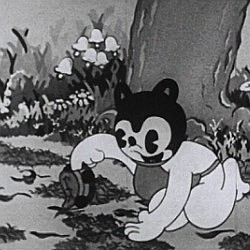
So he rips the skin off a passing fish – ow – and swims on in. He gets caught when he tries to steal the box, and there’s a chase scene. He gets away and opens the box; an octopus comes out and turns him into an actual dog. Everyone laughs, film over.
This isn’t perfect by any means, but to be honest it’s a relief to get back to Ofuji’s exquisitely crafted backgrounds. It’s a reasonable retooling of the “Urashima Tarō” story, with Heibei front and centre. He’s a strange creature; pie-eyed like Cuphead, with little ears and an apron that reminded me of Kintaro’s. I wouldn’t have known he was a dog if not for the title.
There are some clever, slightly surreal touches in this cartoon, that don’t fall into outright chaos as they would have in Western hands. It’s not actually good, but “Heibei The Pooch And The Magic Box” is still worth 5/10.
fin
I would like to give my usual thanks to this blog’s pillars; AniDB, who have helped me work out what to look for, the Japanese Film Archive, who have given me the material to actually watch, and the inseparable pairing of Jonathan Clements & Helen McCarthy and their “Anime Encyclopedia”. I’d also like to thank MyAnimeList for their help with this post.
- He’s got a hat on that’s either Spanish or American, I can’t quite tell ↩︎