HISTORY SIDEBAR: KOKUTAI NO HONGI
I’ve adapted this part of the blog from the work of historian Herbert P. Bix, and his biography of the Showa Emperor, “HIROHITO AND THE MAKING OF MODERN JAPAN”. Much of the historical detail that I haven’t cribbed from online translations of Japanese sources come from him.
The two arms of government that Mutsuhito, the Emperor Meiji (1867-1912) kept for himself when democracy came to Japan were control of the military and education. Those were still in Imperial hands in 1937, and Hirohito exercised the latter power on May 31st of that year.
The Ministry of Education sold two million copies of a new instructional manual called “KOKUTAI NO HONGI“, or “The Fundamentals Of The National Polity”. They also distributed three hundred thousand copies to Japan’s schools. As Bix puts it;
“A transitional ideological tract, it did not completely reject Western thought and institutions, but went beyond merely emphasizing Japanese cultural distinctiveness. Extolling the ‘bright’, ‘pure’ and selfless ‘heart’ of the Japanese, and counterposing the kokutai to modern Western individualism and ‘abstract totalitarianisms’, it stressed the absolute superiority of the Japanese people and state over all other nations.”1
The First Shots Of World War II
On July 7th, 1937, following a minor incident involving a “missing” Japanese soldier who turned up within a day, Japanese forces attacked and took the Marco Polo Bridge2, just outside Beijing. With the approval of the Emperor, and thanks in part to a very weak Japanese government, the Japanese army in China began a full-scale invasion. This started the Second Sino-Japanese War, and is “often regarded as the beginning of World War II in Asia”.
By August, Japan had taken Beijing and Tianjin. By November, Shanghai had fallen, and the Chinese Nationalist capital city of Nanjing was captured by the end of the year. In Nanjing, at least 200 thousand Chinese people were executed, almost all of whom were civilians and prisoners of war. At least twenty thousand women and children were raped. This took place over a six-week period.
What the Japanese government would start to call it’s seisen, a “holy war”3, had begun. As Bix says,
“The undeclared China war would last eight years, set the stage for the triumph of Communism in China, and end only after having given seed to Japanese involvement in World War II, and Japan’s ultimate defeat.”
And that prompts me to to ask three key questions again. What did Japanese animation look like, between this outbreak of World War II, until its terrible end? What made Japanese animation unique, as compared to what was being created in other countries? Who was making it, and why?
WARTIME ANIMATION: YEAR ONE
There are only three pieces of animation from Japan in 1937 that have made it to the present day. But I’m still very happy with what I can talk about.
The first on my list is “Maabou no Shonen Koku-hei” / “Mabo’s Boy Aviation Squadron” (Sato Seneiga, October 10th 1937). It was the third in a very successful series of propaganda cartoons, starring boy hero Mabo, by animators SATO Ginjiro and CHIBA Yoji. The cartoon isn’t online, and Matsuda Film have the restored print. They’ve been restoring silent Japanese films since 1952. If you’ve been lucky enough to attend one of their monthly showings in Tokyo, please drop me a line!
The second of the three is a hybrid, and a co-production between two names I never thought I’d see together. “Shikisai Manga no Dekiru Made” / “The Making Of A Colour Animation” (Ogino Picture/Chiyogami Eiga, 1937) is truly fascinating. The first half is a documentary by everyone’s favourite skiving fuel store owner, OGINO Shigeji. And no less a figure than OFUJI Noburo has allowed him into his studio. I mean, wow.
“The Making Of A Colour Animation”
We get to see Ofuji making a test animation using Kodachrome. That was a colour reversal film process that had only gone on general sale in 1935. Ogino is here to document Ofuji’s process. He shows us how Ofuji paints, just how many cels it takes to make this style of animation, and how the photography works.
But then I read the best caption of this project to date: “when it’s developed, it looks like this”. Because the second half of the film is “Katsura Hime” / “The Wigged Princess” – the test film we’ve just seen Ofuji make!
It’s a simple enough story. A happy little Princess taking some fresh air in her palanquin, and Dangobei the comic samurai is dancing ahead of her procession. They meet a giant – an ogre? maybe, but not a Japanese one – who kidnaps the princess. Heibei The Pooch, in a beautiful little pink apron, runs out from his watermill home to save her. Dangobei tries to help, but falls into a river instead. Thankfully, Heibei is able to steal the princess away, leaving only her titular wig behind.
I cannot tell you how happy this made me. It would have been even nicer to see Ofuji doing one of his chiyogama classics, but that wasn’t the point. Seeing his working process at all both the otaku and historian within me. And then we get to see one of the first pieces of colour animation ever made in Japan! I was ecstatic, not least because getting through 1936’s animation has been a really tough chew. “The Making Of A Colour Animation” is simply wonderful and gets 9/10. If you’ve enjoyed any of my reviews so far, I urge you to watch this piece of history.
“The Missing Dumpling”
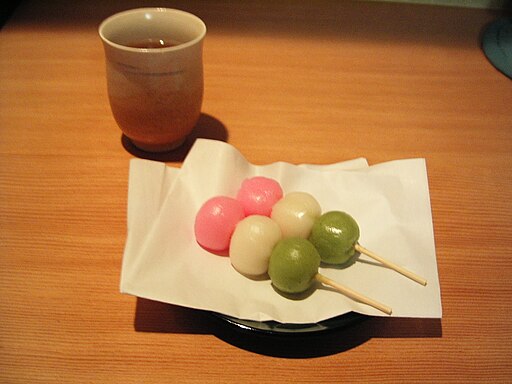
The third animation I could find is only a fragment, but someone, somewhere, has missed a pun. It’s called “Dango no Yukue“, and the literal English meaning of the title is “The Missing Dumpling” (Chiyogami Eigasha, 1937). But you could also read it as “The Whereabouts Of Dango”. Back from “The Wigged Princess”, Dangobei is out in the woods enjoying a dango. That’s his namesake rice flour dumpling. Unfortunately, he loses it to a passing tanuki. The raccoon-dog goes home and tells its parent it’s found some food. In what was probably foreshadowing, the parent reminds their child to transform if things get dangerous.
Time for a little honesty. I only recognised Dangobei in “The Wigged Princess”, because Ofuji used the same, new design for him here. Unfortunately, at the moment, only three minutes of this 11 minute cartoon are available. And the story isn’t close enough to complete to be fairly scored. It’s really interesting to see where Ofuji is going with his work, though.
fin
The history of 1937 has been bitter, and it’s only going to get worse. But being able to watch even one and a bit cartoons from one of the masters of the form in Japan has softened the blow considerably.
I would like to give my usual thanks to this blog’s pillars; AniDB, who have helped me work out what to look for, the Japanese Film Archive, who have given me the material to actually watch, and the pairing of Jonathan Clements & Helen McCarthy and their “Anime Encyclopedia”. I’d also like to thank Kobe Planet Film Archive, who have kindly made their section of “The Missing Dumpling” available online.
The image of some actual dango comes from Maakun at the Japanese language Wikipedia, CC BY-SA 3.0 http://creativecommons.org/licenses/by-sa/3.0/, via Wikimedia Commons.
I’ve been Douglas Howell, and I’ve been watching Japanese animation. Next time I’ll be looking at 1938. I can’t promise you that a lot is going to change.
Leave a Reply