
JAPAN LOOKS EAST
In late 1939, General ABE Nobuyuki had been appointed Prime Minister of Japan to preserve order at home and to strike a balance between the other Great Powers. Abe seems to have wanted to end the war with China and remain neutral, especially avoiding any military alliance with Germany. However, a combination of America’s increasingly pro-British policies and opposing factions within his own cabinet made his position untenable. He resigned on January 14th, 1940.
Emperor Hirohito, keen to win the war in China and keep the Soviets at bay, appointed Admiral YONAI Mitsumasa as Prime Minister. But once again, events overtook Japan. On May 10th, Germany invaded Western Europe. On June 22nd, the French surrendered, which happens a lot less often than some people would have you believe. Yonai started to come under pressure to arrange an alliance with Germany and Italy, to allow Japanese forces the freedom to attack European imperial possessions in Asia. Knowing the relative weakness of his own nation’s navy, Yoneuchi resigned instead.
KONOE Fumimaro became Prime Minister again. He almost immediately started drawing up plans to attack what were then the Dutch East Indies and British Malaya1. On September 27th, with Japanese forces already attacking French holdings on the Asian mainland, the long-awaited Tripartite Agreement between Germany, Italy and Japan was signed. The USA immediately put an embargo on exporting scrap iron and aviation-grade fuel to Japan. This was mostly a symbolic gesture, but it confirmed that unless Japan changed course, a war with America was increasingly likely.
SEO DUCKS BACK IN
Geijutsu Eigasha’s work with SEO Mitsuyo appears to have been slow but steady. They only made one cartoon in 1940, and it was “Ahiru Rikusentai” (Geijutsu Eigasha, 1940). It’s the first time in this project where I’ve seen an English title that’s better than the Japanese one. “The Quack Infantry Troop” is a definite improvement.
“The Quack Infantry Troop”
Our hero is a cutesy looking duckling who wants to play at war. He sounds like a kid, dresses like Donald Duck, and he’s been sent to the shop to get some “fish bullets” for dinner. Some bullying frogs stop him on the way. Our duckling loses the fish to them, and runs home to Mummy Duck. His inevitable pair of brothers argue as to how they’re going to attack Frog Island. Meanwhile, the frogs are enjoying a spot of sumo.
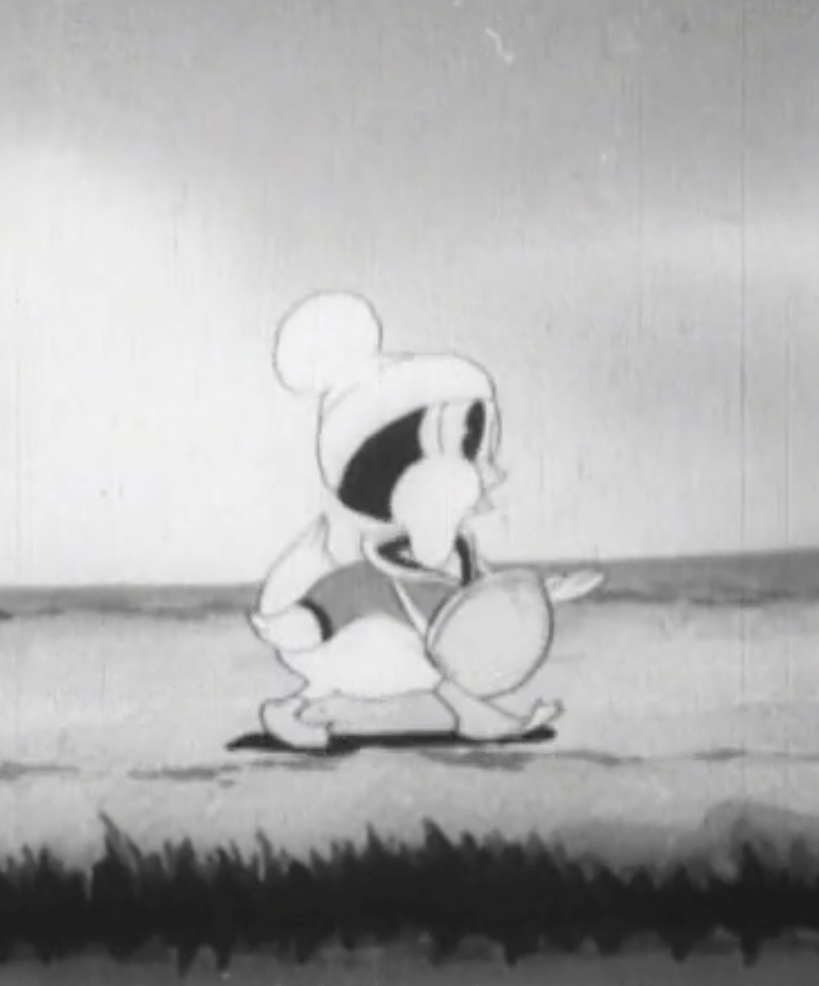
The trio of ducklings break it up. With a field cannon. Sometimes I hate sentences. The frogs pile into their battleship and counter-attack, and the cartoon war plays out as you might expect; pointless but deathless destruction, interspersed with slapstick and lots of explosions. Then a thunderstorm ends the battle. When it passes, Everyone Laughs and the film ends.
This is well-observed, well animated, and totally sickening. The creators are clearly trying to reassure a junior school audience. Yes, they’re saying, war happens sometimes, but it’s all going to be ok once it’s finished. I can see why it was necessary but it’s still horrible to watch, especially knowing that most of the creators involved were significantly lefty. No score by policy. This cartoon perfectly demonstrates the cleft stick that Japan’s remaining cartoonists were stuck in. Their American equivalents would follow them into it, all too soon.
A DENTIST’S MASTERPIECE
It’s usually pleasant to find a new director for this site, but there’s not a lot of information available about ARAI Wagoro beyond what I’m about to tell you. What I have mostly comes from the frankly essential “Anime Encyclopedia” by CLEMENTS & MCCARTHY2. It’s not even clear what his first name was; I’ve copied those authors in using “Wagoro” but it might have been “Kazugoro” instead.
Arai began his animation career in 1931 at the latest, because one of his cartoons – “Walking Of Baby Boy” from 1931 – made it all the way to the United States, winning a “certificate award in the American Cinematographer Amateur Movie Makers Contest of 1932.”
Lost Cartoon: “The Golden Hook”
By 1939, Arai had become the head of a small team of creators who made silhouette animations until 1947, according to the work of Jason Cody DOUGLASS. The team’s first effort came in 1939, and was “Ougon no Tsuribari” / “The Golden Hook” (Independent, November 1939).
THIS NEEDS FIXING It’s lost. I think that it’s based on a Korean folktale about a kind, hardworking fisherman who only took what he needed and was rewarded by the Dragon King of the sea. But that’s no more than an educated guess.
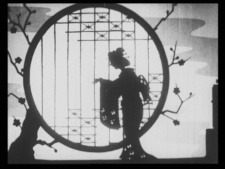
The next film that Arai and his team’s made was a silhouette cartoon called “Ochou Fujin No Genso” / “Madame Butterfly’s Dream”. It’s an adaptation of Giacomo PUCCINI’s legendary opera, “Madame Butterfly”. And thankfully, it’s available online. So I get to ask the question: was it any good?
“Madame Butterfly’s Dream”
Mount Fuji stands proudly in the distance. A black ship is in the harbour, and a woman and child are waiting in a beautiful house. A swift flies and feeds her chicks. The ship fires two warning shots, and the woman runs for a telescope. She sees the American flag waving on the ship. She makes herself up, and the child gathers flowers and looks at a photograph of an American officer. They wait. No-one comes.
The woman, alone, remembers butterflies. She walks through a garden, and a soprano sings an aria in Japanese. The woman meet-cutes her officer, and they make love in the garden. Blossom falls, and the pair share the tea ceremony. But then he’s called away to his ship. The swifts grow and fly the nest. Snow falls, and the woman cares for her new child. A butterfly dances into a spiderweb.
The officer walks the deck. His wife, in a Western dress, is with him. They return to their house, which the woman we’ve been watching has been looking after for them. She writes a note with her brush and hugs her child. She prays to Buddha, and draws a dagger with the text “I will die in shame”. The child gives the note to her new parents. The woman kills herself. Mount Fuji stands proudly in the distance.
A Copyright Tangle
This is simply done and incredibly effective. I thought the pacing would be gentle; it’s slow, yes, but all that does is draw out every drop of emotion. This animation leans heavily on the shared high art tradition of Japan and China, and is superb throughout.
If the creators has been able to couple this with Puccini’s original score, it would have been basically perfect. That was the original plan, and Japan’s rather fuzzy animation copyright law of the period would have made it possible. Unfortunately, this was 1940, and they couldn’t really trample on the copyright of a fellow Axis power. The new score tries its best, down to writing a good aria and a hummed choral piece that’s a straight conceptual lift from Puccini. It’s not as good. It was never going to be.
Clements & McCarthy think that this “rather defeat(s) the point of this ‘adaptation’”3. I politely disagree: while this isn’t propaganda as such, it’s very clearly the political tail wagging the artistic dog. This is not a work with any subtext: America’s penetration of Japanese culture back in 1853 is the unashamed villain of the piece.
But it’s just too good to ignore. It would have been very easy for a cack-handed animation team to blast Puccini and original author John Luther LONG’s story over the bar and into row Z. This adaptation is sublime; “Madame Butterfly’s Dream” scores 8/10.
MASAOKA’S LOST WORK
I called this website “Douglas Watches Every Anime”. No, it’s not even close to being true yet. Even though I can’t watch any of them, I must mention the work that MASAOKA Kenzō in 1940. He made three cartoons, and time has put paid to all of them. They were “Yume no Majutsushi” / “Dream Magician”, “Karasu no Hoken Kan`yuuin” / “Crow’s Insurance Agency”, and a third title you might recognise.
“Kachikachi Yama”/ “Firecrackle Mountain ” was the third attempt to tell a folktale. It’s about an evil tanuki, the farmer he torments and the rabbit who evens the odds. OISHI and ICHIKAWA already made cartoons about it, and both versions are lost. I’m starting to think the title is cursed, and I don’t usually believe in that sort of thing.
Masaoka released two more films that I can’t get my hands on. 1941’s “Karita Boushi” / “The Borrowed Hat” looks like it no longer exists, and I’ll discuss the other one when I get to 1942. But as I’ve noted before, Masaoka was a deeply stubborn man. This won’t be the last time I’ll mention his name.
RETURN OF THE GOLDEN BOY
While I’m sure the Shadow Staff, who spent most of their time making training animation for the Japanese armed forces, considered ASHIDA Iwao a valued member of the team, he isn’t the “golden boy” here. Ashida’s sole publicly released effort from 1940 was “Kintarou Taiiku Nikki” / “Kintarō’s Training Day” (Sanko Film Eigasha, 1940).
Kintarō is a semi-mythical superhuman child who wanders around Japan wearing an apron with “gold” written on it. Hence, he’s called the Golden Boy. He’s semi-mythical because while he couldn’t have done most of what’s attributed to him, he is based on a real person. SAKATA no Kintoki was one of the Four Heavenly Kings, who served the equally mythologised samurai MINAMOTO no Yorimitsu, some time around the turn of the Western 10th century.
“Kintarō’s Training Day”
His face opens the cartoon, splashed in imitation of an early Disney short. Except Uncle Walt never put Mickey’s face in front of the Japanese war flag. As the action starts, an unusually adult-looking Kintaro is leading his animal friends in stretching exercises, each in their own way.
Then the animals have a sumo tournament. A bear wins it. Kintarō faces him, first at sumo and then at boxing, and wins handily; this repeats what we saw Kintarō do back in his first outing, 1934’s “Kamishibai Kintarō”, and it’s one of the mythological character’s most famous feats. All things considered, the sumo is fairly accurate.
The animation isn’t fantastic, but considering that Ashida’s attention was split at the time – or this was tidied up and rushed out before he left for the Shadow Staff – it’s not too bad. And apart from the flag at the very beginning, and being a general exhortation to good exercise practices, it’s very hard to see how this counts as propaganda of any kind. Given Kintarō’s nature, that’s a pleasant surprise.
That means I have to score the thing; “Kintarō’s Training Day” is slightly above average in the circumstances, so gets 6/10. A refreshing change from some of the horrible stuff I’ve been watching for this project recently.
FIN
And that’s it for 1940. I would like to give my usual thanks to this blog’s pillars; AniDB, who have helped me work out what to look for, the Japanese Film Archive, who have given me the material to actually watch, and the inseparable pairing of Jonathan Clements & Helen McCarthy and their “Anime Encyclopedia”.
Today I’d also like to thank Amateur Cinema. Image of “The Quack Infantry Troop” is by Mitsuyo Seo, Public domain, via Wikimedia Commons.
I’ve been Douglas Howell, I’ve been watching Japanese animation, and I’ve finally managed to get into the 1940s. Joy. Join me next time, please, as the war grinds on and somehow, animation keeps on being made.