
A HORRIBLE FOX – YAMAMOTO RETURNS
As I hope has already become clear, this period of Japanese animated film-making is either superbly and precisely documented, or involves 85% guesswork. The location and work done by YAMAMOTO Sanae between his last animation in 1936, and his return to directing in 1941, are more than a little foggy.
The Kobe Planet Film Archive pin three works to him in the period; “Thanks To The Turtles” in 1937, “Origins Of Minamoto no Yoshitsune” in 1938 which I think is a semi-historical piece about the famous 12th century samurai, and “The Fox’s Father” from 1940, for the Ministry of Education. But of course, it’s all long lost. Thankfully, we do still have one complete work of his from 1941; “Namakegitsune” / “The Lazy Fox” (Eiga Kyoiku Chuokai/Ministry Of Education, 1941). Was it any good?
“The Lazy Fox”
It’s springtime and the flowers are in bloom; monkeys and rabbits dance to a bird jazz band, and the titular Fox in his Western high-collared shirt is getting good and drunk. Meanwhile, a hard-working family of tanuki are plowing and sowing seed in a field nearby.
Soon enough, the tanuki are harvesting, but they have a bit of a laugh while they’re doing it. The very ugly fox meets them with a walking stick, and laughs at their hard work. The tanuki brush him off; the fox then turns his stick into a gun and uses it to drive off some innocent rabbits and steals their food instead.
Then winter comes. The tanuki remain fat, happy and warm in a home under the Japanese flag, but the fox is freezing and starving in rags. Then he has a cunning plan; use his magic to create fire and try to burn the tanuki’s storehouse down. Naturally they rush to save it, and the fox “helps” them by turning into a truck. As soon as the tanuki have loaded him up, he drives off with the loot.
The tanuki give chase, which thanks to everyone’s shapeshifting turns into an air battle, AA gun and all. The tanuki win and drive the fox away, and we see our heroes are all safe before the film ends.
A Series Of Unfortunate Choices
I felt really ambivalent about this one. The animation was fine, but the story is very dark indeed. It was nasty enough back in 1929 when MURATA Yasuji told it as “Two Worlds”, but his lazy Western animals were merely feckless. The titular fox here is an unrepentant villain, and that’s compounded by Yamamoto’s bizarre choice to add aircraft and artillery to the plot.
And using tanuki as the heroic, hard-working animal is, mythologically speaking, significantly out of character. I’m forced to assume that they’re being used as a uniquely Japanese animal. I had to wonder, after all that, if the loss of the soundtrack wasn’t a blessing in disguise.
On first watch, I wasn’t sure which side of the fine line between propaganda and actual art this cartoon fell on. But I slept on it. “The Lazy Fox” is pretty clearly meant to instruct and scare, more than it’s meant to entertain. No score, by policy. I suspect that decision saved this cartoon from a metaphorical paddling.
Thanks And Farewell
This cartoon marks the end of this blog’s reliance on the archives of the Japanese Animated Film Classics website. They have been the absolute bedrock of the viewing I’ve done to this point, and I hope I’ve given them the respect and honour that they deserve. The sixty-four animations that they host are available at their website. I strongly urge you to go and take a look, if you haven’t already.
TWO UNKNOWN FILMS
As always in this period, there are a handful of cartoons which are still extant but have no creators name attached to them, and usually no studio either. Two of those have made it to the present day from 1941, and I looked at “Doubutsu Tonarigumi” / “Animal Neighbourhood Association” (Unknown, 22 January 1941) first.
There’s an interesting word in that title. In September 1940, the Japanese Home Ministry divided Japan up into “Tonarigumi”, clusters of ten to fifteen adjacent households. Those households were meant to help each other with fire-fighting, working together during air-raids, and rationing. Given human nature, it also let you drop your neighbour in it, should they dare to suggest that the whole war thing was a bad idea. Given the timing of this cartoon, one has to assume it was to promote and explain the government’s new policy.
“Animal Neighbourhood Association”
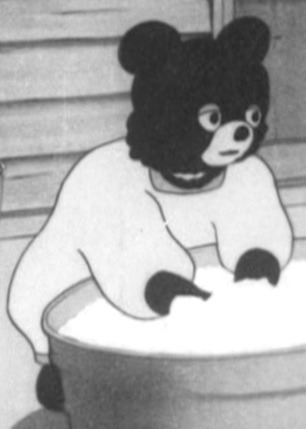
There are no recognisable names on the credits, and the first frames of the cartoon make it clear why; a weirdly bipedal postal horse trots across the screen to deliver the association instructions to a helpful tortoise. He passes it on to the rabbits next door, and soon every house in the neighbourhood has seen it. We see it too. According to a Japanese-speaking reader of mine, this is a note from the Squirrel family; their cat’s had kittens, and they’re offering them up for adoption.
For absolutely no reason, the bear family’s house burns down, and everyone rallies around to help. Later, a goat that’s just as creepily bipedal as the initial horse wanders across the screen. We see the association drive off a black-markety looking hyena. Then there’s an air-raid and everyone blacks their houses out and runs into a shelter. The all-clear sounds, and the animals sing their song as they march back home.
While, as a work of propaganda, this isn’t getting a score, it wasn’t even close to that “work of art” line I wrote about earlier. While all the animals stayed on-model, those models were very crude and in some cases near the uncanny valley. I didn’t have any subtitles, but the story was basic enough that I didn’t really need any. And perhaps the song was as successful as the introductory English captions said it was. But given the openly thought-crimey nature of the associations, I don’t think anyone dared to complain about it.
“Baby Kangaroo’s Birthday Surprise”
Finally for this year, we have “Kangaroo no Tanjoubi” / “Baby Kangaroo’s Birthday Surprise” (Unknown, February 1941). This time around there’s a benshi, so I could understand the plot!
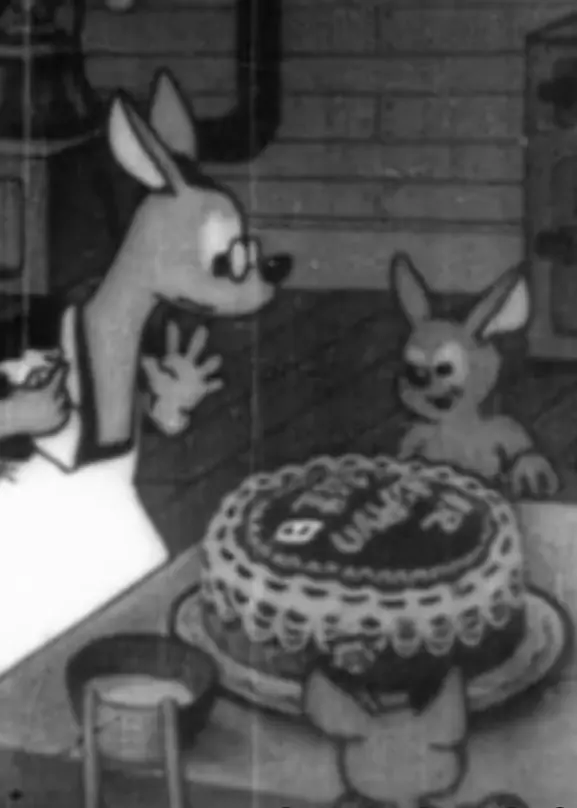
A very well-drawn family of kangaroos are celebrating their youngest’s birthday. One of the joeys steals some cake batter and eats it, and while he’s playing with the whisk, a big cloud of good-smelling steam bursts from the house. It weaves its way into a wolf’s lair, who finds the house and breaks into it.
He eats everything and steals one of the kangaroo children, outpacing its mother in no time at all. But she meets a family of moles, who quickly dig their way to the wolf’s lair. The other children hop through the tunnel, and the moles and kangaroos are able to defeat the villain and return home.
A Kangaroo? In Japan?
This was the weirdest cartoon I’ve seen for this project so far, and it’s for the weirdest reason. This is Japanese animation. The intertitles are in Japanese and the credits are all for Japanese names. But nothing about the cartoon is Japanese in the slightest.
The setting is fundamentally Australian, which was still the British Empire at the time. The physics of how the characters move is heavier and more solid than anything Japan had done before, including all the times when animators were inspired by or straight up copying the Americans. We even see a Western mousetrap used on the wolf, which is another first.
Even the characters bear no resemblance to anything I’ve watched for this project. The wolf looks like a riff on Goofy but is original enough to stand alone. This was clearly shot on a multiplane camera, which was brand new technology at the time. And strangest of all for a cartoon from this year, there are no propaganda elements at all. That was illegal in 1941 Japan.
It was a decent enough cartoon without being spectacular, and the story is sweet if basic. “Baby Kangaroo’s Birthday Surprise” gets 5/10. But it asks more questions than it can possibly answer.
Clarity And Completion
There’s one more bit of confusion that needs clearing up. There’s a cartoon out there that’s labelled as a work from KATAOKA Yoshitaro, called “Sankichi The Monkey: Our Marines”. But there’s nothing very paratroopy or special forces about it at all. It was only when I was looking at the cartoons for next year that I realised what had happened. It’s actually “Sankichi The Monkey: Air Combat”, from 1942. So I’m going to call “Our Marines” as lost, and I’ll talk about “Air Combat” next time around.
FAN
Before I launch into my usual wave of thanks, there is one more cartoon to mention. I have covered all the Japanese animation I could find from 1941. But over in China, specifically in Shanghai, a group of animators led by the Wan Brothers had done something remarkable. Their city was split between Britain, America, Vichy France, the Republican Chinese and Japanese occupiers at the same time. Somehow they managed to create the world’s fifth, and Asia’s first, feature-length animated film.
“Princess Iron Fan”
It was “Tiě shàn gōngzhǔ“, or “Princess Iron Fan”. It was based on a part of Chinese literary classic, “Journey To The West”, and sees the Monkey King duel with the titular Princess for her magical fan, which is desperately needed to “quench the flames that surround a peasant village”. I can’t think how they came up with that idea.
It was 73 minutes long and was shown as far afield as Hong Kong and Japan itself. While it was understandably banned in the latter country, given its themes of rebelling against unfair attack, it was seen by future manga legend TEZUKA Osamu, and by the Japanese Navy. And the Navy weren’t going to let the Chinese beat them in the field for animation for long.
There’s that distant rumbling noise again. Weird.
FIN
But that does conclude my look at 1941. As usual, I’d like to give my thanks to this blog’s pillars; AniDB, who have helped me work out what to look for, the pairing of Jonathan Clements & Helen McCarthy and their “Anime Encyclopedia”, and Clements’ own “Anime: A History”. I’d also like to thank the reader who sent me a note, although they’ve asked to remain anonymous.
And for the final time, I’d like to thank the Japanese Film Archive. Without their help, I would never have been able to crawl out of the rabbit hole marked “1917 Japanese Animation”. Words cannot express my gratitude. It was cold down there.
I’m Douglas Howell, and I’ve been watching Japanese animation. Please join me again, as the horrors continue to mount, and Japan finally stops being able to pretend that everything is ok.
Leave a Reply