
THE END APPROACHES
Japan’s attempt to gain more territory in Burma1 at the start of the year failed utterly, and they continued to lose their new territories in the Pacific Ocean. By the end of this year, Japan had lost the war in the Pacific.
In June, American B29s stationed in India and refuelling in China were able to begin bombing raids on Japanese-occupied Taiwan, and the southern Home Islands. They weren’t enormously successful from a military point of view. But now Japanese civilians knew the war was real. Even the ones whose homes hadn’t been turned into rubble.
By this point, the Allies had successfully re-invaded Europe. Based on the assumption that the war there would soon be over, Japanese military planners were calculating what might happen if all that war materiel was used against them instead. For whatever reason, Hirohito was not contemplating defeat. Instead, due to his dissatisfaction with the state of the war, he withdrew his support for Prime Minister Tojo. Tojo resigned on July 18th.
Hirohito appointed KOISO Kuniaki as his new Prime Minister. Koiso was a former governor-general of Korea. He ordered plans for what Bix calls “showdown battles” across almost all of Japan’s territory, and to have every Japanese subject begin military training with bamboo spears. Calling this “Oto-san’s Army” is frankly too bitter a joke.
Retreat And Take Fire
By the end of August, American forces had successfully captured the Northern Mariana islands, sinking three Japanese carriers and downing 395 aircraft in the process2. This allowed the Allies to build new airbases on Saipan, Guam and Tinian, ready to strike more deeply into the Japanese Home Islands. XXI Bomber Command moved there in October.
At the same time, Emperor Hirohito gave orders to his commanders in the southern Phillipines, over-riding the advice of his own general staff, that led directly to their defeat3. In November, direct air attacks from the Mariana Islands began to rain down on Japan.
On October 21st, 1944, an unknown Japanese pilot flew his aircraft directly into the heavy cruiser HMAS Australia. He was the first kamikaze pilot, bringing the “divine wind” into the service of his country. He wasn’t the last.
MOCHINAGA GOES UNDER THE SEA
There was, quite understandably, not a lot of animation going on in the Japanese Empire in 1944. While it’s unavailable, the frankly essential “Anime Encyclopedia” by CLEMENTS & MCCARTHY4 says that live-action documentary maker KATOO Tai made a partly animated piece in Chinese for a Manchurian audience with the lovely title “Lice Are Frightening”. It might be available online. I chose not to find out.
But one film from this year is still watchable. It was the directorial debut of MOCHINAGA Tadahito. Geijutsu Eigasha hired MOCHINAGA in 1941, to build Japan’s first multiplane camera for SEO Mitsuyo. The pair worked together on the sublime “Ari-Chan The Ant” in that year, and on the sublimely terrifying “Momotaro’s Sea Eagles” in March of 1943.
No sooner had that film been finished, than Geijutsu told Mochinaga he had more work to do. Instead of a short cartoon that would allow him to spread his wings, he was given a 32-minute script based on work from future TV anime icon, YOKOYAMA Ryūichi.
YOKOYAMA invented Fukuo “Fuku-chan” Fuchida in 1936. Fuku-chan was originally a background character in “Edokko Ken-Chan”/ “Little Ken From Edo”, a newspaper comic strip, the first manga to be adapted to live-action film. Fuku-chan became popular enough to get his own, titular comic, which ran from 1936 to 1971.
That story was “Fuku-chan no Sensuikan” / “Fuku-chan’s Submarine” (Shochiku Film, 9 November 1944). It marked the beginning of Yokoyama’s far-reaching influence on the Japanese animation business. But you don’t have to read very far between the lines to realise this was propaganda.
“Fuku-chan’s Submarine”
The opening titles see waves crash and shoals of fish swim, and the titular submarine surfaces. Men pile out of it – there’s a weak blackface joke – and a martial song plays. Dolphins swim along with the boat, and seabirds fly until a suspiciously self-similar flotilla of surface ships sail across the screen. They carry the badge of the American Air Corps, which I can only put down to iffy research.
The submarine quickly puts paid to the fleet, and Fuku-chan gets kidnapped by a passing seagull. One of his crewmates swims after him for a successful rescue. Then the sub travels through an icefield and has a duel with another sub.
What follows is a series of badly connected vignettes of Fuku-chan and his adult crewmates. We see them sailing around, taking easy victories against various American targets. Eventually they bite off more than they can chew: an aircraft carrier. There’s some mild peril as they sink to new depths to avoid attack and the boat cannae take it.
Hurrying Up To Wait
They emerge for repairs and to catch some passing flying fish. Then the sub returns to port to restock on torpedoes, over soothing music that probably spoke of home and safety. Then there’s a clumsy fade to black.
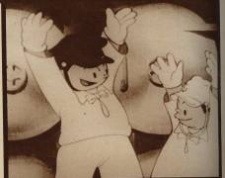
We watch the crew continue to restock and do everyday submarine tasks together at glacial pace. Then they head out into sweltering heat as they go back after the carrier. Poor Fuku-chan is literally dripping wet here. Orders are bellowed over the boat’s tannoy as they prepare for an attack. All light-heartedness vanishes as the sub sinks to attack depth, and the torpedoes fly to destroy their target. Somehow two identical destroyers collide and explode, and cheery music plays as the carrier sinks. Fuku-chan even films it, and then the sub sails away with Mount Fuji in the distance.
A Mess of A Boat Story
There were a lot of skips and jumps in this cartoon. I don’t know if that’s down to the march of time, or the work of an Occupying censor. Regardless, you can definitely see where the lost fragments were. There is, of course, the core of a good story here, as anyone who’s seen “Das Boot” or “Star Trek: The Wrath Of Khan” will tell you. But this isn’t a good story, or any kind of story at all really. It’s just a lot of things happening, one after another. Mochinaga seems to have been aware of that, and tries to make the enemy aircraft carrier the villain of the piece. But it doesn’t work.
Fuku-chan is essential to allow the film to be marketed to children and families, but he doesn’t do a lot. His presence makes the whole film feel like “Take Your Children To War Day – The Movie”. I think Mochinaga was going for “idealised life of a submariner”. But with no proper antagonist or noticeable plot, it’s hard to say that the message landed very hard.
Mochinaga’s Strain
It’s not a surprise to see that Mochinaga made a fantastic job of the animation here. But there was enormous amounts of padding, and the pacing was very odd. In a propaganda film, I would expect more time to be taken over a submarine surfacing than a sailor swimming to the rescue of Fuku-chan. If anything, the latter got more than the former. Mochinaga’s inexperience – and lack of backing – was very obvious at times.
The character designs, which I’m sure are comic-strip accurate, reminded me of British wartime cartoons which poked fun at the Axis leaders. But it was obvious that they tried to avoid animating the actual submarine whenever they could. The sound design was frankly bizarre: this was almost entirely music with very little dialogue, and they forgot to put the explosion noises into the first five minutes.
Nothing in this film landed or made coherent sense. By policy, no score; but “Fuku-chan’s Submarine” was paper thin in any case.
Mochinaga Leaves
I think making “Fuku-chan’s Submarine” broke Mochinaga a little. According to his daughter, he didn’t want his first film as a director to be this long and complex. Shochiku gave him no choice, though. They signed him to make it immediately after “Momotaro’s Sea Eagles” had wrapped. His animators were being drafted out from under him while he made it. He was nearly drafted during production, but managed to get a waiver.5 It was hard to find animation materials, and there was no money to buy them in any case. To add insult to injury, when Mochinaga went home after the film’s release, he discovered the Americans had bombed it flat.
Anyone would have snapped at that point. Mochinaga left Japan almost immediately, with his pregnant wife in tow. They moved to occupied Manchukuo on the Chinese mainland, where both he and his wife had relatives. He quickly found work with Man’ei, the Manchukuo Film Association, as a graphic artist. A month later, the war ended.
A New Name
The Mochinaga family were now stranded in China. But their luck finally turned; Man’ei was captured by the Soviet Red Army, who were happy to cooperate with the Chinese Communist Party. Man’ei became the CCP’s Northeast Film Studio, and Mochinaga started subtitling films for them. When Manchuria became a war zone in the Chinese Civil War shortly afterwards, his family were captured by the “POW-friendly” Eighth Route Army6, who seem to have been Communists pretending to fight for the Nationalists.
Mochinaga could have gone home. Instead he chose to stay in China and work for the Communists. One of his first jobs there came in 1947, working for feminist director CHEN Bo’er, on the anti-Nationalist propaganda puppet film, “Emperor’s Dream”. There wasn’t a lot of money or film to spare, so I think this is when he chose to shoot the puppets frame-by-frame instead of live. While it was Chen’s choice to base the film on Chinese opera, Mochinaga seems to have popularised stop-motion animation in China almost by accident. Chen also gave him his Chinese name; FANG Ming.
Fang Builds Foundations
In 1948, Fang would create another landmark; “Go After An Easy Prey” or “Turtle Caught In A Jar” (Northeast Film Studio, 1948), China’s first cel animation. In 1950, he moved to Shanghai to help set up the Art Film Group.
While he left in 1953, in 1957 it would be renamed to The Shanghai Animation Studio8. Today that studio produces 80% of the country’s domestic animation production. Fang returned to his home country and his old name in 1953, and he will return to this blog when I get to 1956.
fin
While I do feel that the lives of Mochinaga and Yokoyama, and their creations, are worthy of examination, you wouldn’t be wrong to suggest that I’m procrastinating a bit here. It’s pretty clear why. Exactly one Japanese animated film from 1945 is available online, and it’s one I’ve been afraid to watch ever since I realised my project would require me to. I was not happy to see that it was viewable online. At least the worst will be over after I’ve seen it.
For a while, anyway.
As usual, my thanks go out to AniDB, who have helped me work out what to look for, and the pairing of Jonathan Clements & Helen McCarthy and their “Anime Encyclopedia”, in addition to Clements’ work, “Anime: A History”. Without them, this project would have been impossible, instead of being merely bloody daft.
I’ve been Douglas Howell, and I’ve been watching Japanese animation. Join me next week, for “Momotaro: Sacred Sailors”, the end of a world, and the start of another.
- Called Myanmar today. ↩︎
- “Hirohito And The Making Of Modern Japan”, Herbert P. Bix (2000), p. 475 ↩︎
- “Hirohito And The Making Of Modern Japan”, Herbert P. Bix (2000), p. 481 ↩︎
- “The Anime Encyclopedia, Third Revised Edition”, Clements & McCarthy, p. 2758, 2015 ↩︎
- “Anime: A History – Second Edition”, Clements, p. 96, 2023 ↩︎
- Their history looks baffling and fascinating, but I’ve fallen into enough rabbit-holes for this blog as it is. ↩︎
- “The Anime Encyclopedia, Third Revised Edition”, Clements & McCarthy, p. 1642, 2015 ↩︎
Leave a Reply