
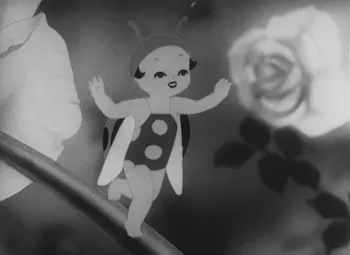
MASAOKA STAYS CUTE
The next Japanese animation to debut – that still survives, of course – baffled me before I even watched it. Shochiku Animation made a propaganda cartoon, “Fuku-chan’s Surprise Attack”, in 1942. And it did well enough to earn enough film to make something in 1943. But the laws in Japan were very clear at the time. No films were to be made that weren’t glorifying the war, or supporting Our Brave Boys in some way.
And that doesn’t describe “Kumo to Tulip” / “The Spider and The Tulip” (Shochiku Film, 15 April 1943) at all. It was the last wartime work of the studio’s animation manager and established director MASAOKA Kenzō. Given his batting average, I was looking forward to watching it. I usually ask “is this any good”, this time around I have to wonder; “how did this get made?”.
“The Spider And The Tulip”
A ladybird sings a sun salutation, and the opening credits roll. Then a bass voice takes over, as a spider offers rides in his webbed hammock. The spider appears, and is blatantly Al Jolson in full blackface. After attempting to catch a passing fly, the spider tries to lure the ladybird into his web instead. But the moon rises, and the good little ladybird tries to fly away home.
Inevitably, the spider attacks her on the way. But a nearby flower with a child’s face deliberately knocks into his line and sends the villain flying. The ladybird flees, and the spider webs up the flower and pursues her. Thankfully, the titular tulip opens her leaves and lets the ladybird hide inside her bloom. I was starting to wonder when she would show up. The spider webs that up as well and threatens them both.
In a lovely gag, the spider rigs up a fishing line that leads to the trapped tulip and a bell that will wake him when the ladybird escapes. He tries to sleep, but the wind gods show up and open their bags to blow him awake again. Rain begins to lash down and the storm whips away the spider’s web. But he’s able to steal an umbrella of sorts from some tiny bears – I didn’t understand this bit – and tries to hang on. It doesn’t work; the plants bounce him along until he lands in a pool and vanishes.
The storm passes, the sun rises, and that fly from earlier helps to unweb the tulip to free the ladybird. She sings her song and pulls the rest of the webs away, as the orchestra plays us out.
Music and Technology
This is a deeply musical film, with two excellent singers at the cartoon’s head. Opera singer MURAO Gorou plays the spider, and SUGIYAMA Yoshiko sings for the ladybird. Sugiyama was famous for recording songs for children, and her acting career carried through to 1951.
The score for this film was superb, and drove the story throughout. It was provided by Shochiku’s own Symphony Orchestra, who usually did all the heavy musical lifting for the studio’s live-action work.
All the stops were clearly being pulled out for this film. It helped that Shochiku have managed to make a multiplane camera. The fly at the film’s start spends its time zipping over a bed of flowers in a “look what we can do!” way that anyone who’s seen a 3D film will recognise.
The animation is superb throughout, partly because Masaoka is involved. But it’s also because Shochiku gave him a significant budget for the film. The characters are all wonderfully expressive and the trees and flowers are beautifully observed. Even if I didn’t already know someone had sneaked “Fantasia” into Japan in 1940, I would have guessed that some Disney had made it across the Pacific anyway.
Finally, A Score
This is clearly for the kiddies. By 1943, they needed something to soothe and calm them. A lot of their parents had already left home, never to return. It’s sweet and clever, but the story is quite thin and the ladybird is passive. The spider loses at the literal whim of the gods. The animation overcomes some of that, but not everything. This is still worth your time, but “The Spider And The Tulip” scores no more than 7/10.
As to the question of how the Japanese government allowed this film in their cinemas; I’m still not sure. The spider is terribly racist and American-coded, yes, and Al Jolson was a star at the time. But this cartoon’s juvenile audience couldn’t possibly have heard of him. They wouldn’t have officially seen anything non-Japanese for years.
After its initial release in 1943, this film wouldn’t see the light of day again until 1984. It rounded out a VHS tape that was far more famous thanks to the other film that was on it. I’ll talk about that when I get to 1945. Yes, it’s the film you might have heard of. CLEMENTS and MCCARTHY are almost certainly right to suggest, in their frankly essential “Anime Encyclopedia”1, that for both releases, it was there as a distraction from the wartime main event.
ONE LAST PIECE OF PAPER PROPAGANDA
The last surviving film from 1943 was made by OFUJI Noburo. “Maree Oki Kaisen” / “The Battle of the Malay Sea” (Yokohama Cinema, 11 November 1943), would be his final wartime animation. It marked his return to Chiyogami paper animation, which he hadn’t used since 1931’s record talkie, “Spring Song”. And of course, it’s propaganda, because it had to be.
But I can’t review it. The animation was at the high level I’ve come to expect from Ofuji. But this is a cartoon without dialogue. Instead, a male benshi intones a description of the action, as Japanese planes bomb the hell out of Hawai’i and Malaysia. And I understand less than 50 words of the language.
I have self-imposed rules for this blog, and one of them is that I can’t review unsubtitled cartoons. I’ve been lucky enough to cheat a couple of times, but I can’t do it for “The Battle Of The Malay Sea”. By policy: no subtitles, no score.
THE LOST
Three other cartoons from this year, that the AniDB database reassures me were definitely made, are definitely gone. The only things that have survived from “Fuku-chan no Zousan Butai” / “Fuku-chan’s Increased Force” (unknown studio, July 1943) are the year, the title, and two details about the creators. We know that it’s one of only two films that animator KUWATA Ryotaro directed, and Masaoka was in charge of the photography.
We have even less information about the final appearances of Japan’s favourite propaganda chimps. There’s no director, no studio, not even a running time for “Osaru Sankichi: Funsenki” / “Monkey Sankichi’s Brave Battle Story” (unknown studio, 1943). But while the presumed follow-up, “Osaru Sankichi: Tatakau Sensuikan” / “Monkey Sankichi: Fighting Submarine” (unknown studio, July 1943) is also lost, we do have some details about its creators. Because it had two directors.
YAMANE Mikito had a significant pre-war career directing live-action films. According to Japanese Wikipedia, this was his last work. On the other hand, if you’ve been reading along with me, you’ll know the other director’s name; this was the last film to be helmed by KATAOKA Yoshitaru. After this he almost vanishes from the records: Zakka Films say that after the war, he “tried to make color films using the newly developed Konicolor system, while also working as an artist for rental manga”. But none of it survives. He might have done some animation work on “Ken The Wolf Boy” / “Ookami Shounen Ken” (Toei Douga, 1963-65), but even if it was him and not someone with a similar name, it was only for one episode. I can’t even work out when he died.
THE OFFLINE
There are three cartoons that definitely exist, but aren’t available to me online. The first is Kuwata Ryotaro’s other directorial credit: “Tokkyu Nikudan Sen” / “Human Rugby Bullets” (unknown studio, 1943). According to Clements and McCarthy2, the short sees “a sports match between Japanese dogs and foreign monkeys [which] attempts to make light of the taiatari ramming technique”. Taiatari is a term taken from kendo, but here it’s used as a precursor to the kamikaze attacks that would begin in 1944. I’m a rugby fan, so I’m not too sad to miss out on this one.
“Nippon Banzai” / “Long Live Japan” (unknown studio, May 1943) is also only viewable offline. Clements and McCarthy3 say that this showed “evil British soldiers … oppressing the natives of Asia beneath a hot sun”, with caricatures of Allied leaders being humiliated and “live-action footage exhorting young men to join up”.
The last of the trio of offline films is the last wartime appearance of a certain boy propaganda hero. “Maabou no Rakkasan Butai” / “Mabo’s Paratroopers” (unknown studio, July 1943) is also only available offline. So I don’t know much about it, but it does appear that this was also the last time that CHIBA Youji would work in animation. As in the case of Kataoka, he essentially vanishes from the records after this work. His colleague SATO Ginjiro would return with Mabo after the war, but only once.
fin
And that wraps it up for 1943. As usual my thanks go out to AniDB, who have helped me work out what to look for, and the work of Jonathan Clements & Helen McCarthy on their “Anime Encyclopedia”. Without them, this project would have been impossible.
My thanks for this week also go out to Zakka Films. The image for “The Spider And The Tulip” comes from TV Tropes.
I’ve been Douglas Howell, and I’ve been watching Japanese animation. I have two cartoons left to watch – if I can – before Enola Gay flies and changes everything. Please join me again next week.
Leave a Reply