
JAPAN GETS OUTPLAYED
Before the year was a week old, Japanese Prime Minister KONOE Fumimaro resigned. He had been in office since before the war in China began. He was replaced by HIRANUMA Kiichirō, who was largely seen as continuing Konoe’s work. The Second Sino-Japanese War had, as a whole, essentially fallen into a very bloody stalemate by this point. But that didn’t mean new fronts weren’t opening. In May of 1939, uncertainties over the border between the two puppet states of Manchukuo and the Mongolian People’s Republic – ruled by Japan and the Soviet Union respectively – boiled over into a border war. Once again, the Kwantung Army had attacked without authorisation from the Japanese government. There is some evidence that Emperor Hirohito approved, though1.
That battle, however, would quickly become irrelevant. Back in 1936, Japan and Germany had signed the Anti-Comintern Pact, to ally against the Soviets. On August 23rd 1939, Germany and the USSR signed a non-aggression treaty, without informing Japan beforehand. Prime Minister Hiranuma resigned within the week. On August 30th, he was replaced by General ABE Nobuyuki.
Two days later, Nazi Germany invaded Poland. On September 3rd, Britain and France declared war on Germany. On September 15th, Japan and the Soviets agreed a ceasefire. Two days later, the Soviets attacked Poland from the east. I didn’t want to come to this conclusion, but it felt like the Japanese government had been completely outmaneuvered.
THE SHADOW STAFF
From this year on, there is an enormous reduction in surviving Japanese animation. Some of that is because it’s hard to make art when bombs are falling. But some of it is because this was the year that the Japanese government took certain matters in-house. The Japanese government put together a who’s who of future anime and tokusatsu production, calling it the Shadow Staff. They were effectively the animation arm of the Japanese military. Most importantly for this blog, OISHI Ikuo and his USHIO Soji were drafted to take part.
According to the frankly essential Anime Encyclopedia by CLEMENTS and MCCARTHY, they would make 21 films across the next six years. That included the “Principles Of Bombardment” series which it’s thought was “used to train the pilots who attacked Pearl Harbor”2. Their longest work was “Principles Of The Wireless: Triodes”. That one must have made the hours whiz by, not least because it was at least seventy minutes long.
Several of the men who worked as the Shadow Staff would go on to “join forces with Nichido in the 1950s to form the basis for…Toei Animation”3. Why is Japanese so good at coming up with cool-sounding names for teams and organisations? None of the animation made by the Staff made it to 1950, never mind the present day. In the last days of World War II, someone destroyed every last inch of the footage made for the war effort. Presumably, because the creators wanted to have careers afterwards.
The Film Law (1939)
Additional strictures were put in place for all film-makers, animated or not, by the 1939 Film Law. This censorship law obliged movie theatres “to play newsreels of the war and related news as well as cultural films showing nature and the everyday lives of the Japanese.” It also “bann[ed] the import of foreign films…permitt[ing] animators to flourish in unprecedented numbers on military and propaganda contracts”4.
OISHI IKUO (1901-1944)
OISHI Ikuo’s last publicly available animation, “Oyoge ya Oyoge” / “Swim, Swim!” was released in this year. It isn’t available online. Oishi would spend the rest of his life making animated films and subtitles as part of the Shadow Staff.
In late 1944, Oishi left Japan for a tour of the Caroline Islands in what’s now Micronesia. He was looking for locations for future films. He was aboard the Japanese destroyer Kishinami, when it left Manila in the Phillipines on December 2nd. The Kishinami was part of a group protecting an oil tanker on its way to Singapore.
On December 4th, the USS Flasher, an American submarine, sank the Kishinami. While 150 of the ship’s complement survived, Oishi and one of his junior animators were killed in the engagement. He was 43.
MASAOKA CHANGES HIS NAME
I will say this for MASAOKA Kenzō; the man was stubborn. The Masaoka Film And Art Institute, his hugely over-ambitious studio project, had fallen apart in 1935. He worked with OFUJI Noburo for a while to make ends meet. But in 1939, Masaoka was able to set up shop in what Wikipedia calls “a room in a movie theatre” in central Kyoto. He released three films as Nihon Doga Kenkyusho, or the “Japan Animation Association”. For anyone else it would be pompous in the extreme; from Masaoka it feels like an apology.
“Nyan no Urashima” / “Cat’s Folktale” (Nihon Doga, 30th May 1939) has been lost. The Japanese title makes it clear, though; this must have been a retelling of “Urashima Taro” with cats. Seems a bit unfair to the cat, given that the whole story happens underwater, but so it goes.
He also released “Manguwa Shin Saru Kani Gassen” / “New Monkey & Crabs” (Nihon Doga, 1939). I think this is the first usage of “shin” – “New” – in an anime title, on it’s own, to distinguish it from previous works. It’s the third animated version of the tale, after KITAYAMA Seitaro’s in 1917, and MURATA Yasuji’s swing at it in 1927 for Yokohama Cinema Shokai. But was it any good?
“New Monkey And Crabs”
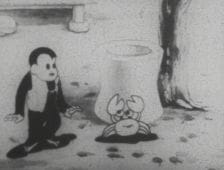
The story is, of course, largely the same. A mother and son crab sow a persimmon seed in the hope of big, red persimmon fruit. The tree grows quickly, and a happy little hornet colony sets up home in it. The monkey who sold the seed to the crabs arrives, and since the crabs can’t pick the fruit, offers to do it for them. Naturally, the monkey keeps all the sweet fruit for himself. Then he shouts at the crabs when they try to argue, and knocks mother crab out with a thrown, sour fruit. He evicts the hornets too, and steals the crabs’ house.
The hornets nurse Mother Crab back to health, and work with the family’s mochi pestle and some handy chestnuts to carry out a successful counter-attack. The monkey gets flattened, and everyone else takes out their Rising Sun fans and celebrates.
Masaoka continues to produce very good animation. But for each step he’s taken forward in technique and technology, he’s taken two other steps back. He’s made a much more military take on the folktale, presumably to keep the censors happy. It doesn’t help that there’s no surviving soundtrack, thanks either to time or copyright. I can only grade what’s in front of me, and this hasn’t improved on the 1927 version. “New Monkey & Crabs” can only earn 5/10; “shin” isn’t all it’s cracked up to be.
“Benkei Vs. Ushiwaka”
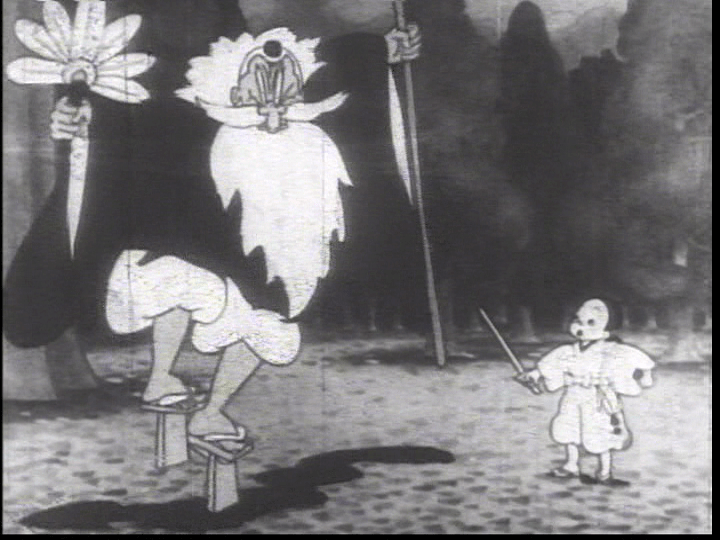
“Benkei Tai Ushiwaka” / “Benkei Vs. Ushiwaka” (Nihon Doga, July 1939) is remarkable in another way. Despite their story being as famous as the meeting between Robin Hood and Little John and far older, hardly anyone has animated it.
From “Benkei Vs. Ushiwaka” (Nihon Doga, July 1939).
Child warrior Ushiwaka is gleefully riding a boar around and utterly fails to shoot down an owl. After he climbs a tree to reach it and cuts off one of the branches, a storm blows up out of nowhere, and an ancient forest lord emerges, impossibly, from a tree. Infuriated at the damage the child has done, the pair throw temper tantrums at each other – no, really – and they fight. Smaller tengu crow-spirits arrive but Ushiwaka wins easily enough. The storm lord gives him the paperwork he was after, and then flies off.
Benkei is a samurai, and he’s collected 998 swords. He’s two away from completing his quest, and he travels to Gojo Bridge in Kyoto to wait for a couple of fights. The first warrior who turns up gives his blade away very quickly, but then Ushiwaka arrives and turns the battle into a farce. After losing, Benkei pledges his allegiance to the young warrior, and there’s an Everybody Laughs ending.
But I think that’s a flaw; the need to give this cartoon a light-hearted ending unbalanced the story quite badly. I thought that the training battle against the tengu was going to be comedic and scrappy, and the clash of the titular characters would be the intense and tricky one. Instead it’s the other way around, and for a while I thought the soundtrack was misleading me.
All The Wrong Notes
“Turkey In The Straw” is not what this mythologically important battle deserves, but it’s what it got, and unfortunately it fits this clown-car of a fight perfectly. Ushiwaka wins out like he’s peak Bugs Bunny, and I don’t get why, especially when a 1939 Japanese cartoon about the pair would have made a nationalistic, warriors-unite ending appropriate.
That said, again, I’m here to review the cartoon I saw, not what I thought I was going to see, and this is entertaining enough for what it is. Masaoka and his wife Ayako voice the characters well, the story works and the animation is decent. That adds up to 5/10.
HAVE I GOT OFUJI FOR YOU
Despite his reputation and body of work, OFUJI Noburo was just as trapped by the 1939 Film Law as any of his peers, and between 1939 and 1945, I think he only made three films. The first came out in 1939, and it was called “Sora no Arawashi” (Chiyogami Eigasha, 1939) which is a pun of sorts. It means “Eagle Of The Sky” and “Heroic Fighters In The Sky” at the same time. I only had access to a small fragment with no audio.
If it hadn’t been for the notes from Kobe Planet Film Archive, I would have been totally lost. Nationalist Chinese leader CHIANG Kai-Shek is in talks with Soviet President Joseph STALIN, when the Japanese Air Force show up in bombers. The Chinese air defenders are useless, and Chiang and his wife are made to look so silly that Stalin giggles at them. Japanese flying boats attack, there’s a surreal little fight, and that’s all there is.
The animation in this cartoon is smooth and shows that Ofuji had a deep understanding of the Western art that he was parodying – I think – but even if it wasn’t propaganda, it’s too short and too out of place for me to grade anyway. No score.
FIN
And that’s all there was, at least as far as we can tell today. As always, I would like to give my thanks to this blog’s four pillars; AniDB, who have helped me work out what to look for, the Japanese Film Archive, who have given me the material to actually watch, and the pairing of Jonathan Clements & Helen McCarthy and their “Anime Encyclopedia”.
In addition for this post, I’d like to thank the Kobe Planet Film Archive. I’ve been Douglas Howell, and you’ve been watching me, watch Japanese animation. Join me next time, please, as things in Japan continue to get worse.
Images taken from Nishikata Film Review and Wbijam.
- “Hirohito And The Making Of Modern Japan”, Herbert P. Bix (2000), p. 352 ↩︎
- “The Anime Encyclopedia, Third Revised Edition”, Clements & McCarthy, p. 2250, 2015 ↩︎
- “The Anime Encyclopedia, Third Revised Edition”, Clements & McCarthy, p. 2251, 2015 ↩︎
- “The Anime Encyclopedia, Third Revised Edition”, Clements & McCarthy, p. 1388, 2015 ↩︎