
HERE COMES THE FLOOD
In 1950 there were four major film studios in Japan: Toho, who had just avoided total self-destruction1, breakaway company Shintoho2, Shochiku and Daiei. 1951 saw the founding of Toei, and Nikkatsu would break away from its forced wartime merger with Daiei in 1954. Japanese live-action film was about to enter a Golden Age.
But none of those companies were regularly making animation. In his indispensible “Anime: A History”, Jonathan CLEMENTS writes that exactly two home-grown cartoons were shown in cinemas between 1950 and 19533. Between various other sources, I think Japanese animators only made ten cartoons across those four years. I haven’t needed to compress multiple years worth of cartoons into one week since I wrote about 1931, but it would be absurd to do anything else here.
Here Comes Uncle Walt
One of the questions I pose in these blog posts is, “What were Japanese audiences watching at the time?”. Surely the demand for cartoons didn’t completely go away? Well, no. But the Japanese public had more options now. For the first time since the passing of the 1939 Film Law, it was legal to import films from overseas. The law hadn’t stopped everything, of course, but the vast majority of Japanese audiences hadn’t seen anything from the West for years.
In 1951, with a new chairman, but still in the catastrophic hole that had been dug for them by their previous unlamented boss4, Toho completed their agreement with Paramount Pictures to show “Mr. Bug Goes To Town” (Fleischer Studios, 5 December 1941). But that wasn’t the headline news.
Rather than attempt to create their own, home-grown product, Daiei signed up to be Disney’s distributor in Japan. Reading between the lines of the entry for Daiei in CLEMENTS & MCCARTHY’s frankly essential “Anime Encyclopedia”, the authors seem quietly furious at the degree to which this move discouraged the efforts of Japan’s animators5.
Disney: A Killers’ Row
But while it’s not an excuse; if Daiei hadn’t done it, someone else would have. These American cartoons, as I’m sure I don’t need to tell you, were excellently made, but still hadn’t broken even at home. So another revenue stream must have seemed like manna in the desert to the board at Disney. Cold comfort for Japan’s animators and associated trades, yes, but inevitable at some stage.
In the period I’m writing about, four full-length animated films from Disney made their debut in Japan, and it’s a killers’ row. “Snow White And The Seven Dwarves”, “Bambi”, “Pinocchio” and “Alice In Wonderland”6. All it would have cost Daiei were the licensing fees, shipping costs, and some dubbing fees. Japanese voice actors, as far as the job existed in 1950, must have been ecstatic to get the work. This doesn’t take Disney’s library of supporting short cartoons into account, which was already huge by 1950.
LOST AND LOCKED AWAY
Of the ten films I mentioned earlier, three aren’t available online. The other five are completely lost. I’ll try to make this bit as fast as possible.
OISHI And ASHIDA Leave Us
The earliest to be made, by quite some way, was “Ponsuke no Udekurabe” / “Ponsuke’s Strength Contest” (Toho Educational, February 1951). The director was OISHI Ikou, and he made it at some point before his death, aboard a Japanese warship in 1944. His colleagues from that period finished it off for him in 1951.
Despite Disney’s efforts, the flow of cartoons between Japan and the West wasn’t all one way. ASHIDA Iwao was still rumbling along, and was the only animator and studio owner to export his work. Various sources from the period claim that he was “the face of Japanese animation abroad”. His “The Forest Concert” (Ashida Manga, March 1953) isn’t available online, but seems to have done very well. But after this cartoon, Ashida seems to have disappeared. He has no Wikipedia page, even in Japanese. None of his work after this seems to have survived to the present day. And none of it is online. No-one even seems to know when he died.
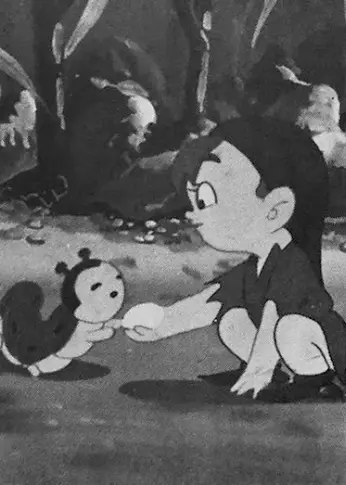
Next up is “Kobito to Ao Mushi” / “The Boy And The Caterpillar” (Toho Educational/Nichido, December 1950), from director FURUSAWA Hideo. It was seventeen minutes long, but it was going up against Snow White in cinemas7, so it didn’t stand much of a chance. While Furusawa didn’t actually leave animation after this, coming back as late as 1980 to storyboard a couple of episodes of a take on Don Quixote, this was his last attempt at directing. He passed away in April 1991.
MORI: Not Just A Director
I have a bad habit of focusing on THE DIRECTOR as the most important person in any given production, and MORI Yasuji‘s body of work is a good reason why I should think about that a little. He was an architectural student who fell in love with American animation after the War, and joined Nihon Manga Eigasha in time to work on “Tora-chan And The Bride” in 1948. Of course, he lost his job alongside everyone else when the plug was pulled out in the following year.
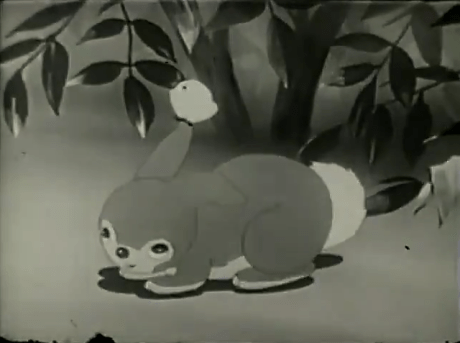
But he came back to the business in 1952. While he never had a full directorial credit – “Kousagi Monogatari” / “Story Of The Little Rabbit” (Nichido Eiga, March 1952) saw him merely share the Big Chair with YABUSHITA Taiji – his impact on the look of anime in the decades to come was enormous.
Because Nichido Eiga – under a different name, of course – had a very bright future ahead. Under new ownership, Mori would effectively be the head of animation direction for one of the biggest anime studios, and would keep working in that capacity clear through to 1976. Countless key figures in the business would learn from him, including (but not close to limited to) MIYAZAKI Hayao and TAKAHATA Isao of future Studio Ghibli fame. Frankly, their animation debut together can’t come soon enough for me.
But that makes it all the more unfortunate that “Story Of The Little Rabbit” isn’t available online.
YUHARA: Another Invisible
The last lost animation in this cavalcade of joy and happiness is “Ari to Hato” / “The Ant And The Pigeon” (Unknown, August 1953), by YUHARA Hajime. This was the second adaptation of the story, one of Aesop’s Fables.
The first version was one of the many cartoons from KITAYAMA Seitaro in 1918 that are lost. This version shares its fate. Yuhara is listed as directing a Tora-chan film in 1955, but that seems to be lost too. And like so many people in this period, Yuhara disappears from the records after that.
GOODBYE, MASAOKA: TORA-CHAN
Even during the collapse of his industry, the Most Stubborn Man In Early Anime kept working. MASAOKA Kenzō managed to make a third film starring his stray-turned-housecat Tora-chan in 1950. It was “Tora-chan no Kankan Mushi” / “Tora-chan And The Angry Bug” (Toho Educational, 1950). But I’m not totally sure anyone saw it at the time.
And unfortunately, I can’t review it. While it still exists, and looks and sounds beautiful, I couldn’t find any subtitles in English. So by policy: no subtitles, no score. Damn.
And I really wanted to give this one its due, because it was Masaoka’s final cartoon. Exactly why he left the business isn’t clear: some sources say his eyesight had deteriorated due to overwork8, but given how badly wounded the animation business had become by 1950, he might have given it up as a bad job. As with so many of his peers, he moved into illustrating childrens’ books, although he appears to have returned to the industry as a teacher in the Sixties.
And it’s also Tora-chan’s last appearance, since the supposed existence of “Tora-chan no Bouken” / “Adventures of Tora-chan”9 from 1955 doesn’t have a frame of animation to back it up. It is such a shame that he and his sister Miike, a pair of characters with such incredible potential and flexibility, ended up lost to time.
Masaoka passed away on the 23rd of November, 1988. In his working life, he was bold, focused on getting his next animation out of the door at all costs, and was the very definition of resilience and tenacity. I’m going to miss the old boy.
FIN
I hope that lot was at least fun to read. As usual, my thanks go out to AniDB, who have helped me work out what to look for. Plus the pairing of Jonathan Clements & Helen McCarthy and their “Anime Encyclopedia”, and Clements’ own “Anime: A History”. Thanks today also go to ANIDO FILM.
I’ve been Douglas Howell. My next article will, finally, discuss the pair of Japanese cartoons I could actually watch from this period.
Image of “Kobito To Ao Mushi” from Anime Planet. Image of “Kousagi Monogatari” from Anilist.
- and a dreadfully handled union dispute ↩︎
- literally “New Toho” ↩︎
- Jonathan Clements “Anime: A History”, p. 120, 2023 ↩︎
- if KUROSAWA Akira isn’t going to name him unless he has to, I don’t see why I should. ↩︎
- “The Anime Encyclopedia, Third Revised Edition”, Clements & McCarthy, p. 2758, 2015 ↩︎
- Jonathan Clements “Anime: A History”, p. 119, 2023 ↩︎
- Jonathan Clements “Anime: A History”, p. 120, 2023 ↩︎
- Jonathan Clements “Anime: A History”, p. 120, 2023 ↩︎
- I’m assuming a transliteration error on IMDB’s part, otherwise this is “Tora-chan’s Motherhood”. ↩︎
Leave a Reply