
KINDAIEIGASHA: ONE LAST ATTEMPT
I’ve spent most of this week pushing through Japanese history and lots of cartoons I couldn’t watch. It’s quite a relief to get back to Watching Every Anime again. Even if it’s not really anime yet. Anyway.
Kindaieigasha Company gave up on the whole cartoon thing in 1950. They would retreat to the safer waters of publishing manga and film magazines, until they went bankrupt in 2015. Their final animation was a take on an Anglo-Irish satirical classic. Which ended up being an even weirder choice than you might think.
“Gulliver Funtouki” / “Gulliver’s Great Activities” (Kindaieigasha, December 1950) doesn’t seem to have made it into cinemas, though. In his indispensible “Anime: A History”, Jonathan CLEMENTS says he checked the two relevant databases, “Animage” and “Stingray and Nichigai”, and found nothing. “As far as cinema audiences were concerned, it may as well never have existed.”1 But it does. So: was it any good?
“Gulliver’s Great Activities”
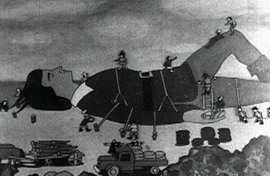
A storm rages, and a huge humanoid swims and collapses on a distant shore. Someone finds him, and sprints back into a town full of brick houses with the news. The townspeople – with some really obviously European hats on – rush to see. Wanting to be safe from this giant, they work together to tie him down. But it starts to rain, which wakes the giant up and makes a nearby river burst its banks.
In desperation, the locals cut the giant loose and empty their warehouses to feed him. All the boxes are marked with the word “tax”. The giant rises and stretches, then casually resets the river with his hands. Then Gulliver uses his enormity to help them out with mining coal and moving trade goods around. When fire threatens to burn their town to the ground, he fills a huge bucket with water and splashes it to safety. He’s a hero, and the town asks him to stay forever. Then the film ends.
A Missed Mark
This animation was funded by the National Tax Agency, and it’s profoundly unsubtle. I think the taxmen wanted the viewer to think that Gulliver represented a properly working State. Trust us, they said, to take your tax yen and use it sensibly. We’ll fix national infrastructure, save you from disaster, and bring new goods into the country.
It doesn’t land that way. Gulliver is, painfully obviously, America; terrifying, enormous and financially transformative. But he’s able to change your world for the better if you can feed him properly. Gulliver comes off as a monstrous, alien figure compared to his tiny saviours. None of the other versions of this story that I’ve seen have handled him this well. I think he might be a kaiju. The film also really hits you over the head with its European setting. And seeing a story I know this well, through a Japanese looking glass, felt really strange. In a good way.
There are a couple of decent visual gags in this. But overall, the animation isn’t of a particularly high standard for the period. It also feels quite anachronistic. One moment the locals are threatening Gulliver with polearms. The next, they’re using petrol-driven trucks to bring him enormous amounts of food. It’s not funny enough to justify, either.
Category Error
I am stuck, once again, behind the eight-ball of my “no score for propaganda” rule. The last time I had to think about this was “The Tale Of The Grey Starling’s Tree” from 1947. On that occasion, I felt the film’s message was aimed at the censors and not the audience.
But this time around, the film-makers are using government money to tell their viewers how to feel about taxation. Even if they failed, I must declare myself snookered. “Gulliver’s Great Activities” is propaganda; by policy, no score.
DANGOBEI RETURNS: OFUJI NOBURO
When your work is important enough to Japanese animated cinema that the Mainichi Film Awards – the Japanese Oscars, if you must – would decide to name their main award for animation after you once you’re gone, you aren’t likely to be the kind of person to let a little thing like the total collapse of the Japanese animation industry stop you.
OFUJI Noburo wasn’t that kind of person, and he didn’t. He was able to release three films in these four years. In this context, especially without major studio backing, that counts as a flood. The first is not available online, and it’s called “Seisho Gensō: Adamu To Ibu” / “A Biblical Fantasy: Adam And Eve” (Chiyogami Eigasha, 1951). It marked the beginning of his experimentation with coloured cellophane. I know it’s still out there because it was shown to a small audience in 2010, but that’s all I know.
Back To Dangobei
His second, more conventional cartoon, sees him return to one of his favourite characters. It’s Dangobei, the lazy-heroic samurai with a dumpling pun in his name. But before I talk about him, there’s another elephant in the room that needs to be dealt with. I don’t know how they keep getting in here, I’ll have to close the windows in future.
I can’t speak or read Japanese, apart from a few phrases I’ve picked up from studying and watching anime and sumo. So I’m using machine translation, whenever there isn’t an official title available. But I need to reassure my readers that I’m not doing it thoughtlessly. If I don’t trust my translation, I’ll tell you. And I’m happy with this one, even though it’s the most complicated title I’ve seen so far.
So: the cartoon is called “Dangobee Torimono Chou: Hirakeegoma no Maki” / “Dangobei’s Detective Story : The Open Sesame Case” (Chiyogami Eigasha, 1952). Was it any good?
“Dangobei’s Detective Story: The Open Sesame Case”
Well, the subtitles were iffy. But thankfully, a large enough number of thieves turn up in the second minute. I’m safe; this is a retelling of the Ali Baba story. So I can still review the things. As in the original tale, Dangobei hears the password to their lair. He’s able to run in and steal an enormous stack of cash. Then he goes back home to his wife, who looks like somebody put Betty Boop through a “make her a geisha” filter.
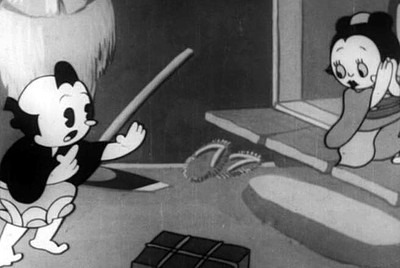
But the stupid peasant from 1948’s “The Bear Dodger” has returned. He must have a name but I don’t know what it is. Anyway, he hears Dango tell his wife how he found the money, and the fool goes and tries it himself. He eventually remembers the password but the thieves are inside, and they tie him up. Then the fool gives up Dango’s name. Thankfully, Betty-san heard them coming and left a huge amount of booze in their path. By the time the sozzled thieves make it to Dango’s place, they’re easily taken care of.
There’s a little mild peril at the end, where the leader of the gang is a bit trickier to deal with than his men. But naturally, Dango finishes the story in the traditional way, leading the people of his village to the villains’ lair and emptying it out.
Back To Basics, And On To Cannes
I’m still not keen on how Ofuji’s interpreting his cel-animated characters, post-war. But otherwise, as far as the music, voice acting, and overall story are concerned, this would have been a fun way to spend ten minutes in a movie theatre before the main picture started. Except I have no idea if that happened. Regardless, this is decent enough but nothing special, so “The Open Sesame Case” scores 5/10.
At the end of the year, to what Clements suggests was a tiny audience2, Ofuji managed to get a film out that he’d been working on for a long time. He made a black and white version of a film called “Whale” back in 1927. But I deliberately avoided looking for it back then. I knew, in the future, he would manage to do better with newer technology.
That future is now, and the technology is colour film. He remade “Kujira” / “Whale” (Chiyogami Eigasha, December 1952) into an 8-minute cartoon that was somehow shown in Japan. More significantly, he submitted it to the Cannes Film Festival in April 1953. It apparently impressed two very famous attendees: artistic polymath Jean COCTEAU, and the equally legendary Spanish artist Pablo PICASSO. Let’s see what they saw in it; was it any good?
“Whale”
This is, of course, where I have to mention that there are pre-commercial whale-hunting references in this film. If that’s uncomfortable for you, please skip down to “Fin”, ironically enough.
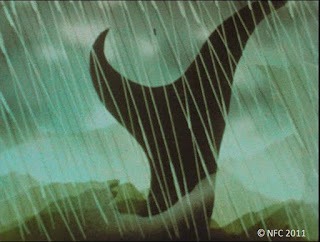
Ofuji leaps right back into his strongest art style: silhouettes and chiyogami paper. We see a ship with its sail hoisted, and a group of brave sailors go out on the hunt. But a storm strikes, and to the screams of the crew as they leap overboard, the ship sinks. Three men survive on a crude raft, and one of them pulls a woman from the sea. She tries to leap back in, and the men argue3 and fight over her.
Then the whale returns and devours them all. The four humans run around inside the thing’s stomach, panicking. Of course the woman gets the blame for it all, until the whale fires them all out of its blowhole. The men go back to fighting over the woman4, and two of them quickly get thrown into the ocean to die. Then the whale has had enough of the remaining man’s stupidity and grabs him with its tail.
The woman, revealed at last as a mermaid, swims into the night alongside the whale. Human greed, foolishness, and arrogance has been defeated, and peace returns to the sea.
A Return To Form
This is so much better than the traditionally animated work I’ve been watching from Ofuji in recent years. The seabirds in the cartoon’s first minute have more beauty and poise in them than anything he managed in “The Bear Dodger” apart from the trees. The depth of field he’s able to create with layers of paper is all the more powerful now he can work with colour as well. And thankfully it’s not a pro-hunting film, which would have been very hard to swallow, even from 1952.
It’s also a very adult film, confronting death and sexuality head on. While it’s not erotic in the slightest, the mermaid’s nature as a sexual being drives the plot, and this film also has anime’s first surviving female nipple5. The soundtrack is very good indeed. If it wasn’t a recording of an actual thunderstorm, then Ofuji’s Foley operator should have got an Oscar.
If it had subtitles, and I therefore knew what everyone was saying, then I’d be able to add at least a point to the score I’m about to give. Thankfully, once again, the overall plot is solid enough and explained well enough by the animation that there’s no need to hide behind a rule.
It’s impressive enough for me, and I’ve spent the last ten months immersed in the Japanese animation that led up to it. To the original, mostly French audience in 1953, it must have been groundbreaking. “Whale” by Ofuji Noburo scores 7/10. That’s still pretty rarefied air for this blog.
FIN
By the end of 1953, Japan was in control of itself again. Mostly. But her animation industry was in serious trouble. Thankfully, a new technology was coming over the hill with a chance to save it. 1953 was the year when broadcast television began in Japan, and it would definitely need animated adverts. Maybe, if the viewers were really lucky, someone might try and make an entertainment cartoon for them as well. Not that the market for it was very big: on launch day, there were only 866 TV sets6 in the entire country.
As usual, my thanks go out to AniDB, who have helped me work out what to look for, and the inseparable pairing of Jonathan Clements & Helen McCarthy and their “Anime Encyclopedia”, and Clements’ own “Anime: A History”. In addition, I’d like to thank the Japanese Film Archive, Nishikata Film Review, and NextAnimeManga.
I’ve been Douglas Howell, and I’ve been watching anime. Kind of. Join me next week, where Japanese animation continues to bounce along the bottom of the graph, but somehow the industry keeps going.
Images of “Gulliver Funtouki” from AniDB, of “Dangobei’s Detective Story: The Open Sesame Case” from AnimeClick, and of “Whale” from NextAnimeManga.
- Jonathan Clements, “Anime: A History”, p. 120, 2023 ↩︎
- Jonathan Clements, “Anime: A History”, p. 120, 2023 ↩︎
- I didn’t have subtitles, but I am planning on cheating this time. ↩︎
- On the back of a bloody whale! One thing at a time, eh? ↩︎
- Presumably “Cool Ship” by KIMURA Hakusan had a few, but the Japanese Police won’t let us see that one. ↩︎
- Jonathan Clements & Tamamuro Motoko, “The Dorama Encylopedia: A Guide To Japanese Drama since 1953”, xi , 2003, in Jonathan Clements “Anime: A History”, p. 117, 2023 ↩︎
Leave a Reply