
TOHO CALLS IN THE ARMY
In December of 1947, with the finger of the Occupying forces openly on the scales, Toho Company fired their entire board of directors. The company’s new head was WATANABE Tetsuzō. He was exactly what the new order wanted. Watanabe was a former law professor, with a wartime criminal record for making and distributing anti-government pamphlets1. His role was to “defeat the two kinds of Red … Communists and deficits”. While he was a clearly anti-Communist political appointee with no interest in film, he had a point. Toho was 2 billion yen2 in debt. And even though they planned to make 24 films in 1948, they had three times the number of staff they needed.
In early April, Watanabe’s new leadership fired 1200 employees. That included over 250 studio staff, specifically targeting “Communist party members, sympathisers and all forty-two animators”. Understandably, the Japanese Motion Picture and Theatrical Workers Union3 saw this as a declaration of war. They called for a full strike on April 15th. Equally obviously, this also led to more staff and actors defecting to Shintoho. I have a certain sympathy for the Union’s position. But I have no time at all for their decision to occupy and barricade the Kinuta studio in Setagaya, on the outskirts of Tokyo4. There’s a certain irony to the choice, though. Toho acquired the site when they merged with Photo Chemical Laboratories. By inheritance, it’s where the company made its first animation in 1933.
On the first of May in 1947, Toho suspended their entire studio operation, and froze all their funds. Watanabe reminds me of a schoolmaster, putting his whole class in detention until whoever threw that chalk owns up to it. It didn’t work. A month later Toho announced it was closing indefinitely and stopped paying their workers.
KUROSAWA GOES FREELANCE
Oddly enough, given that they were employing people to be creative, various Union members found creative ways to find other work. That included forming travelling theatre troupes, to put food on the table and to raise funds for the union. One of those was run by legendary live-action film maker KUROSAWA Akira. When he wrote his autobiography in 1983, a full quarter century later, he still refused to use Watanabe’s name5.
Matters continued to escalate until the start of August. Toho hadn’t made any films since April. By then, the Union members inside the studio were casting longing looks over Toho’s inventory of film-making equipment. If Toho went under, all that kit would have made them a lot of money. On August 13, a group of staff approached the Tokyo District Court. They said that they wouldn’t work for Toho unless Watanabe resigned. But the Court jumped the other way, declaring the Union’s occupation of the studio unlawful.
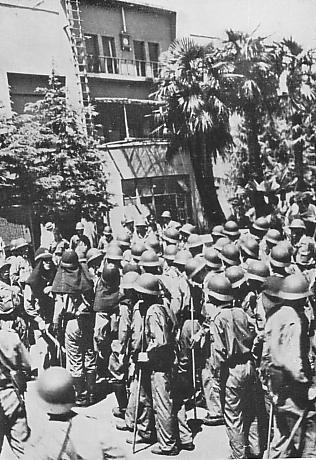
However, when they arrived to serve the eviction notice, the court officials couldn’t get through the barricades. So on the morning of August 19, two thousand policemen showed up. And unfortunately for the Union, the Occupying forces had got wind of the affair. So they got Toho to ask them to show up. And that’s why the police were joined by a platoon of the US Cavalry, three scout planes, six armoured cars and five tanks6. Got to make sure those uppity actors know their place, right?
The Birth Of The Independents
Understandably the union folded at this point and left. Although “marching out of the rear gate while singing The Internationale“7 strikes me as a bit silly. But in many ways, they had won. Toho had dealt themselves irrepairable reputational damage. Many of their staff had simply walked out of the door, most notably Kurosawa Akira himself. And a lot of the staff who chose to return to Toho did so in an entirely new way.
They now organised themselves into independent subcontracting group. These flexible new groups only leased themselves out to Toho, with the freedom to work elsewhere. It’s been argued that today’s Japanese film industry, where independent studios make the films and large corporations market and distribute them, is a direct result of the Toho strike8.
With no new work coming out of their studio, Toho started to buy cartoons in. Max FLEISCHER had been busily filling pre-war American cinemas with cartoon classics like Betty Boop and Popeye The Sailor. In 1939, in an effort to keep up with Uncle Walt, Fleischer made the world’s second cel animated feature film. It was a version of “Gulliver’s Travels”. While it met with critical acclaim, it ran hugely over-budget, and contributed to the studio’s demise in 1942.
Paramount Pictures now owned the entire Fleischer library. So when Toho and Watanabe came knocking, Paramount were more than happy to open the door. Toho imported “Gulliver Ryokoki” in April of 1948, making it the legally imported American cartoon there. And a lot of Japanese children paid to see it.
THE LOST AND THE OFFLINE
Most of the animation that I know about from Japan in 1948 is either lost, or not available online. And that’s a real pity when it comes to the first one on my list, because it’s the last directorial credit of MURATA Yasuji. He made more cartoons than anyone else in of the pre-war period, even if most of his funding was from the Ministry of Education.
Mind you, taking on “Kachikachi Yama no Shouboutai” / “The Fire Brigade Of Firecrackle Mountain” (Shoubouchu/Fire Defence Agency, February 1948) was probably unwise from a historical point of view. This is the fourth version of the story to be animated, which I think is a record. None of them have made it to the present day. Even more ironically, this was a fire safety film, commissioned and distributed by Japan’s National Fire Department. I’m pretty sure this story is genuinely cursed.
Murata put his directing career aside to concentrate on his role as managing director of Nihon Dogasha, and we’ll come back to that shortly.
FURUSAWA’S SHORTS CAREER
Next up is FURUSAWA Hideo, and I’m afraid that as far as this blog is concerned, his story is fairly short. He’d been working as an animator since 1941, but his first directorial credit was “Masakari Katsuide” / “Carrying An Axe” (Unknown studio, April 1948). As far as I can tell, it’s lost.
Furusawa directed two more cartoons in the Occupation period; “Sports Kotanuki” / “Sports Tanuki” (Unknown studio, 1949), which is also lost, and “Kobito to Ao Mushi” / “The Dwarf And The Green Caterpillar” (Unknown studio, December 1950), which still exists but isn’t online.
But that would be it; while his footprint in the anime industry would be significant going forwards, it wouldn’t be as a director. He would continue as an animator for years, until establishing his own studio, Nichidou Shin Pro, in the late 1960s. He would do it again in 1973, forming Doga Kobo. That company was considerably more successful, doing in-between work and key animation for baseball masterpiece – I’m told – “Samurai Giants”. No doubt I’ll be discussing Doga Kobo at greater length when I get to the seventies. In 2050, at this rate.
1948 would also see the last animation from another, perhaps less palatable stalwart of Japanese propaganda cartoons. SATO Kinjiro had made fifteen of them, all featuring his boy hero Mabo, by the end of the war. Sato’s “Mabo Goes To Mars” was presumably a failed attempt to resurrect his war “hero” for the new era. But it’s lost. And so are his creators; I couldn’t find out anything more about Sato or his former colleague CHIBA Yoji after this, not even the dates when they died.
KUMAKAWA’S STATION MASTER
But thankfully, I’m able to close this section out on a happier note. While 1946’s “The Magic Pen” made me feel awful for its audience, the actual art involved was of a very high standard. So I was hoping to see a less painful work from its director, KUMAKAWA Masao. And that’s what staff working for Japan National Railways got, with “Poppoya-san no Nonki Ekichou” / “Poppaya-san, The Good-natured Station Master” (Japanese National Railways, October 1948). According to Clements, in his indispensible “Anime: A History”, this was one of the first jobs done for hire by Nichido9.
It was a training film, to teach newly minted station masters in the real world to keep their eyes and ears open to avoid the catastrophies which dogged Poppaya-san’s heels. Unfortunately, the JNR are keeping this one under lock and key, and having read a little ahead in the history, I might have an idea why. I’ll be less cryptic very soon.
OFUJI AND ASHIDA RETURN
Finally, there are a few Japanese cartoons that were made in this year that I either can’t meaningfully discuss, even in this format, or which are better tackled in a future article. The latter applies to OFUJI Noburo’s “Shakyamuni” / “Buddha”; an incomplete version of the film was shown at Cannes, but a completed one came out after the director’s death, in 1961. So if I can, I’ll watch and talk about it then.
According to the frankly essential “Anime Encyclopedia” by CLEMENTS and MCCARTHY, this year also saw the directorial return of ASHIDA Iwao, with a 48-minute version of “Baghdad no Hime” / “Princess of Baghdad”10 (Ashida Mangaeiga, 1948). But it’s not online. Neither is “My Baseball” / “Boku no Yakyu” from ASANO Megumi, which was the first colour anime to be released in theatres11, but remains strangely un-lauded and unavailable online.
FIN
That’s all the unwatchable cartoons out of the way. As usual, my thanks go out to AniDB, who have helped me work out what to look for, and the inseparable pairing of Jonathan Clements & Helen McCarthy and their “Anime Encyclopedia”, and Clements’ own “Anime: A History”. Unexpectedly, I also have to thank Billy Bragg.
I’ve been Douglas Howell, and I haven’t been watching anything. Next week, I’ll be talking about things I actually saw.
- Clements, “Anime: A History, Second Edition”, p. 115, 2023 ↩︎
- call it $75m/£56m in today’s money, although that’s a very dodgy conversion ↩︎
- henceforth simply The Union, for the sake of my fingers ↩︎
- Hirano, Kyōko, “Mr. Smith Goes to Tokyo: The Japanese Cinema Under the American Occupation.”, p. 225, 1992 ↩︎
- Clements, ibid ↩︎
- Hirano, Kyōko, ibid, p. 228 ↩︎
- Hirano, Kyōko, ibid p. 228-9 ↩︎
- Kawanishi, Hirosuke, ed. ,”The Human Face of Industrial Conflict in Post-War Japan.”, p.56-7 , 1999 ↩︎
- Clements, ibid, p. 116 ↩︎
- Clements & McCarthy, “The Anime Encyclopedia, Third Revised Edition”, p. 166, 2015 ↩︎
- Clements & McCarthy, ibid, p. 166 ↩︎
Leave a Reply