
1956: SIX IS BETTER THAN ONE
Japanese animation studios were still working hard in 1956. But the vast majority of that work was either advertising or subtitles. Given my focus on art and entertainment pieces, there are really only six pieces of animation I can talk about. Fully half of them are stop-motion, not cel animation and two were commissioned by an advertising company. Going forward, unless I specifically say that a cartoon is in colour, you can assume it’s black and white. That will change in the early sixties, but it’s still true now.
While I’m housekeeping: I’m doing my best to use each studio’s name as it was, at time of release. For example, Toei didn’t change their name to use “Animēshon” until 1998. Tokyo Movie didn’t reshuffle their corporate structure to become Tokyo Movie Shinsha until 1976. So I won’t use those names until I get there.
Imported And Lost
Daiei only imported one animated film from the US in 1956, but it’s a stone cold classic: “Lady And The Tramp” (Walt Disney Productions, 1955). In Japanese, the film’s title was the glorious “Wanwan Monogatari”. That alone must have made the lines go around the block. You would need a heart of stone to deny your child a chance to see “Woof Woof Story”.
As for Japanese animation, I’ll start with the cartoon I couldn’t watch. That’s the fourth animated retelling of traditional fairy-tale, “Issunboushi” / “Inch High Samurai” (Nichido Eiga, May 1956). It’s completely lost, to the point where even attributing a studio to it is an educated guess, based on the director, YABUSHITA Taiji, and the producer, YAMAMOTO Sanae.
Nichido Eiga: Audition Piece
It counts as “educated” because just a month later, the same team of creatives got another cartoon out. This was “Kuroi Kikori to Shiroi Kikori” / “The Black Woodcutter And The White Woodcutter” (Nichido Eiga, June 1956). I’ve watched it, it was in full colour, and I suspect they were trying to impress someone. Did it impress me? Was it any good?
“The Black Woodcutter And The White Woodcutter”
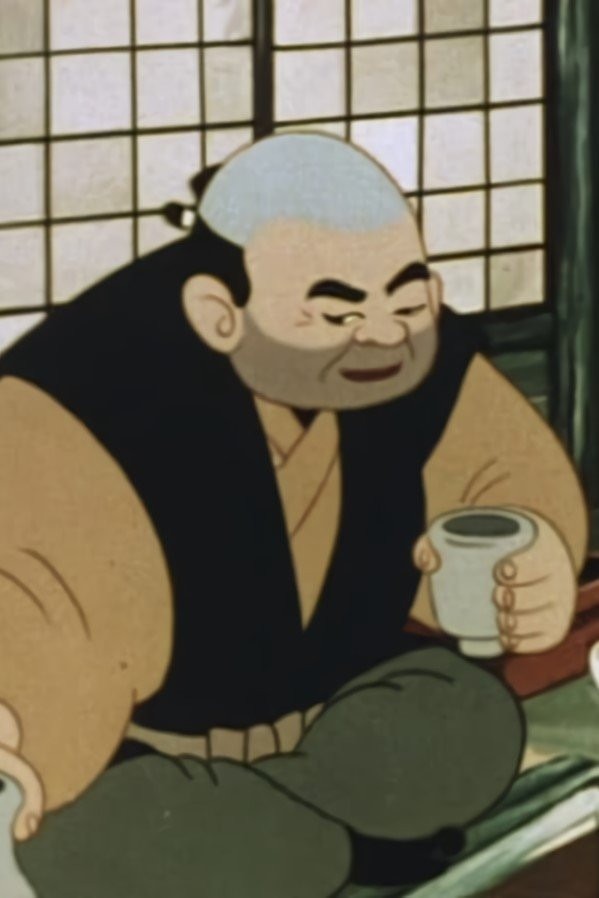
We start with a slovenly man, with a rifle and a penchant for warm sake. We watch him kill off a bear, a fox and a squirrel for the terrible crime of begging for food in the wintertime. The animals’ ghosts wander through the forest until they find a mystical, white-bearded man with a vast halo. He resurrects them on the spot. It must be Christmas1. He vanishes again, and the grateful animals kneel and pray in thanks.
Our second human, bald and white-bearded, is happy to let the animals come in from the cold. He even shares his porridge with them, without thought of gain. Or bullets. Then the scene changes, and we watch a woman appear from nowhere, and travel over the snow at impossible speed2. She appears in the first human’s house, and despite his best efforts, freezes his fire with a glance. He dares to shoot her; the ice lady turns him into an ice statue for his stupidity. When she visits the second human and his animal friends, they work together and prevent her from harming them. She’s forced to flee, leaving our heroes in peace.
Eerie And Cute At Once
This was a fascinating piece of art. While the animals in it do peopley things – knock on doors, pray, eat out of bowls – they generally look like the beasts they’re meant to be. They’re only slightly cute, especially in comparison to the animals I’ve generally seen in this project so far. There’s a Disney-esque attention to detail, but a profound realism to the subjects. For example, both times we see a rifle fired, we can see the smoke coming from the fuse as it burns down. The humans are realistic too; a little too real in the case of the first one, who clearly takes too much pleasure in killing.
It’s the first time I can remember a theramin being used in a Japanese cartoon’s score, too, and it was certainly chilly enough to deserve one. And I don’t remember anyone saying anything. The animators have let the images and score carry the story. Perhaps that was a cost-cutting exercise, but I think it’s far more likely that Nichido had one eye on exporting this overseas, and decided to skip the dialogue to make that sale easier. There’s no evidence that it happened, alas.
This is at the top end of what I expect from Nichido at this point. It’s beautiful, it’s spooky, and it has a kind heart. It’s well worth your time: “The Black Woodcutter And The White Woodcutter” scores 8/10. There’s nothing wrong with quality over quantity.
Nichido Becomes Toei Douga
If it was an audition piece, it was a successful one. Nichido Eiga had been strongly tied to Toho from its inception. While they had survived the self-destructive mismanagement of Toho through to 1949, “surviving” was all they were able to do. Future industry stalwart MORI Yasuji could only make ends meet in this period by working for the advertising office of a department store.
But that was all over now: in July of 1956, Toei Company bought Nichido out completely. From now on, they would be Toei Douga / Toei Animation, and this film’s director, Yabushita, would be hired as their director of production. Toei would send him to America, with simple orders: find out how Disney has “industrialised the animation process”3, and bring it back to be copied. We’ll see how successful that was soon enough.
Anyway; time for a spot of history.
MOCHINAGA: REPATRIATION AND PUPPETS
1956 was the year that the newly democratic Japanese government joined the United Nations. The nation’s economy was in something of a boom, largely because they were supplying the American military’s bases in Japan in support of their efforts in the Vietnam War. While this boom would start to tail off by 1957, right now Japanese homes were starting to fill up with the new Three Sacred Treasures: fridges, washing machines, and black-and-white televisions.
By this point, most of the 6.6 million Japanese people, troops and civilians alike, who had been stranded outside Japan when World War II ended had made it home. If that number screams “humanitarian catastrophe” to you, you’re not wrong. They didn’t all get home until 1958. Tens of thousands of people died trying to get back. I couldn’t find proper statistics beyond that.
A History Of Tadahito/Fang
MOCHINAGA Tadahito and his family were among over one and a half million Japanese people who had gone to sleep in Japan and woken up in China. His career in animation had already been significant in both countries. He had made Japan’s first multi-plane animation camera in 1941, and worked with director SEO Mitsuyo to make the sublime “Ari-chan The Ant”.
Left on his own and stripped of resources, Mochinaga went on to make the less good “Fuku-chan’s Submarine” in 1944. Then he went home to find that the Allies had levelled his house. Quite understandably, he moved to occupied China, where he and his wife both had relatives.
Between 1944 and 1953, working as FANG Ming, Mochinaga was hugely important in establishing the ground floor of China’s stop-motion animation industry, focusing mostly on puppetry. But in 1953, his citizenship caught up with him, and he took his family home to Japan. He retook his birth-name, and started again from scratch. Mochinaga called his new company Ningyo Eiga: the Puppet Animation Studio.
No, I’m Not Using That As A Heading
Ningyo Eiga made three pieces of stop-motion animation in 1956. I’m going to get the unpleasant one out of the way first. “Chibikuro Sambo no Tora Taiji” / “Little Black Sambo Versus The Tiger” (Ningyo Eigasha, November 1956) was based on the hugely popular and hugely controversial children’s book “Little Black Sambo” by British author Helen Bannerman (1862-1946).
The 1956 version of the story isn’t available online and I’m not too sad about that, even if it did win the Best Children’s Film award at the first Vancouver International Film Festival in 1958. For the sake of research, I did some digging, and it looks like whenever they gave this book to non-African illustrators before 1980, they almost always drew horribly racist caricatures. It’s still on sale in Japan today, although not everyone there is happy about it.
Enter Dentsu Advertising
Ningyo Eigasha wanted to make more entertaining animation. But in order to do that, they had to pay the bills with advertising. And since Japan was now the home of two TV channels which were funded through adverts, various companies had risen to make them and get their slice of the money. One of the most successful was Dentsu, who are the biggest advertising firm in Japan today and one of the biggest in the world.
And you get there by integrating your services. Dentsu “actively involv[ed] itself in the production of the programmes which the adverts were placed between.”4 So they created Dentsu Eigasha, specifically to fund and get their hands into the creative processes of the animations that would make them money. I don’t hate the players, although I do have concerns about their game.
Five Macaques
So that’s why the first animation by Mochinaga and his studio from 1956, “Go-hiki no Kozaru-tachi” / “Five Little Monkeys” (Dentsu Eigasha, June 1956), has Dentsu’s name in the credits and not Ningyo’s. I would have watched it, but unfortunately the version I could find doesn’t have subtitles. Dentsu aimed this pretty squarely at an infant school audience, with beautifully made macaque puppets doing monkey-ish things as a family.
While I’m not at all sure when its target audience would have been able to watch it, an advertising agency wouldn’t have funded the thing if it wasn’t going to earn them money. And it’s certainly of high enough quality to have been shown in cinemas. Regardless, by policy; no subtitles, no score.
So that leaves me with exactly one stop-motion animation from 1956 that I can review: the beer commercial I talked about at the start. Ningyo Eiga made most of it in-house, although they brought OFUJI Noburo in for one section. It was for Asahi Breweries5, and it’s called “Beer Mukashi Mukashi” / “Beer Through The Ages” (Ningyo Eigasha, July 1956). I’m very doubtful about asking this, but; was it any good?
“Beer Through The Ages”
A ceramic beer mug sprouts human features, and takes us to the Beer Museum with him. Hurrah! We get a series of slowly animated sequences that carry us through beer’s history, from its beginnings in the Middle East, through Europe, and eventually back to Japan. The models and puppets borrow art and musical styles from each period and region as we go. While it’s entirely right that my native Britain belongs in any proper history of ale, I was pleasantly surprised that they gave the women, who were the backbone of our beer production for centuries, as much respect as they did.
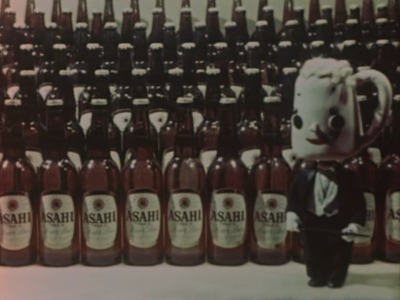
Near the end, we get Ofuji’s contribution, as carefully created silhouette sailing ships glide over a calm sea. There’s also a scene where a puppet of KAWAMOTO Yuki, supposedly the first Japanese person to drink beer6, is given a pint on board a Western ship. Fair play to the man; he necks it in one and then bows politely. Kawamoto was definitely the first Japanese brewer, though, and we’re shown that too. Naturally, the film ends by focusing on Asahi’s modern-day production with a little live-action film.
This is historically accurate and fair, as far as I could tell, and while the animation wasn’t anything special for the period, it was decent enough. You could see where the money went. But it’s still an advert. “Beer Through The Ages”, by policy: adverts get no score. Fascinating watch, though.
Is It Really Anime, Douglas?
Well; no. Ningyo Eigasha will be a regular presence in these blogs for the rest of this decade, even though there is no way to sensibly think of them as “anime”. I contemplated not reviewing them, to be completely honest, but as long as I can’t see the strings, it still counts as animation, and that means I have to try and watch.
Besides, the future of Japanese animation feels very much up in the air at this point. Mochinaga had already built the foundations of Chinese stop-motion puppetry, and in 1956 there was no reason at all to think that he couldn’t do it again in Japan.
He didn’t. But that’s a tale for another week.
OFUJI SAILS FORTH
Ofuji Noburo’s career must have been on the up, following his successful outing to the Cannes Film Festival in 1953. Granted, I’m not entirely sure if his main work from 1956 actually made it into cinemas in Japan. But “Yureisen” / “The Phantom Ship” (Chiyogami Eigasha, 1956) is still viewable today, in full colour. So; was it any good?
“The Phantom Ship”
We open with an live-action shot of (presumably) Ofuji cutting up coloured cellophane, which instantly becomes part of a rolling sea.
Then a dark pirate ship, its decks covered in dead bodies, sails into view. The scene changes, and we watch a beautiful vessel full of beautiful people. As Japanese instruments play, we watch a woman on board dance and play for the ship’s captain.
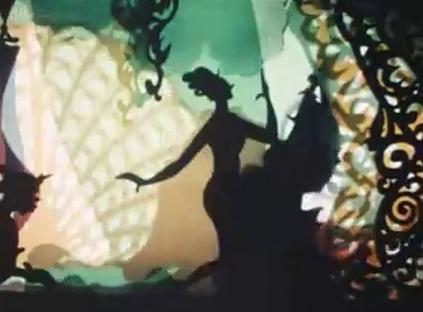
Then a powerful pirate ship sails alongside. The pirates strike, and a battle ensues, heroic rapiers against evil cutlasses. One by one, the heroes fall, and at last the woman pulls a dagger out and ends her own life before she can fall to the pirates’ will. The pirates sail on, and find another target – but this time their cannonballs pass straight through it. The ghosts of the men and women they killed have returned for revenge, and it is terrible and total. At the end, the broken pirate ship from the opening returns.
Art For Arthouse’s Sake
It was quickly obvious that this has a lot more to do with arthouse cinema than the popular entertainment which has made up the vast majority of the work I’ve looked at for this project so far. Other artists will pick this thread up throughout the 1960s and presumably beyond, but the nature of the award that would be named for Ofuji – all too soon, alas – makes sense now.
This continued to explore the themes of the risks involved in challenging the sea that Ofuji began to look at with “Whale”. The animation, score and overall effect was all very strong indeed – the ghosts laughing at the foolish pirates as they killed each other was a brutally lovely touch. It was very good, but it mostly grabbed me by the brain instead of the heart. That’s not a bad thing at all: “The Phantom Ship” gets 7/10, at least in part because it tells its story without a word needing to be spoken in any language at all.
fin
And so concludes another relatively short year in the history of anime. But I think it was a good one. As always, my thanks go out to AniDB, who have helped me work out what to look for, the pairing of Jonathan Clements & Helen McCarthy and their “Anime Encyclopedia”, and Clements’ own “Anime: A History”.
I’m Douglas Howell, and business is about to pick up. Come back next week, for a year of firsts, and a couple of serious landmarks in anime history.
Image of “The Black Woodcutter And The White Woodcutter” from Letterboxd. Image of “The Phantom Ship” from FilmAffinity.
- I think this is really Jurōjin, the ANTHROPOMORPHIC PERSONIFICATION of the South Pole. Sort of. ↩︎
- She’s much easier: it’s Yuki-onna, the terrifying snow-girl youkai. ↩︎
- Clements, Jonathan & McCarthy, Helen, “The Anime Encyclopedia“, Third Revised Edition, p. 2834, 2015. ↩︎
- Jonathan Clements “Anime: A History”, p. 137, 2023 ↩︎
- Other breweries are available. ↩︎
- I find this very hard to swallow. ↩︎
Leave a Reply